The Hidden Reason Couples Can’t Communicate: Their Nervous Systems.
Most couples think they have a communication problem. In reality, their nervous systems are reacting to old emotional wounds.
Last year, I presented at the Texas Association of Marriage & Family Therapists on the intervention I created for couples on the brink of divorce — Marriage Crisis Management. In my model, I incorporate the trauma-focused work of Pia Mellody and Terry Real because of the power of their approaches to help people heal at the root and grow emotionally.
Both of these things are crucial if a marriage in crisis is going to survive.
During the presentation, I was about to explain the role of the human nervous system in relationships, so I asked the audience how many therapists in the room ever talk with their clients about the nervous system.
Out of about 200 therapists, maybe 20 raised their hands.
I asked a follow-up question: Did they know much about it, and how crucial it is to relationship dynamics?
Silence.
I was surprised, but maybe I shouldn’t have been. I don’t remember being taught anything meaningful about the nervous system in graduate school either. We did learn from relationship research pioneer John Gottman that couples should stop arguing if their pulse rises above 100 beats per minute, because people become physiologically flooded and can’t think clearly. But that was about the extent of it.
Continued learning strikes gold.
Thank goodness for post-graduate training that therapists seek out on their own to expand their knowledge. When you first begin doing therapy, you quickly realize you don’t yet have all the tools needed to help people. If you are a good therapist, you become curious and begin filling in those gaps.
Because I came to understand that trauma plays a role in every relationship, my 95-percent right-brain self had to wrap itself around some left-brain science. That meant learning the basics of the autonomic nervous system.
As much as I resist detailed scientific explanations, understanding the nervous system has been a game-changer in helping clients.
Understanding it can help you, too.
Why?
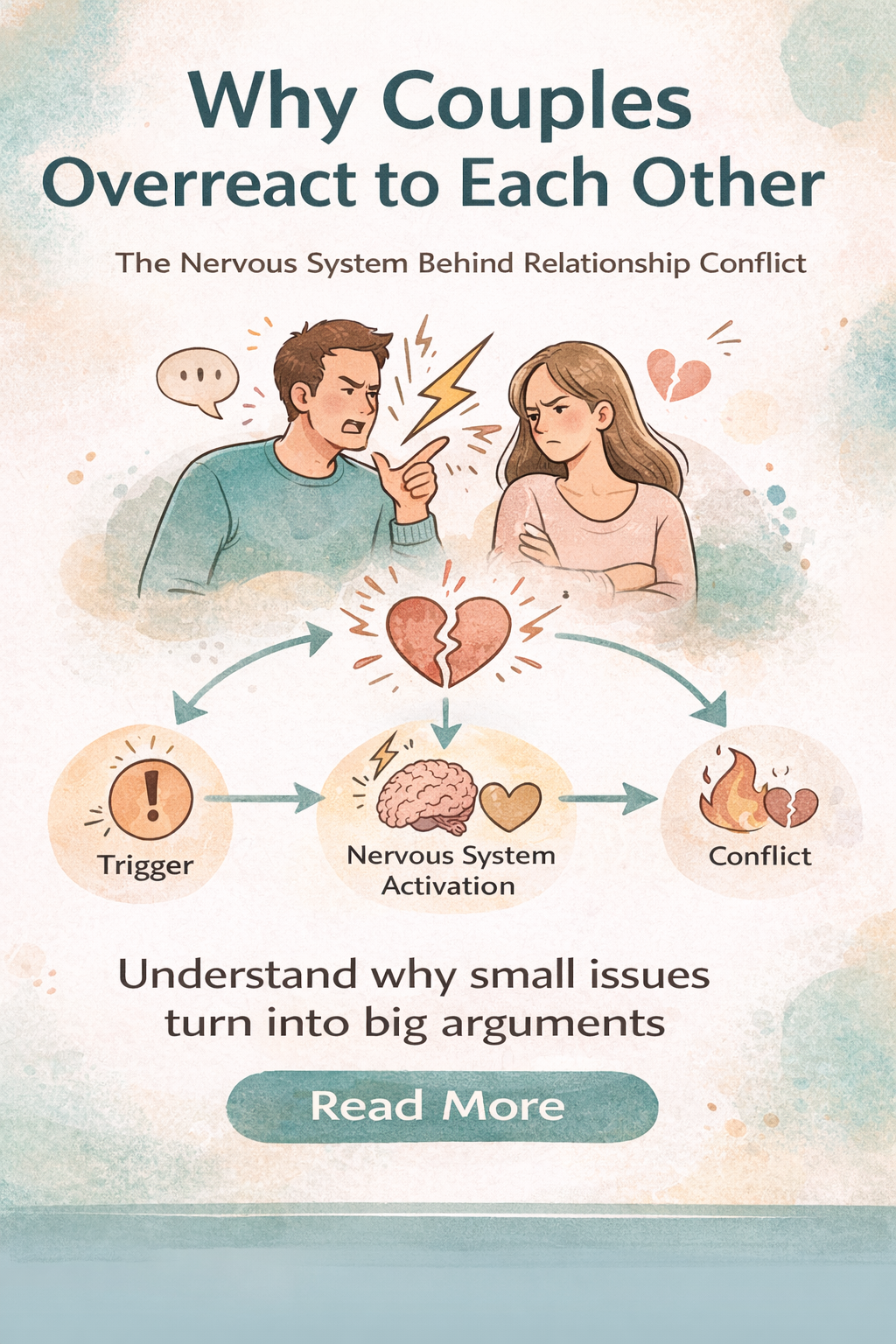
Because the trauma-related pattern most couples fall into during arguments looks something like this:
- Person B says something to Person A, or does something, or fails to do something.
- Person A’s brain senses a threat. An old trauma wound has been inadvertently touched.
- Person A moves into fight, flight, freeze, or fawn (trying to fix or appease).
- Person B reacts by either chasing harder or shutting down and giving up.
When couples are stuck in this pattern, frustration and resentment build. By the time they come to therapy, they usually say something like, “We just can’t communicate.”
“Most couples don’t have a communication problem.
They have two nervous systems reacting to old trauma at the same time.”
But the real issue isn’t communication.
It’s the fear of each other’s reactions once the nervous system is activated.
Unfortunately for humans, we can go from a calm state — regulated by the parasympathetic nervous system — to a threat state in the sympathetic nervous system in less than one second. All it takes is something someone says or does that reminds the brain of a past injury.
In other words, the brain can perceive a life threat even when our life is not actually in danger.
The Triggers
We all have triggers. They come from old wounds — past hurts and injuries that left an imprint.
If something happens today that mirrors a painful experience from years ago, it can ignite the threat system in the brain.
The more trauma a person has experienced, the more easily their nervous system activates.
Over time, the goal of trauma work is to reduce these activations by understanding and resolving the triggers one by one. If a person were completely free of unresolved trauma, their nervous system would only activate in response to genuine danger.
In my practice, I have clients track their triggers in a journal. They write down situations that triggered a fight, flight, freeze, or fawn response, and bring those stories back to therapy.
Common themes I see include:
• You’re not good enough
• Something is wrong with you
• You’re an idiot
• I reject you
For example, Sue might write:
“Yesterday, Dave came home at 7 p.m., but earlier he told me he would be home in ten minutes. When he didn’t show up, I got really upset.”
Then Sue is asked to explore the emotional theme behind her reaction. Perhaps the theme is someone not keeping their word.
When did that happen before?
Sue might say:
“My parents were divorced, and my dad would tell me he was coming to pick me up on Saturday. He was always hours late — and sometimes never showed up.”
A skilled trauma therapist helps clients connect the trigger from Tuesday with the emotional theme from childhood. When that connection becomes clear, the trigger often loses much of its power.
We don’t fully understand why this connection is so relieving to the brain and nervous system, but it consistently is.
The next time that theme appears, the nervous system is far more likely to stay calm.
And calm is what we want.
Calm people can think clearly, respond thoughtfully, and maintain healthy relationships.
When Are We Finished?
As long as your nervous system continues to ignite into threat responses during everyday relationship situations, there is probably still trauma work to do.
Over time, however, the goal is to remain calm for longer and longer periods, until they are rare.
Eventually, many people learn to recognize these patterns on their own and connect present triggers to past experiences without a therapist guiding them through the process.
It becomes a powerful form of self-care.
Nervous System Activations
Nervous systems do not ignite for no reason.
There is always something — whether we consciously recognize it or not — that triggered the response.
Sometimes the trigger is external.
Sometimes it is internal.
People frequently trigger themselves through the stories they tell themselves.
Maria discovered she was not included in Julie’s new lunch group. Maria immediately told herself it must be because she wasn’t good enough for the group. She felt sad, rejected, and alone — all because of the story she told herself.
In reality, Julie’s group was created specifically for mothers of children in the public school system. Maria’s child attended parochial school. Maria remained a valued friend, just not part of that particular group.
But many traumatized people quickly jump to a painful conclusion, such as, “They left me out because they don’t like me.”
Without all the facts, they end up making themselves miserable.
Therapists often spend their days helping clients reconsider the stories they tell themselves — not by lying to themselves, but by exploring more accurate and compassionate interpretations.
Clinical Exceptions
There are rare situations where nervous system activation appears disconnected from psychological triggers. These can include:
• acute medical conditions
• substance effects or withdrawal
• severe sleep deprivation
• certain panic disorders
• PTSD with somatic flashbacks
Even in these cases, however, the nervous system is responding to something — whether a physiological signal or stored trauma.
The nervous system does not randomly misfire.
It fires in response to something it has learned to watch for.
In the end, our nervous system doesn’t betray us. It reacts to patterns it learned long ago. The work of healing is helping it learn something new.
Understanding the nervous system changes the way we see conflict in relationships. Instead of seeing anger, withdrawal, or defensiveness as personality flaws, we begin to see them as nervous system responses to old emotional injuries.
And once those patterns are understood, they can be changed.
Then, once couples understand how the nervous system works, many of their conflicts begin to make sense.
Instead of believing their partner is intentionally hurting them, they start recognizing when a trauma trigger has been activated. This awareness allows couples to slow down, calm the nervous system, and respond more thoughtfully.
Learning this skill is one of the most powerful ways to stabilize a relationship in crisis.
She has appeared in national and international media and numerous podcasts, and has released her memoir, The Congressman’s Wife: A Political Memoir, available for now only on Substack,about her five years married to a powerful man, and how the powerful get away with … everything.
WORKING WITH ME
I’m Dr. Becky Whetstone, a licensed marriage and family therapist and America’s Marriage Crisis Manager®. I’ve spent nearly 30 years with people at the worst moment of their marriage.
I work with clients everywhere by Zoom. If something in this post hit close to home, here’s where to start.
My book: I (Think)I Want Out: What to Do When One of You Wants to End Your Marriage — Read the whole framework, in order, at your own pace.
Appointment: 90-Minute Marriage Crisis Consultation — Bring me your situation. You’ll leave knowing what stage your marriage is actually in and what to do next.
Relationship University — Live classes and a private community for people who’d rather understand relationships than keep guessing.
Quiz: What Stage Is Your Marriage In? — A free 10-question quiz.
Note. Becky is an Amazon affiliate and may receive a small percentage if you purchase a book from her links, at no extra cost to you.