How to Spot a Calculating Person Early (Before It Costs You).
Why some people compete, manipulate, and position themselves — and why it takes so long to see it.
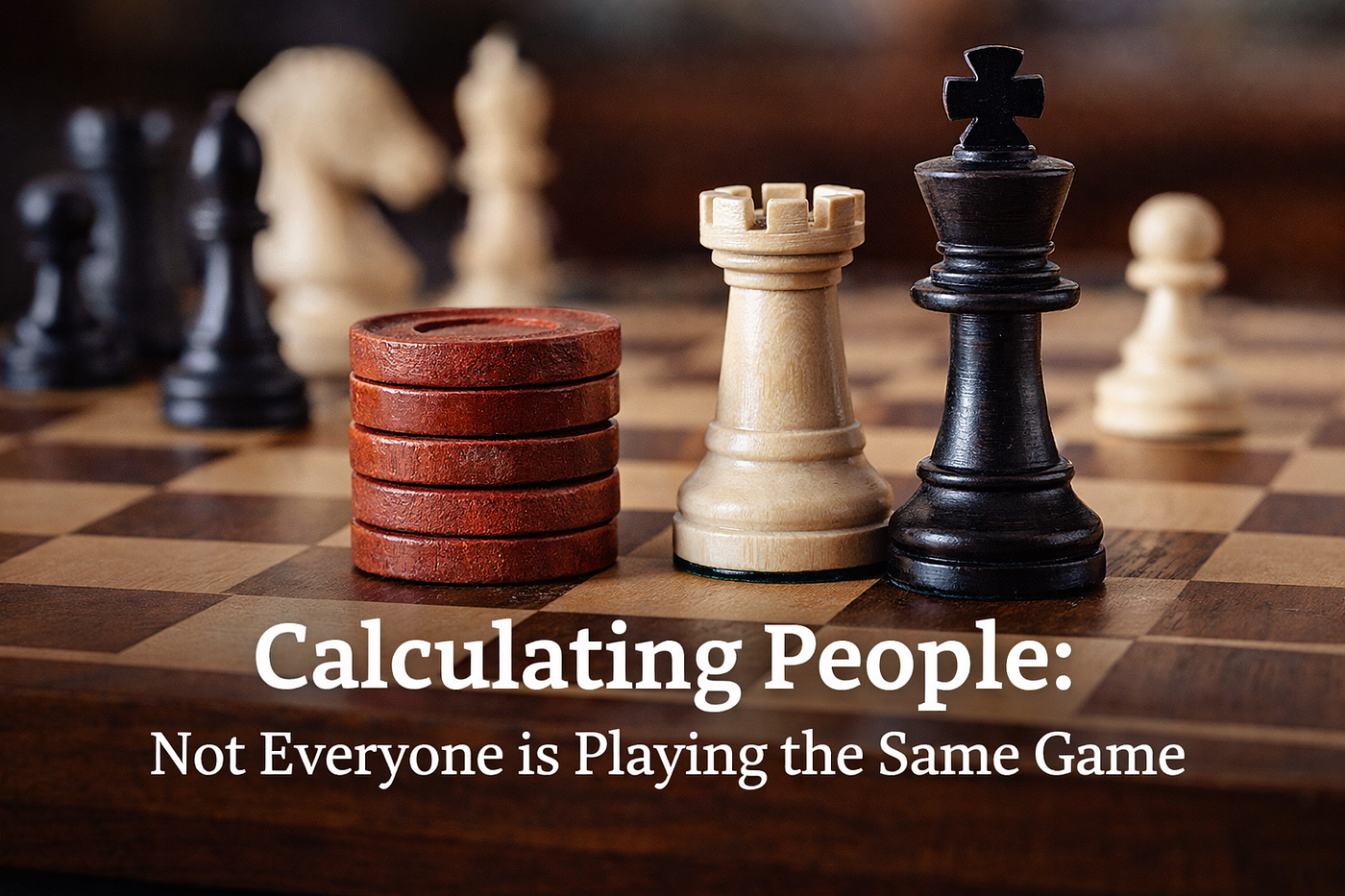
It wasn’t until my 40s that I realized that a significant number of people are manipulative and calculating. I always played life like checkers, reacting in the moment, naively wishing the best for everyone, while others were playing chess, with what appeared to me to be a certain (often ugly) agenda in mind.
Instead of a mindset that the universe provides enough opportunities for all of us to be successful, the sinister folk who operate this way see someone or something doing something they want or envy, and it makes them feel discomfort about their own lives.
The next step is to make it their business to take it or remove it from the person who has it, or to disempower them by diminishing them or their work, instead of seeking to get some of whatever it is on their own, for themselves.
In my case, I had not known this problem existed until I experienced the chess player’s attempts to negatively affect my life. “Why do they care so much about what I am doing?” I thought when it first started happening. “I have done nothing to them except exist.”
That’s about all it takes, though. My existence made certain people uncomfortable. After studying the research on the subject, I had to conclude that they saw me as a threat to their well-being and ability to esteem themselves, so instead of self-reflection, they chose destruction of the thing that was bringing them down, or at least to throw obstacles in my way that would make my life difficult.
I didn’t think I was a big deal. Why did they?
What I read about these types of people is that I was a reminder of who they are not, and what they have not done with their lives.
So go get some of that for yourself, I say.
But the people who feel threatened by others are not that type. They often have a self-fulfilling prophecy that they could not attain what I had, or others might have had it if they had gone for it. People underestimate what they are capable of all the time.
Seeing people who have things you’d like to have, but telling yourself you will never have them, can be painful if you aren’t comfortable in your own skin. A person with a solid sense of self can process it in a way that doesn’t feel threatening or bring themself or the person they envy down.
I have often mentioned working at the San Antonio newspaper back in the 1990s. I arrived hellbent on working there, even though I had no experience in newspaper writing whatsoever. I was a journalism major in college, but it meant nothing to the editors. I got the job by proving myself through freelance writing for them and by calling the editor every couple of months to ask, “Have any spots opened up for a features writer?”
I knew his secretary left at 5 pm, so I called at 5:05, when he would answer the phone himself.
I finally got the job after two years of trying and then spent the next two years begging them to give me a column so I could write about relationships. My stratospheric rise seemed to make no sense to anyone but me and a few editors, and while my editors were completely amused by my chutzpah, it made me a target of many of my colleagues.
“I have been here 9 years and have never gotten a column,” one writer said to me one day. “How did you get yours?”
I knew this wasn’t asked innocently. I could feel that I was on her radar as a person who had not earned and did not deserve the numerous opportunities top editors sent my way. I took a deep breath.
The top contending story in the newsroom was that I had slept my way into a job, then a column.
“The day I was hired, I told them I wanted a column,” I responded. “I wrote them a proposal with sample columns for them, and stayed at it for two years, and finally was given the opportunity. Did you ever tell them you wanted a column? Did you write them a proposal?”
“No,” she said.
“Well, that’s probably why I got one, because I worked for it and I asked.”
I don’t think I am being paranoid by thinking that she was put up to asking me that question by a few dozen others in the newsroom who wanted my take on why I had risen so fast. It never occurred to any of them that I was talented, enthusiastic, grateful for the opportunity, and an extraordinarily hard worker. I went above and beyond in my work. Did they?
Of course not. They weren’t nearly as happy to be there as I was, and it showed.
So why can’t humans allow space for people to be successful?
Why must they tear others down?
What the research says.
Put two people in a room, and each will compare themselves to the other, and this is how most humans evaluate how they are doing in life. This comparison will go one of two ways:
· Inspiration.This is the response of the emotionally healthy person. “I want that too; how can I get this for myself?”
· Threat.The emotionally unhealthy person takes other people’s success as a referendum on themselves. “What does this say about me?” They might ask.
To reduce that psychological threat, the person may conclude — consciously or unconsciously — that the other person needs to be brought down through criticism, ridicule, or, in some cases, a plan to disempower or destroy. Upward comparison, which is deciding someone is doing better than you are, is uncomfortable unless a person is very secure in themselves.
And this is where it gets interesting.
Research suggests that while many people function well on the surface, far fewer are deeply secure and grounded. A significant portion of the population operates from moderate or fragile self-esteem — meaning they feel okay until something or someone challenges it and brings to their attention that perhaps they aren’t doing okay.
How solid a person is, is typically measured by how secure a person feels with themselves, their self-esteem, emotional maturity, and boils down to about 25–35 percent of people who are defined as solid, and feeling secure in a stable, grounded way,[1] with the majority of the population feeling moderately secure, which to me really means, they are not secure.
People often ask: Why is the world such a mess? In my opinion, this is why.
What else is true about calculating manipulative people?
What took me even longer to understand is that not all of these people are sitting around feeling threatened or insecure and plotting. Some of them are simply operating from a completely different mindset that never occurred to me.
They are a subset of the population paying attention to power and perception, and, to them, life is a game that can be won. They don’t see themselves as manipulative. They see themselves as smart. Efficient. Strategic. This is just how they move through the world.
And if you don’t know that, you will misread them every time.
The only thing is, in the game they play, there will be human casualties.
In this group, you will often see:
Those who are not insecure, they are strategic.
They operate from a perspective of “this is how the world works, and I’m going to play it well.”
For them, managing perception and how they are viewed by others is smart. Influencing outcomesis a positive skill, and staying ahead of the game is done for survival.
To people like this, this is what it is to be effective.
The winner takes all. Or at least does very well.
This strategy for success is often learned in families where the child had to read the room, love was conditional, power was uneven, truth wasn’t safe, and image mattered more than reality. They had to be observant, adapt to behaviors, and control themselves in certain ways to help them survive in their environment and carry that skill set into adulthood.
For example, if the child in the family who was closest to dad benefited from that, wouldn’t it make sense that sidling up to a professor or boss might also yield benefits?
I once dated a guy who owned a prestigious tile-and-stone business. One of the reasons we only lasted a year was that, over time, I saw him doing all sorts of unscrupulous things to save on taxes or manipulate his bottom line. My opinion was that what he was doing was corrupt.
His explanation was, “It’s just business.”
What the hell does that mean? Psychologists say it is a way some people give themselves permission to do bad or unethical things.
To the winner go the spoils.
By any means, achieve the end.
Every man for himself.
Phrases like these help individuals separate themselves from what they are doing and how they see themselves. For example, a person might think of themselves as a person of character, but in their value system, business operates under a different set of values and rules, and those rules are meant to be broken when necessary. They use this compartmentalization to make hard calls, justify a self-serving move, and avoid thinking about the human side.
How convenient.
“I can play dirty at work, but not at home.”
My former boyfriend would approach business obstacles with less-than-above-board solutions, driven by the internal conversation of:
“Is this allowed? If not, can I get away with it, and if I can, does this help me?”
At the end of the day, the oft-used phrase, “It’s just business,” comes from a mix of:
· Moral disengagement (turning off the ethical lens).
· Self-justification (protecting identity)
· Power dynamics (I can do it, so I will.)
· Emotional avoidance (I don’t want to feel this).
The people who can compartmentalize their manipulations like this operate from a belief that the outcome is more important than relationships, ethics, or anything else.
Example: The recent DOGE invasion by Elon Musk and his minions in January 2025 in the name of cutting federal spending. Instead of rooting out waste, fraud and abuse, as Musk originally claimed, he shut down departments that helped Americans, like the Consumer Financial Protection Bureau, laid hundreds of thousands of employees off, and took away government grants for research and on and on.
So, What Do We Do About It?
What can we do, knowing we live in a world where this sort of behavior is rampant?
Awareness.
First, my biggest mistake in the beginning was trusting people. I was openand transparent, and I shared information that was later used to hang me. I learned the hard way not to trust anyone at all, then slowly allowed a person to earn some, not all, of my trust over time and many experiences.
Be wary.
If someone seems eager to bring you into their sphere, or wants to come into your sphere of influence, ask yourself, why? What do I have that they want?
In the 1990s, I was doing a lot of talk radio, local television, and writing gigs in San Antonio, and once introduced a friend to all my media contacts because she was interested in getting into the media herself. The next thing I knew, I was fired by these places and replaced by her. As soon as her goal of taking what I had was achieved, she ghosted me.
What stunned me was that, looking back, I could see she valued our friendship only as a way to get what I had, and that, step by step, she had planned her takeover of my media gigs all along. Once I introduced her to my media contacts, she love-bombed and seduced them, then set out to turn them against me. Once I was gone, she took my place. It was stunning.
Lesson: My experience, my knowledge, and my contacts are as precious as gold, and if I choose to share them, you will have to pay me, or go get your own, as I did. So much for helping a friend.
Stop being surprised when people try to screw you.
It happens all the time.
Just being able to say, “Oh, there it is again,” lessens its impact on me, and, as I said, I protect myself by only getting toe-deep into things with people, rather than neck-deep. If someone is too friendly, too good to be true, too helpful, or whatever, they will be on my radar as a person to watch out for.
You don’t fix these people. Deal with them when necessary, and then share nothing they can take, steal, or use against you.
If they ask questions, you are not obliged to answer them or explain yourself.
Once you understand that not everyone is operating the way you are — that some people will be threatened by your power, gifts, or whatever it is, and some are so shameless they will quietly position themselves and do whatever it takes to get what they want — a lot of confusing behavior starts to make sense.
And when things are clear, you make better decisions. Lord knows it took me a while.
The calculating, manipulative person comes in four forms:
· Insecure ones who pull others down.
· Strategic ones who play the system.
· Adaptive ones who learned the game early.
· And a small group who truly do not care who gets hurt.
At the end of the day, I don’t spend my time trying to figure out which type of person I’m dealing with or why they are the way they are. What matters is that I finally understand that not everyone is operating from the same place I am.
Some people build.
Some people take.
Some people connect.
Some people position themselves.
Once you see that clearly, you stop being confused, you stop over-explaining, and you stop giving people the benefit of the doubt when they haven’t earned it.
You don’t have to become like them.
But you do have to see them.
[1] Attachment research: Hazan & Shaver (1987; Bartholomew & Horowitz (1991); Mikulincer & Shaver (2007).
Self-esteem research: Morris Rosenberg & the Rosenberg Self-esteem-scale; Jennifer Crocker & contingent self-esteem, and Kernis & Goldman (stable v. fragile self-esteem)
She has appeared in national and international media and numerous podcasts, and has released her memoir, The Congressman’s Wife: A Political Memoir, available for now only on Substack,about her five years married to a powerful man, and how the powerful get away with … everything. She is also the author ofI (Think) I Want Out: What to Do When One of You Wants to End Your Marriage, available at bookstores everywhere. If you click her book link, it will take you to Amazon, and if you purchase the book, she may receive a small fee at no extra cost to you.
WORKING WITH ME
I’m Dr. Becky Whetstone, a licensed marriage and family therapist and America’s Marriage Crisis Manager®. I’ve spent nearly 30 years with people at the worst moment of their marriage.
I work with clients everywhere by Zoom. If something in this post hit close to home, here’s where to start.
My book: I (Think)I Want Out: What to Do When One of You Wants to End Your Marriage — Read the whole framework, in order, at your own pace.
Appointment: 90-Minute Marriage Crisis Consultation — Bring me your situation. You’ll leave knowing what stage your marriage is actually in and what to do next.
Relationship University — Live classes and a private community for people who’d rather understand relationships than keep guessing.
Quiz: What Stage Is Your Marriage In? — A free 10-question quiz.
Note. Becky is an Amazon affiliate and may receive a small percentage if you purchase a book from her links, at no extra cost to you.