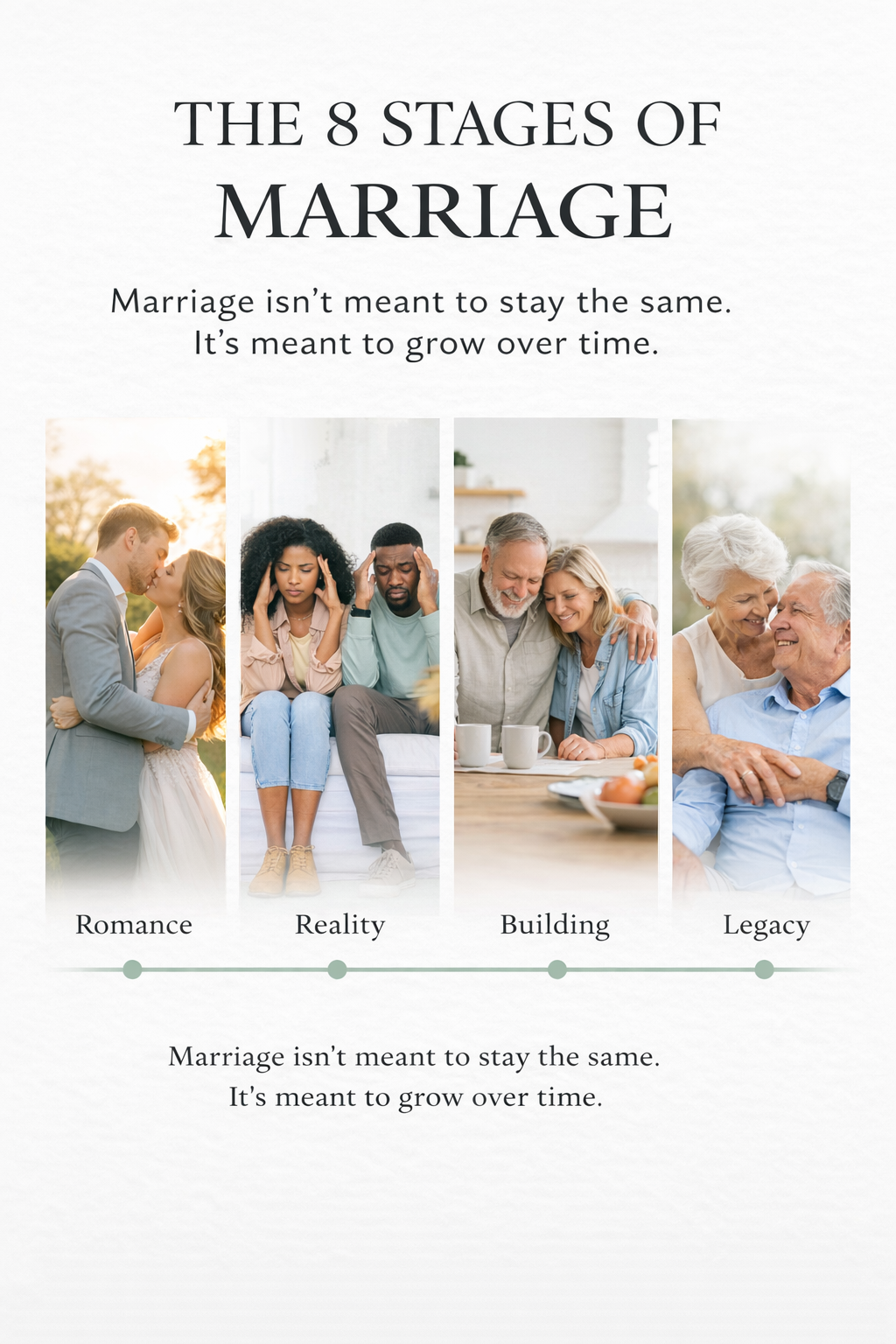
The 8 Stages of Marriage.
From Romance to Growing Old Together.
When people fall in love and get married, they rarely think about how much each person will change over the years—but they should.
The idea that someone will remain the same person—and that your feelings toward them will remain exactly as they were in the beginning of a 30-year marriage—is naïve.
The truth is, marriages evolve through stages, much like human beings do.
Each stage brings changes and requires adjustment. Focus, priorities, and even identity can shift dramatically over time. The couples who make it to the finish line together are usually the ones who can adapt as their partners grow and change.
The Beginning: Peaceful, Easy Feeling
At first, everything feels easy.
Love, desire, focus—even obsession—feel natural and effortless. Once you’ve found your person, the future seems full of promise.
But this stage—the intense pull to be together—is designed to bring two people together. It is not designed to last forever.
That doesn’t mean love doesn’t last.
It means love changes form.
Why Marriage Gets Hard
Over time, real life begins to test the relationship.
Careers, children, financial pressure, personality differences, aging parents, and unresolved childhood wounds begin to surface.
You start to see yourself more clearly—and not always in ways you expected. Long-term relationships reveal who we really are.
Eventually, the relationship that once felt effortless requires skills most people were never taught.
Many couples mistakenly believe something has gone wrong when conflict appears.
But often, nothing is “wrong.”
The marriage is simply developing.
A Note About “Falling Out of Love”
Some people say they “fell out of love” when the honeymoon feeling fades.
What they are often describing is the loss of limerence—the chemical high driven by dopamine, oxytocin, and norepinephrine.
That intense experience is powerful—but it isn’t sustainable, and it isn’t the same as mature love.
The high settles. Reality sets in.
And the relationship moves into its next stage.
The goal of marriage usn’t to stay the same. It’s grow together over time.”
Becky Whetstone, PhD
The 8 Stages of a Marriage
1. The Romantic and Bonding Stage
“We Found Each Other”
This is the falling-in-love stage.
Partners focus on similarities and overlook differences. Attraction is high, connection feels effortless, and both people feel hopeful about the future.
Most of the “love languages” happen naturally here—affection, attention, kind words, time together, generosity.
Biology helps. Brain chemistry creates powerful bonding and attachment.
Common features:
- High emotional and sexual connection
- Idealization of the partner
- Conflict is minimal or avoided
- A belief that the relationship is uniquely special
This stage is exhilarating.
But it does not last forever.
2. The Reality and Differentiation Stage
“Oh… You’re Human”
The rose-colored glasses come off.
The version of your partner you created in your mind gives way to a more realistic picture.
You begin to notice differences in habits, communication styles, priorities, and expectations.
Things that once seemed charming may now feel irritating.
Common experiences:
- More disagreements
- Disappointment about unmet expectations
- Frustration with differences
- Old emotional wounds are being triggered
Many people worry that they have married the wrong person at this stage.
But what’s actually happening is this:
Intimate relationships activate unresolved emotional patterns.
Your partner becomes the person most likely to trigger your deeper sensitivities.
3. The Negotiation Stage
“How Are We Going to Do Life Together?”
Now the couple must figure out how life actually works.
This includes:
- roles
- responsibilities
- money
- sex
- time
- boundaries
- extended family
Some couples address these directly. Others avoid them—and they resurface later.
This stage requires flexibility.
People grow and change over time. A partner who began more dependent may develop a stronger voice and want equality. The question becomes:
Can both partners adapt to each other’s growth?
Without skills, couples often fall into patterns like:
- “You never…”
- “You always…”
- control, criticism, or withdrawal
Many couples get stuck here, repeating the same conflicts without resolution.
4. The Building and Expansion Stage
“We’re Creating a Life”
This stage often includes:
- children
- career demands
- financial pressure
- increased responsibility
- limited time and energy
The relationship shifts from feelings to functioning.
Couples build a life—home, routines, responsibilities—and often become more task-focused.
This is normal.
The developmental task here is learning to:
- cooperate under pressure
- Stay respectful during stress
- remain connected while managing life
Most marriages don’t fall apart, they evolve.”
Becky Whetstone PhD
5. The Rebalancing Stage
“We Need to Adjust”
At some point, couples begin to feel the strain.
They may notice:
- less time together
- routines replacing connection
- emotional distance
- a sense that something needs attention
This is not failure.
It’s a signal.
Healthy couples begin to rebalance:
- making time for each other
- improving communication
- adjusting roles
- reconnecting emotionally
Marriage requires ongoing recalibration.
6. The Stabilization Stage
“We Understand Each Other Better”
Couples who navigate earlier stages well begin to settle into something more grounded.
They:
- communicate more effectively
- regulate emotions better
- repair after conflict
- accept differences
Love becomes less intense—but more stable.
Partners begin to feel:
- “I know you.”
- “I can count on you.”
Trust deepens.
7. The Mature Partnership Stage
“We Choose Each Other”
The relationship becomes a true partnership.
There is:
- acceptance of strengths and weaknesses
- Reduced need to control
- emotional safety
- deeper trust
Couples operate as a team.
Love is less reactive and more intentional.
8. The Renewal and Legacy Stage
“What Have We Built Together?”
Later in life, the marriage shifts again.
Children may leave home. Careers slow down or end.
Couples are faced with a new question:
Who are we now?
Healthy couples:
- rediscover each other
- develop shared interests
- deepen connection
Over time, the relationship becomes:
- companionship
- shared history
- meaning
- identity
There is often more patience, more perspective, and less urgency.
The marriage becomes a shared life story.
What Makes a Marriage Last
Long-term marriages are not sustained by luck alone.
They require the ability to:
- adapt to change
- tolerate differences
- repair after conflict
- grow emotionally
- shift from control to acceptance
The couples who last are not the ones who avoid difficulty.
They are the ones who learn how to handle it.
The Truth About Marriage
Every marriage will face strain.
Not every marriage will face a crisis.
And some marriages evolve into something deeper than what most people imagine in the beginning.
Like a stiff leather bag that softens over time, a long marriage—when cared for—becomes more flexible, more durable, and more valuable with age.
Marriage diesn’t just test love. It reveals emotional maturity.”
Becky Whetstone, PHD
What These Stages Reveal
Marriage does not just test love.
It reveals emotional maturity.
It asks you to:
- Stay when things are uncomfortable
- work toward solutions
- accept your partner
- grow alongside another human being
Most people were never taught these skills.
So when challenges arise, they assume something is wrong.
In reality:
The marriage may simply be asking both partners to grow.
Other blogs you might enjoy:
The Number One Thing You Can Do To Have a Successful Marriage.
Most People Have Terrible Communication Skills and Dislike Those Who Don’t.
About Becky
Becky Whetstone is a marriage and family therapist and specialist in marriage crises, separations, divorce decisions, amicable divorce, co-parenting, and stepparenting issues. She works with individuals and couples all across America and the world via telehealth. If you would like to spend 90 minutes sorting through your marriage on the brink, click here for information about a Marriage Crisis Consultation.
Here is a video describing how she helps couples via intensive blocks of therapy … https://youtu.be/-5sU57EOqVw
She has appeared in national and international media and numerous podcasts, and has released her memoir, The Congressman’s Wife: A Political Memoir, available for now only on Substack, about her five years married to a powerful man, and how the powerful get away with … everything. She is also the author of I (Think) I Want Out: What to Do When One of You Wants to End Your Marriage, available at bookstores everywhere. If you click her book link, it will take you to Amazon, and if you purchase the book, she may receive a small fee at no extra cost to you.
Contact her at beckywhetstone@gmail.com or visit her website at www.MarriageCrisisManager.com.