
Managed Separation: Why Most Trial Separations End in Divorce.
A licensed marriage therapist on the unmanaged separation trap, the 5 rules of a managed separation, and why a purpose, plan, and timeline are the difference between repair and divorce.
In 1992, I was a stay-at-home mom of two and got so angry and frustrated with my husband of 8 years that I felt I couldn’t take it anymore. I didn’t want to divorce; I wanted a separation to get away from him and catch my breath. We went to a marriage therapist, and he told us that he offered no help for couples needing to separate, and knew no one who did.
We had no option but to handle it ourselves, and what a disaster it was. My husband, especially, was influenced by friends and family urging him to throw me out and to be a hardliner in regard to my marital “tantrum and nonsense.”
“Let her starve!” Was the attitude.
We ended up divorced, and he, my children, and I all paid a terrible price.
During my marriage crisis in 1992, I searched for books and articles that would offer solid, intelligent advice about separating and explain what was going on and how to handle it so we didn’t blow up our family. It was not to be found.
My life goal was not to become a specialist in marriages on the brink, separation, and all issues related to marriage dust-ups and partings. I felt I had to do it because no one else was, and if I was going to do it, I wanted solid, undeniable training and education that people could not negate or minimize.
There were plenty of “how to get your spouse back,” or “I got a divorce, so listen to me,” sources back then and now, and the person selling services had no business advising anyone when their family’s future was at stake.[1] This had to be rectified, in my opinion.
Over five years in graduate school, with this in mind, I gathered all the information and research I could find on the subject from a multitude of academic libraries, conducted my own dissertation research in 2005, and used it to devise a plan to help and guide couples. The information was profound and enlightening, and it showed there was much hope for helping couples in crisis.
Since then, I have seen thousands of marriages on the brink, gained more knowledge, and tweaked my methods. I know for a fact that the plan for marriage crisis I devised has prevented hundreds of people from getting a divorce, and even better, because they write and tell me. I get thank-you letters from their therapists, too.
The people who successfully reconcile after being on the brink of divorce did the work that needed to be done so they wouldn’t fall back into a crisis a second time — a prominent tenet in my work.
Still, with over 600,000 divorces a year in the United States, most couples don’t seek out solid therapist-based information and are still blowing up their family systems unnecessarily.
Marriage crisis, separation, and divorce are such brutal experiences that after people handle most of it alone, and when they reach what they believe is total hopelessness, they hire vicious, mouth-foaming, non-family friendly, money-grabbing family attorneys to get them unmarried, and once that happens, there is no chance for the positive co-parenting experience that children of divorce desperately need.
Why do people hire sadistic family lawyers to get divorced? Because family lawyers have conditioned them to do so. It’s just what you do. Well, not anymore.
Today I am crying, screaming, and yelling from the rooftops — tell yourself and all of your friends, if you have a marriage crisis, there is excellent, high-quality, research-based information curated by a person with a doctorate in marriage and family therapy. It’s uncomfortable to toot my own academic horn, but I am doing it here to underline that this is no fly-by-night or quick-fix sham designed to get you to pay a fee and get suckered; it is legitimate, solid, best-practice information for couples in crisis.
Separating on your own, with no plan.
Here’s the brutal truth nobody tells you when your marriage is on the brink: most separations end in divorce, not because the marriage was doomed, but because the couple had no idea what they were doing and the separation had no plan.
Just like my ex-husband and me back in the day.
No purpose. No timeline. No rules. No required growth. Just two exhausted people drifting apart in separate apartments, mom’s house, or an Airbnb, telling themselves they’re “figuring it out” while griping about one another and unconsciously building a life that no longer includes the other person. It is a marital death by default, caused by inaction and allowing stagnation and disconnection.
I’ve been a licensed marriage and family therapist for over two decades. I’ve sat with thousands of couples in crisis. And I can tell you with painful certainty: an unmanaged separation is almost always a slow-motion path to divorce. A managed separation, on the other hand, is one of the most powerful interventions in modern marriage work — when it’s done right.
This is the post I wish every couple read before one of them packs a bag.
An unmanaged separation is often a slow-motion divorce. A managed separation is a structured intervention. The difference is a plan.
Why “We Just Need Space” Almost Never Works
When one spouse says, “I need space,” the other usually hears, “It’s over.” Both are wrong, and both are right. What’s actually happening is that one person has hit a wall — they believe they can’t communicate, that everything, as they see it, is hopeless, and that they cannot think clearly in the marriage anymore. Their nervous system fires, they go into the fight-or-flight response, and feel an urgent need to distance themselves.
The problem isn’t the need for space. The problem is what most couples do with that space. They move out with no agreements. They do things that make things worse: cut off credit cards, start dating, lean on friends who aren’t friends of the marriage, date their phones, sleep with someone new “just to see.” They let months pass without a single hard conversation. And then one day they look up and realize they’ve built parallel lives — and parallel lives don’t usually reconnect. They diverge.
Unmanaged marriage crisis and unsupervised or unplanned separation are the single most predictive behaviors I see for divorce. Not infidelity. Not money fights. Not even contempt. Drift. Quiet, structureless, planless drift.
What a Managed Separation Actually Is
It is a plan for separation that supports growth and change. A managed separation is a deliberate, time-limited, structured break from cohabitation with three non-negotiable elements:
1. A purpose. You are not separating to escape. You are separating so the partner who is close to leaving can come out of nervous system activation and return to feeling settled and calm. It’s like resetting a computer. Marriage Part One is over; now let’s see if we can orchestrate a Marriage Part Two that works. None of this is possible without both people feeling calm and able to access their best selves. Only then can they do the growth work that will be required — individually and as a couple. Of that space without a break away from their partner.
2. A plan. Written. Agreed to. Everyone knows the rules, boundaries, and guidelines and understands why they are there. It covers money, kids, contact, dating, therapy, sex, social media, boundaries, and how often you talk.
3. A timeline. Usually 60 to 90 days, not longer than 6 months, with a clear decision point at the end. Not “as long as it takes.” That phrase is how people end up divorced unnecessarily.
And one more thing — if I haven’t already made it clear enough: growth is required. Both people. Not optional. Not “if I feel like it.” If neither of you changes during the separation, you will return to the exact marriage you left, the one you couldn’t stand.
If neither of you changes during the separation, you will return to exactly the marriage you left.
The 5 Rules of a Managed Separation
After years of watching what works and what destroys couples, these are the rules I give every client. Break them, and your odds of repair plummet. Follow them, and you have a real shot — even when one partner has a foot out the door.
Rule 1: Define the purpose in writing.
Not “To figure things out.” That’s a vacation, not a separation. Try: “We are separating for 75 days to each work individually on the patterns that brought us here, to interrupt our daily conflict cycle, and to make a clear-eyed decision about whether to recommit to this marriage.” Specific. Honest. Time-bound.
Rule 2: Set a timeline — and protect it.
Sixty to ninety days is the sweet spot. It could be six months, as I said. Shorter and nothing shifts. Longer, and you start building a life apart. Put the decision date on the calendar. Tell your therapist. Tell each other. Do not let it quietly slide. Sliding is how marriages die. And one more thing: the decision is not necessarily to reconcile; it may be to do intensive work on the marriage so they are ready to reconcile.
Rule 3: No dating. No new partners. No “just coffee.”
This is where 90% of separations go off the rails. The moment a third person enters the picture, the work stops, because motivation is lost. You’re no longer feeling or focused on your marriage — you’re feeling the dopamine of someone new. New is always easier than repair. If either of you cannot agree to this rule, you are not separating to save the marriage. You are separating to leave it. Be honest about which one it is.
Rule 4: Stay in active work — individually and as a couple.
Each spouse needs their own work: therapy, coaching, deep self-examination, energy healing, and often a hard look at family-of-origin patterns. And you need shared work — weekly structured sessions with a professional who understands crisis, not generic couples counseling. A managed separation without coaching is just an empty apartment.
Rule 5: Decide — then act.
At the end of the timeline, one of three things happens: you recommit and dedicate yourselves to being ready to reconcile with a real plan, you extend by a defined number of weeks for a specific reason, or you separate permanently with honesty and dignity. What you do not do is drift into month four. Drift is the enemy.
Drift is the enemy. A separation without a deadline is a divorce in slow motion.
What Most Couples Get Catastrophically Wrong
Most couples — and, frankly, most therapists who don’t specialize in marriage crises — treat separation as a pause button, just like you can’t press pause on a battle and then return to it when you decide. It is a high-stakes intervention that requires more structure, not less, than living together. Here are the most common mistakes I see:
• Treating it as a trial divorce. If you’re testing what life feels like single, you’ve already left. We do want you to get a feel for what it is like, but we hope you won’t like it.
• No written plan. Verbal agreements during an emotional crisis are not agreements. You must know what you’re doing, where you’re going, and why. Whatever decisions you make must be made from a place of calm.
• Letting kids carry messages. Never. Not once. Not even “tell your mom I’ll be late.”
• Discussing the marriage with everyone. Friends, family, coworkers, the internet. Your marriage is not a focus group. Pick one or two trusted people who would never talk about your business to anyone, and your therapist. I suggest that the person not be someone who lives near you or is enmeshed with your spouse and children. That’s it.
• Stopping the work the moment things feel calmer. Calm is not a repair. Calm is just distance. Repair requires sustained discomfort. This is a long-term, ongoing project that has no foreseeable end. I have been working on myself for 35 years, and I’ll never stop.
• Refusing to look at yourself. If you spend the entire separation cataloging your partner’s failures, you will return to the marriage as the same person who helped break it.
Who a Managed Separation Is Actually For
Managed separation is the right tool when:
• One partner is seriously considering leaving, and the daily conflict makes clear thinking impossible.
• There is no active physical abuse (in which case you need safety planning, not a structured separation).
• Both people are willing to do real work, even if one is doing it skeptically.
• The couple has tried traditional couples therapy and hit a wall.
• There is enough goodwill left to follow rules together — even reluctantly.
It is the wrong tool when one partner is using it as a soft-launch divorce, or when there is ongoing abuse, or when one spouse has already entered an affair and refuses to end it. In those cases, you need a different intervention entirely.
The Hard Truth About the Partner Who Wants Out
If you’re the one who wants to leave: your urgency to escape is real, but you haven’t done enough research and work to have enough data to make a wise decision, and you are probably in a mindset of, “Please, just make the pain stop.” You probably believe the only way to make the pain stop is to kill the marriage, but often, when we stop and look at everything, there is still much that can be done to save a couple from divorce.
We know that once in a marriage crisis, the unhappy spouse thinking of leaving will not return to the way things were. That marriage is over. If you feel that, if there were major improvements and changes, you could have a change of heart, you owe yourself, your spouse, and your children one honest, structured attempt before you walk away. Not five years of trying. Not endless couples counseling. One real, time-bound, fully resourced attempt. That’s what a managed separation is.
If you’re the one being left, your job is not to convince. Your job is not to pursue, beg, threaten, or perform. Your job is to do your own work so relentlessly that the person who wants out finds a different partner soon. Pursuit creates more distance. Growth creates curiosity. Become the person your marriage needed all along — not for them, for you.
Pursuit creates more distance. Growth creates curiosity.
What the End of a Good Managed Separation Looks Like
When it works — and it works often — here’s what I see: two people walk back into the same house as slightly different humans. They’ve each owned something hard about themselves. They’ve grieved the marriage they had. They’ve chosen, with eyes open, the marriage they’re willing to build. The conflict cycle that ran them is now a thing they can name and interrupt. The intimacy that died has a path back.
It is not a romantic-comedy ending. It’s better. It’s real.
And when it doesn’t work — when both people honestly do the work and still arrive at the same conclusion — the divorce that follows is dignified, clear, and far less destructive to the children and the family system than a slow, ugly, drift-based divorce would have been. That’s also a good outcome. A managed separation is not designed to save every marriage. It’s designed to give every marriage one structured, honest chance — and to give every couple a clear answer.
This was a very important concern of mine when designing this intervention, because I have seen many marriages end needlessly and unnecessarily. Those who decide to end their marriage are then gently guided through the amicable divorce process, which means they will not need to hire a family lawyer. Yes, it can be done. Check it out here.
If You’re in This Right Now
If one of you is one foot out the door, please hear this: do not let this happen by accident. Do not let drift make this decision for you. Do not move into separate apartments without a written plan, a timeline, and a professional in your corner who has done this work hundreds of times.
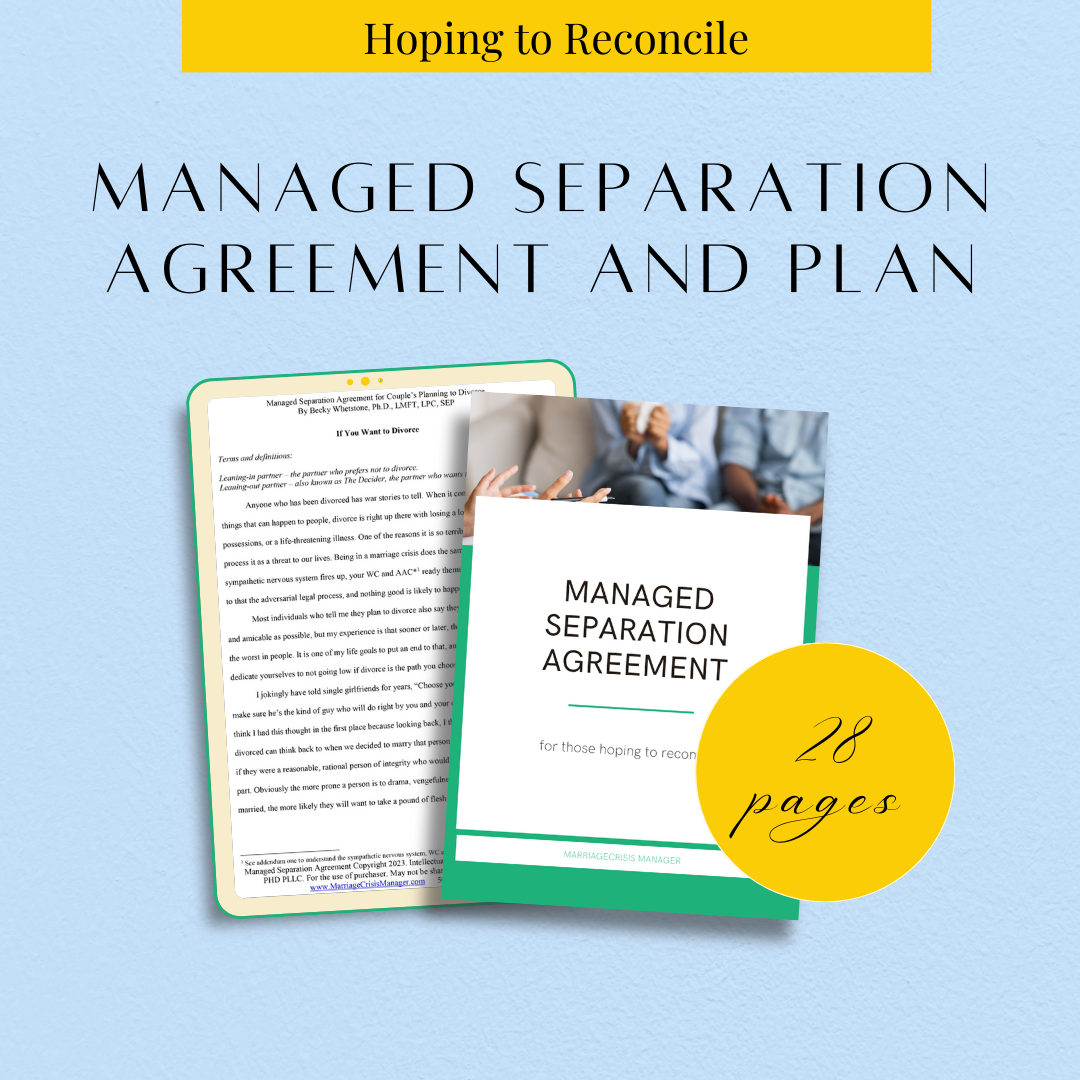
A managed separation plan is not a script you can pull off Pinterest. It’s not a thing your friend can tell you how to do and then implement it. The stakes are high. It’s a clinical framework that needs to be customized to your marriage, your kids, your finances, your history, and the specific reasons you got here. That’s the work I do every day with couples on the brink. If you want to learn what a real managed separation looks like for your specific situation, you can purchase one of my managed separation plans on my website. If you’d like to work with me or want to know what I think about your situation, you can schedule a Marriage Crisis Consultation. Otherwise, take the agreement you bought to the marriage and family therapist of your choice and ask them to help you in managing the separation. Never, ever, do this alone.
You can find me at marriagecrisismanager.com and doctorbecky.com. My book, I (Think) I Want Out: What to Do When One of You Wants to End Your Marriage, walks through the full framework in depth.
Whatever you do, do not separate without a plan. Please. I have watched too many marriages end that didn’t need to.
Do not let drift make this decision for you.
—
Here is an article we wrote about power and partnership in marriage …https://marriagecrisismanager.com/marriage-is-a-partnership/
Working With Me
I’m Dr. Becky Whetstone, a licensed marriage and family therapist and America’s Marriage Crisis Manager®. I’ve spent nearly 30 years with people at the worst moment of their marriage. I work with clients everywhere by Zoom. If something in this post hit close to home, here’s where to start.
I (Think) I Want Out: What to Do When One of You Wants to End Your Marriage — Read the whole framework, in order, at your own pace.
90-Minute Marriage Crisis Consultation — Bring me your situation. You’ll leave knowing what stage your marriage is actually in and what to do next.
Relationship University — Live classes and a private community for people who’d rather understand relationships than keep guessing.
What Stage Is Your Marriage In? — A free 10-question assessment. Two minutes, and you’ll know where you stand.
beckywhetstone@gmail.com · doctorbecky.com · marriagecrisismanager.com
Book link is an Amazon affiliate link.
More on Managed Separation here …https://marriagecrisismanager.com/managed-separation/
[1] I recently conversed with a prominent non-qualified divorce resource who runs ads all over social media, and when I asked about their knowledge and experience, they called me a narcissist and blocked me.