The Most Toxic Marriage Advice Ever Given: Ridiculously Misguided Relationship Phrases We Need to Stop Saying
Why marriage advice like “Don’t Go to Bed Angry,” “Happy Wife, Happy Life,” and “Two Become One” may be damaging your relationship instead of helping it.
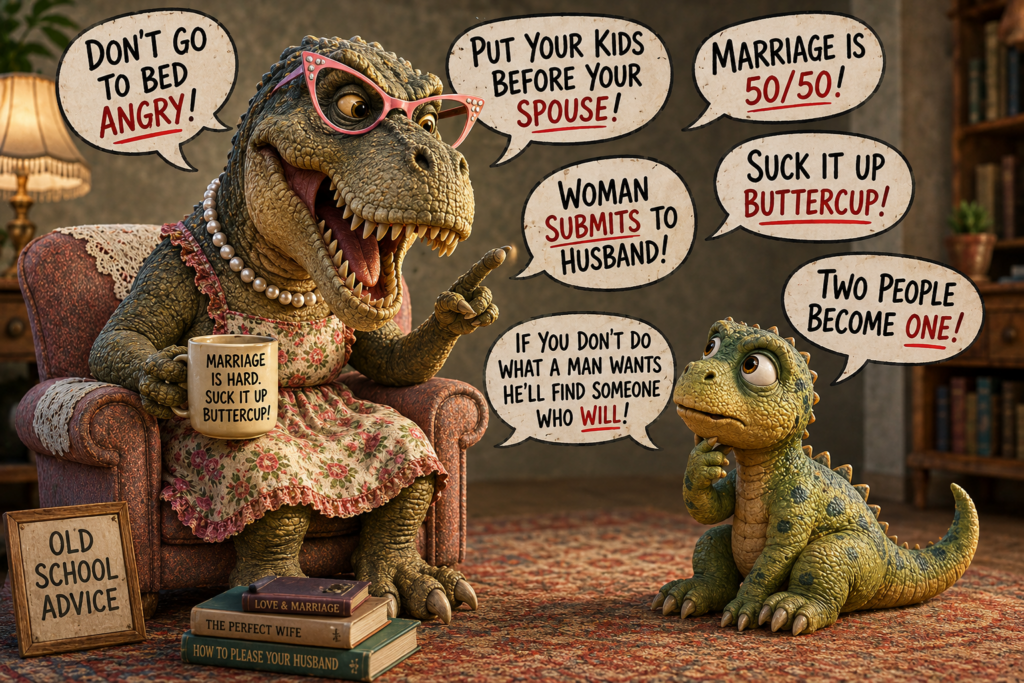
People repeat marriage cliches like they are sacred truths. Some of the old relationship advice and sayings are helpful, but a lot of it is toxic marriage advice that creates guilt, disconnection, power struggles, emotional suppression, and unrealistic expectations.
Many couples enter marriage carrying a backpack full of these phrases and bring them up often as a defense or an excuse for a misguided decision, or they just flop them out for no particular reason, having put very little thought into it.
“Did you ever question what the phrase really is saying?” I ask.
“Not really.”
Toxic Marriage Advice and Phrases
One thing I hear a lot that drives me bonkers is, “I don’t believe in divorce.” Really? To me, this is a first cousin to not wanting to set boundaries with people. It screams, “Here I am. Stomp on me!”
As a marriaeg therapist, I have seen harmful marriages continue for years because people believed divorce was morally unacceptable under any circumstance.
Married people should always know that divorce is an option if the relationship becomes unhealthy for them. People who say they don’t believe in divorce don’t realize that a spouse who doesn’t have their best interests at heart will hear that and tell themselves they have a blank check to conduct themselves however they choose, and I have actually seen this happen.
“Your spouse has cheated, spent all of the family savings, won’t work, says awful things to you, and abuses medications, and my question is, ‘What would they have to do for you to end it once and for all?”
“I honestly don’t know,” is usually the answer. “I just don’t believe in divorce.”
Good God, people, have you no self-respect?
Then they wonder why they feel lonely, resentful, controlled, invisible, or exhausted.
Let’s debunk some of the most common relationship clichés that deserve retirement.
“Don’t Go to Bed Angry.”
My blood pressure rises whenever I hear this one, and yet it is one of the most common pieces of toxic marriage and relationship advice out there, and it needs to go.
What a great idea in concept. In reality, it often pressures couples to reach a resolution before they’re emotionally ready to have a productive conversation. It also insinuates that you’re doing something wrong if you do go to bed angry. Nonsense.
Example: I am feeling very angry at my husband for flirting with a woman at a party right in front of me, and I am supposed to somehow bury those feelings before sleepy time? Are you kidding me?
Human nervous systems don’t work that way. Feelings don’t have an electrical switch you can turn off and on.
And for some people, some betrayal events are so enormously painful that if they wait to sleep until all of them are tied up in a bow, they will never get sleep.
Feelings are the way our souls speak to us.
Feelings are organic. We cannot manufacture them or order them on Amazon. We can’t order anger on a scale of 5, 1, or 10. When they arrive at whatever level you are feeling it, your soul is tapping you on the shoulder and saying, “Something is going on here, check it out.”
Often, we misunderstand something, and once we realize it, our feelings of alarm immediately go away. But you and I cannot make our feelings of fear, anger, pain, toxic shame, or sadness just disappear by wishing it so. The most extreme ones are past trauma-related, signaling to you that you have some trauma work to do. The quickest way to end them is to feel them and figure out what messages they bring. People who anger us can help us come out of it sooner if they engage in sincere, heartfelt repair, but that is as rare as an albino tiger.
Some hurts require reflection, time for the nervous system to calm, or multiple conversations over time. Some take years to resolve; some are never resolved.
One reason there isn’t better news about this is that so many people will not go to therapy or do whatever it takes to get as healthy mentally and emotionally as they possibly can. People are apparently fearful and dismissive of all the emotional tools available to help them clear their injuries. Here is a cliché that is true — you can lead a horse to water, but …
Healthy couples learn this:
- You do not have to resolve everything immediately.
- You do need to reassure each other that the issue matters and will be revisited.
- Sleep is sometimes the wisest intervention available.
A better phrase:
“Don’t abandon hard conversations. But don’t force resolution when you are tired and your nervous system is overloaded.”
“Put Your Kids Before Your Spouse.”
Parents hear this constantly and proudly sacrifice the marriage “for the children.”
One couple I worked with was on the brink of divorce. The husband put his job first, and the wife put the kids first, and each was griping about the other’s priorities, but were blind to the fact that they’d both made the same choice — to neglect the marriage.
Ironically, children are often healthiest when they grow up inside a stable, emotionally connected adult partnership that demonstrates a balance of responsibilities. Role modeling a happy, joyful, multifaceted life of your own individuality, as well as devotion to family, is healthy for children and the best marriage advice you can find.
That does not mean spouses should become neglectful parents. It means the relationship itself must remain emotionally nourished first, except in very rare cases, most of which are temporary. We all have a certain amount of energy in a day, and it is wise to dole it out for your own self-care, your marriage, and your children, in that order. People in tune with themselves work every day to tweak their lives, seeking that magic spot where everyone they love gets enough.
When couples pour every ounce of energy into the children or their career while starving the marriage, they are setting themselves up for a marriage crisis because:
- intimacy erodes
- friendship disappears
- resentment builds
- Co-parenting replaces partnership
- eventually, the children leave, and the couple realizes they no longer know each other
Children benefit from seeing:
- affection
- teamwork
- emotional repair
- healthy boundaries
- adults who matter to each other
- A fulfilled life away from the role of parent or spouse.
A better phrase:
“Self-care is first, then protect and nurture the marriage while raising the children.”
“Marriage Is 50/50.”
No. It isn’t.
Healthy marriages are fluid systems, not accounting spreadsheets.
Sometimes one person gives 80 because the other is grieving, sick, depressed, overwhelmed, postpartum, burned out, or struggling.
Sometimes it’s 20/80.
Sometimes 90/10.
Sometimes one person carries the emotional labor while the other stabilizes financially.
Sometimes that reverses.
Personally, I aim to give 100 percent of what I am capable of while maintaining a balanced life, but that’s just me.
Typically, though, trouble starts when couples begin scorekeeping, and I see it all the time:
- “I did this.”
- “You owe me.”
- “I carried more.”
- “I sacrificed more.”
Transactional marriages become emotionally cold. I do see this all the time.
Healthy couples think more in terms of:
- generosity
- teamwork
- repair
- flexibility
- mutual care over time
I have said at least 10,000 times over the years — people in healthy relationships think in terms of, “What can I do to make your life better and easier,” and aren’t singing Janet Jackson’s old tune, “What have you done for me lately?” When I changed my own attitude from what do I get to one of what can I give, my relationships transformed.
A better phrase:
“Marriage works best when both people remain deeply invested in the well-being of one another, followed by the whole family system.”
“Suck It Up, Buttercup.”
Translation:
“Your feelings don’t matter and inconvenience me.”
This phrase is one of the more obvious pieces of toxic relationship advice, and teaches emotional suppression, not resilience.
Many people were trained to ignore:
- loneliness
- emotional pain
- betrayal
- fear
- exhaustion
- unmet needs
- attachment injuries
Then those ignored feelings emerge sideways through:
- anger
- affairs
- resentment
- emotional shutdown
- addiction
- anxiety
- depression
Emotionally healthy adults are not people who never feel pain.
They are people who can:
- acknowledge reality
- regulate emotions
- communicate honestly
- tolerate discomfort
- seek solutions without denial
A better phrase:
“Your feelings are important. Period. Feel them and discern their message, then act to repair them through action and setting boundaries.”
“The Woman Submits to the Husband.”
This marriage advice is coming back around as a wing of MAGA markets this model of coupledom as ideal, but if I were MAGA. I wouldn’t bank on changing many women’s minds. Women fought for the freedom to live their lives as they choose, whatever that means. I don’t see many wanting to give that up.
No matter, this phrase has caused immeasurable damage and continues to do so.
Many times, a husband calls me and says his wife wants to leave him, and he is looking for a Christian-based therapist.
To me, this is code for, “I want to use the scripture to shame my wife into staying married.” I refuse to be a part of that sinister practice.
Healthy marriages are not parent-child systems.
One adult should not dominate another.
We have, and should have, free will to make or break our lives. No one has the right to control us, whether we are contributors to the world or self-destructive train wrecks.
Submission-based models often create:
- power imbalance
- emotional silencing
- dependency
- fear
- loss of self
- covert resentment
The healthiest marriages are collaborative partnerships where:
- Both voices matter
- Both people influence each other and the family decisions
- Both adults retain dignity and agency
- leadership shifts depending on strengths and circumstances
Mutual respect is healthy.
Forced hierarchy is not intimacy.
A better phrase:
“Strong marriages are built on mutual influence, not domination.”
“If You Don’t Do What a Man Wants, He’ll Find Someone Who Will.”
My mother actually told me this one. It explains her choices in life very well. Based on fear and dependency-based thinking, it says I have no other options in life but a male meal ticket sort of relationship management.
This teaches women that love is conditional upon compliance.
It encourages:
- self-abandonment
- people pleasing
- fear of authenticity
- tolerating mistreatment
- emotional performance instead of genuine intimacy
Mom did all of these things’ par excellence, and sadly, too many of my clients are women dependent on their spouse financially, with no training or education to be able to get a decent-paying job if the marriage doesn’t work out.
And frankly, old Buddha Whetstone’s philosophy insults men too — reducing them to creatures incapable of loyalty, emotional depth, restraint, or integrity. Give them what they want, or they leave, assuming they only stay to be served.
Real intimacy requires the freedom to:
- disagree
- negotiate
- have needs
- say no
- maintain boundaries
- remain fully oneself
A relationship built on fear of replacement is not a secure attachment.
It’s emotional coercion.
A better phrase:
“The right partner wants a real relationship, not obedience.”
“Two People Become One.”
Romantic?
Poetic?
Dangerous.
Have you been to a wedding where each partner takes a candle, then holds it up to a third candle, and once it is lit, they blow out their individual candles? While some in the crowd swoon, I try not to blow a gasket at the absurdity of a symbol that says you give yourself up once you are married.
Marriage is not supposed to erase individuality.
You are not meant to:
- lose your identity
- Stop having separate thoughts
- Give up personal growth
- abandon autonomy
- fuse into one emotional organism
That level of fusion often creates:
- codependency
- emotional enmeshment
- control
- loss of attraction
- resentment
Healthy couples are:
- deeply connected
- emotionally attached
- interdependent — in case you don’t know what this is, it means two individuals with lives of their own come together into something we call marriage, which is like a farm that both will tend to together. In theory, neither loses anything, and both gain. I am the first to say that if you decide to marry, there will be a sacrifice, and if you don’t want to sacrifice to have the benefit of a partner, then don’t get married.
But once married, they are still two separate people.
The strongest marriages contain:
- togetherness
- individuality
- autonomy
- connection
- boundaries
- each person rooting for the other in life.
- Support, caring, wishing the best for one another.
A better phrase:
“Two whole people create and manage a partnership.”
A Few More Marriage Phrases That Need to Die
“Happy wife, happy life.”
Although there is some truth in this phrase, it suggests the husband’s inner world doesn’t matter. The main thing to know here is: if your wife is making reasonable requests to tweak things in the relationship, perhaps asking for behavioral or other changes, be responsive. If you are not, she will nag, and if you still are not, she will leave.
“Love means never having to say you’re sorry.”
In the 1970s, people had posters of this in their room, as Ali McGraw spoke this foolishness to Ryan O’Neal in the movie Love Story. Actually, healthy couples apologize and have repair conversations continuously.
“If it’s meant to be, it should be easy.”
No. Every long-term relationship eventually requires skill, maturity, repair, and intentional effort. Even great marriages are not usually easy, though there will always be some jackass who says theirs is. When this happens, I envision two adults who are needless and wantless who accept whatever life brings, come what may. In short, they are together but not in a relationship. Have you guys heard of therapy?
“You complete me.”
You are not half a person. You are whole and complete without anyone else. This is barf-worthy.
Spouses are meant to enhance our lives. Period.
“Never go to counseling.” or “Counseling made things worse.”
Some things you just can’t do yourself, people.
And if you go to counseling, things may get worse — at first. That’s what happens when people grow and change, learn to grow up, become confident in who they are, and learn to advocate for themselves and set boundaries. The individuals get healthier, and the family system will change as a result.
It’s called adjustment pains, or the reordering of the family system from an unhealthy to a functional state. People like me didn’t go to graduate school for five years, then spend an extra three years of supervised study and testing to end up empty-handed, with nothing to offer you. Therapy changed my life, and millions of others. I couldn’t have done it myself. I needed a Sherpa to climb that hill, and you do, too.
Final Thoughts
Many destructive marriage beliefs are passed down through generations, disguised as wisdom.
Some came from:
- emotionally immature parents
- rigid religion
- patriarchal systems
- survival culture
- trauma
- fear
- unresolved attachment wounds
The goal of modern relationship health is not domination, emotional suppression, or endurance at all costs.
The goal is for two emotionally healthy adults to learn:
- self-awareness
- boundaries
- repair
- honesty
- emotional regulation
- intimacy
- differentiation
- mutual care
Marriage is not about becoming less of yourself.
It’s about becoming more emotionally mature while staying deeply connected to another imperfect human being. What phrases and cliches are holding you back from life?
Becky Whetstone is an author and marriage and family therapist with 25 years of experience helping individuals and couples. Although she is fully licensed, she works as a consultant and life coach via telehealth. She created the concept of marriage crisis management, the radically positive, amicable divorce plan, and the positive co-parenting plan, and seeks to take the nastiness out of anything to do with relationships. For a 90-minute marriage crisis consultation, click here. For more information, click here, or visit her website at www.marriagecrisismanager.com.
Read her books, I Think I Want Out: What to Do When One of You Wants to End Your Marriage, available in paperback, digital, and audio versions, and The Congressman’s Wife, available only on Substack. She may receive a small percentage of her first book if you click this link, at no extra cost to you.
Other related blogs by Becky …
How to Prepare to Be Married.
Even if You’re Married, It’s Never Too Late to Learn. https://medium.com/unfaithful-perspectives-on-the-third-party/how-to-prepare-to-be-married-055add2ee774
The Number One Thing You Can Do to Have a Successful Marriage.