What it Feels Like When Someone Shuts You Out Emotionally.
Still-Face Experiment Shows Impact of Emotional Disconnect.
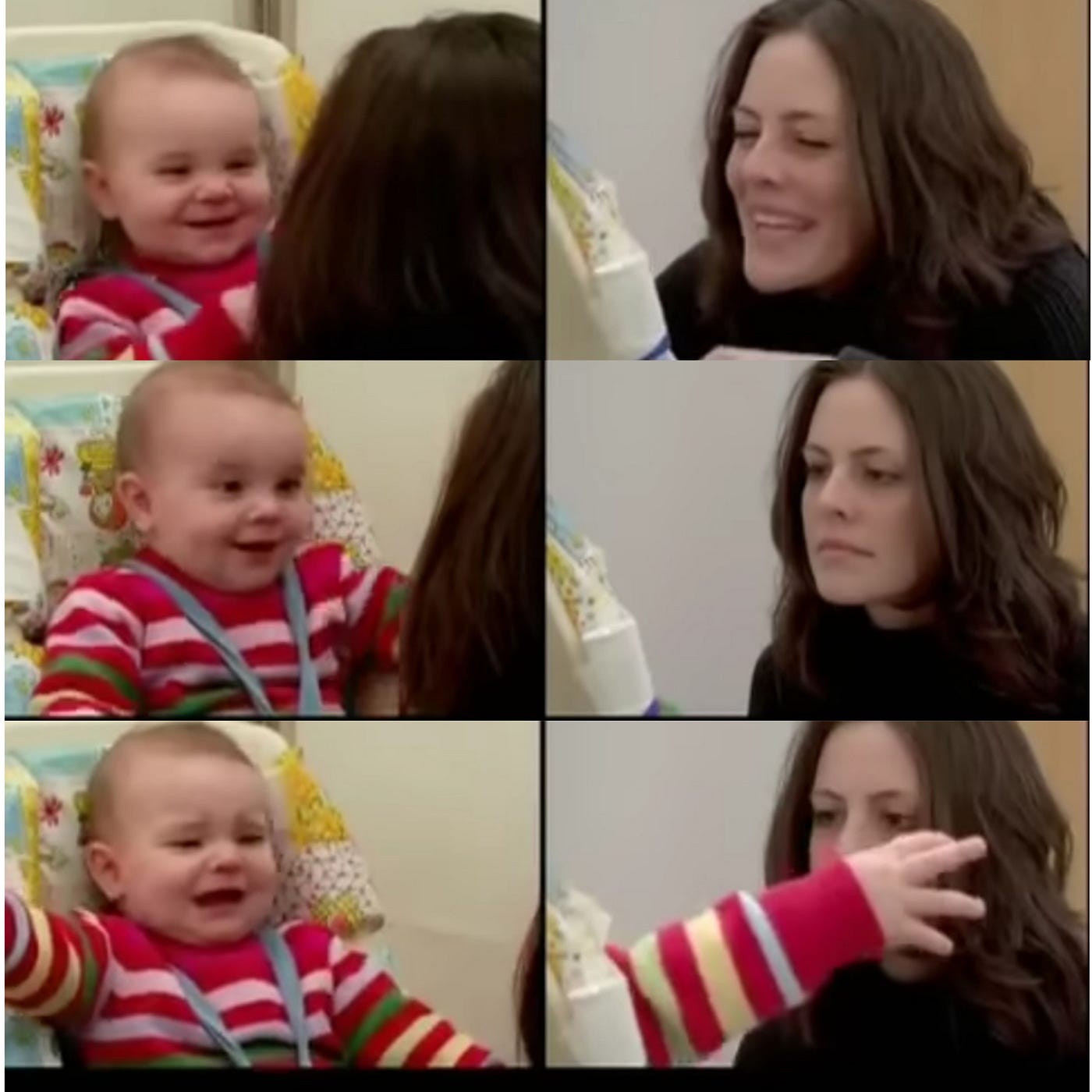
When a person you love shuts you out emotionally, it is a discombobulating experience, like a person physically slamming a door in your face mid-conversation. Whether lover, friend, or family member, and regardless of attachment style, we are meant to seek connection with the important people in our lives, and when it is removed, it causes a person to wiggle and squirm internally. It’s uncomfortable to an extreme. It ignites the fight, flight, freeze/fix response. Often, the rejected person will seek various ways and strategies to gain an emotional connection again, usually to no avail. Clients experiencing this always beg to know if their person will return and play and be vulnerable with them again.As I wrote in my recent article, the answer is probably not, at least not in the fully open way you might desire. Once they shut down, post-chemistry stage, most invulnerable people show up on rare occasions or never, after having shut down once the relationship is well underway.
I saw a Reddit Post not too long ago where a husband felt his wife’s needs for emotional connection were manipulative, and so he gave her a tough time about it and refused to “enable her.” He said she was now giving him the cold shoulder treatment, and he couldn’t understand why. Readers slammed and criticized him and told him he was clueless and should start packing his bags, as his spouse was in the lost hope phase of marital deterioration, and he was undoubtedly about to get kicked out. What creates a person like that man?
As developing children, we all need and hunger for the nurturing of a welcoming caretaker.
Someone who never had the opportunity to form an attachment to a significant caregiver when young, had been shamed for showing emotions or having feelings, and/or one who may have themselves been accused of being manipulative when showing a need for anything comforting and nurturing. I could imagine that if his parents were that way, like non-emotional robots, and he decided that was the way things are, and adopted the same belief system as a coping mechanism, as wrong as it is.
I remember working as a counseling intern at the university family life clinic. A young girl came in with her mother, and what I found was that she was depressed because her dad was cold and distant. He wanted nothing to do with counseling, but I called him, and he agreed to come in once. Sitting there with his daughter, he said that he was tired of his daughter’s games and manipulations to get attention from him. I said, “Sometimes a need for connection isn’t a game, it’s a real need.”
I don’t think I got through to him or was able to make a difference, but at least he heard the truth one time. I shudder every time I think of that case — that innocent child wanted love from her dad so badly, and he wouldn’t give it to her. This is a recipe for a child who grows up to be needy in adult relationships, especially with men, forever trying to get love from a man to make up for the love her father wouldn’t give her.
One thing I learned while studying trauma was how much babies need eye contact, a caretaker’s body language, and verbal and facial expressions to show them how happy they are in the world. The “I’m so glad you’re here!” energy is the first building block of self-esteem and emotional security. When I see a young parent goo-gooing over their child and showing an animated and happy facial expression, I always praise them and comment on how important it is.
Suppose a child’s needs for emotional responsiveness and adoring connection aren’t met enough. In that case, they have to adapt to live without the very early experiences vital to our emotional well-being and sense of safety. Most of us didn’t get enough in childhood, because a child’s need for nurturing, guidance, and protection is tremendous. When I was a child, it was thought that holding a baby too much spoiled them. No wonder we boomers are such a mess.
To drive home the importance of remaining emotionally attuned and connected to your loved ones, I sometimes show an individual or couple a famous experiment performed in the 1970s by developmental psychologist Dr. Edward Tronic. It illustrates better than anything else what it feels like to be shut out emotionally by someone you care about. It is called the still face experiment, and I have never met anyone it didn’t profoundly affect. Here it is:
https://youtu.be/uSmMJgpTVcs?si=HF1ICSjnvFDXXBBw
Every time I watch that and see the baby’s reactions to the mother’s face going blank, my heart aches. Still, the situation has been replicated numerous times with the same results, showing us how vital emotional connection is. Infants need a caregiver who is consistently sensitive and emotionally responsive to infants’ needs. If they are, the child should develop a positive internal working model that the caregiver is a reliable source for care and comfort, which leads to secure attachment. (1) A rejecting, intrusive, or neglectful caregiver who is inconsistent with their responses sets a child up to be insecurely attached.
These things remain true when we grow up and play out in our primary relationships with family members, romantic partners, best friends, or anyone we feel attached to and care about.
To be clear, all of us parents who have been busy with dinner or other things and couldn’t immediately be responsive and attentive to our child did not ruin them for life. Of course not. The chronic, ongoing inattention teaches them they are on their own emotionally. Since that’s painful, they do what we all do when young, adapt to cope with what we get too much or too little of. Emotionally neglected children often numb themselves to avoid feeling the emotional pain of needing something they will not receive, literally turning off the valve they were born with to need emotional responsiveness. Once grown, you will see an unemotional, shut-down person, and feel their lack of availability. Where you see that, you see someone whose developmental needs were unmet. Children adapted in dysfunctional ways so they won’t suffer. Numbing and tapping the valve of feeling and connecting does the trick, but stunts the child’s emotional development.
Emotional shutout.
Years ago, I read a book that helped me understand, at least a little, what it meant to be a healthy adult and what a healthy relationship consisted of. The Road Less Traveled, a classic book written by M. Scott Peck, MD, was published in 2003 and described as “A new psychology of love, traditional values, and spiritual growth.” Jack Kelly of Forbes wrote on LinkedIn about the 10 takeaways from the book:
1. Life is Difficult.
2. Discipline is necessary for growth.
3. Love is an action, not a feeling.
4. Problems are growth opportunities.
5. Emotional and spiritual health are intertwined.
6. Acceptance of responsibility is essential.
7. The journey of personal growth is ongoing.
8. Faith and spirituality are important.
9. Self-awareness is crucial.
10. Growth requires risk and discomfort.
Peck taught me the basics of being a healthy, functional adult, what a mature romantic relationship consists of, and the necessity of discomfort and risk-taking to grow and evolve. It was life-changing and directed me where I needed to go. What does this have to do with emotional disconnect? Those of us who want to be emotionally healthy partners and family members, who signed up for marriage, have a responsibility to show up emotionally in our relationships. Peck explains in the book a concept I write about in my book, I (Think) I Want Out, What to Do When One of You Wants to End Your Marriage.I call it getting Zinged,but I first learned about the concept from Peck.
In his section on love, he explains why the chemistry stage feels so wonderful for couples in romantic relationships — it’s because each takes their walls down, and we get to freely share, for a time, it feels safe, and what you say is welcomed and accepted. When this is going on, it is truly one of the best feelings in the world. Then one day, your partner throws something back in your face that you said, uses it against you, or emotionally shuts off, and you don’t know why, and the dance of the disappearing, disconnecting lover begins. Some come back now and then, and others never do, but Peck says all people put their wall up when they get zinged or injured by someone, but the trick to staying emotionally connected is consciously taking it down again so that the connection can resume. Like a mom cooking dinner and shooing away her child, who was hoping to connect, she later returns to reconnect and show the child how happy she is to have them in their life. One of the tricks to a lifelong happy marriage is being self-aware and consciously taking your wall back down once you’ve been zinged. I must add that if your partner is abusive when you’re walls are down, and/or you’re in a domestic violence situation, it is wholly understandable and to keep them up most of the time. People in abusive relationships require specialized help that they can get at the local family violence center for free. I encourage anyone to seek information there.
Normal disconnect.
Disconnecting is normal and advised when people are disrespectful or unkind. It is also normal to sway back and forth between wanting to be with people and wanting to be alone. For example, during the holidays, when a typically social person overdoses on social connection, they may feel the need to chill out in January at home for a few days or weeks. Eventually, their need for connection returns, and they come back out to be with people. The difference here is that if the person is capable of vulnerability, connection, and realizes its importance. If asked to connect, they can and will do it. Their retreat to solitude is to refuel and retune themselves so they can return to comfortably being around people. The skill these people have is that they are attuned to their sensibilities about wanting and needing healthy connections and needing solitude, and the sway between the two is often around 50/50. It is excellent self-care to be aware of this and put yourself out there or pull yourself out as you need. What isn’t healthy is to spend 90 percent or more of your time in solitude, or needing to be around people so much that it hampers your life balance.
Rubberband people.
The rubber band person is so moody that on any given day, you don’t know who will show up. One day or moment, they are all about connection and relating, and the next say, “Don’t you dare come close.” This is one of the most unnerving relational experiences a person can have, and can be indicative of several mental disorders, some rather serious, likeborderline personality disorder. People in relationships with these types often say they feel like they are “walking on eggshells.” Books have written about this and other subjects regarding emotional disconnection, but for this article I want to say we all should have emotional connection with our partners if we so desire, and if our partner can’t or won’t give it to us, thinks it’s not valuable or necessary, then the partner of that person has some serious soul searching to do. You can give the person a chance to change, you can accept the status quo, or move on to healthier skies.
Think about yourself being the baby in the still face experiment on a regular basis with your long term partner, and what that might do to you mentally and emotionally on the receiving end, with no mom to quickly return and interact with you once again. Your partner’s inability to come in close and be with you emotionally is almost always not your fault, but the result of the childhood experiences and the resulting adaptations your partner made to live without a nurturing connection, as a result of associating closeness with engulfment, perhaps due to a smothering caretaker, or a severe anxiety disorder. In any event, if they want to be a healthy adult and meet the emotional needs and obligations of a contented long-term relationship, they must get professional help and learn the importance of emotional connection, how to take the risk of vulnerability, and the benefits for them in the long term. As Brene Brown, a famous sociology professor specializing in shame and vulnerability, says, without vulnerability and putting yourself out there emotionally, you will never know joy.
What is vulnerability? Showing up as who you really are. Invulnerability is hiding who you are. When people disconnect, they hide themselves from us; when they do, we feel like the baby in the still-face experiment. Sometimes, I show that video to shut down men and women in front of their partners so they may see how it feels to be shut out. Most come out of it deeply stunned, having no idea of the effects of disconnect on others. The good news is that a healing process is available, and in most cases, a person can learn to open up and become emotionally available. It does take courage; it will be uncomfortable, and there is risk. However, it’s necessary to take your life and relationships to a higher level, and to have a good marriage, with a hopeful future.
(1)J Exp Child Psychol. 2014 September ; 0: 63–84. doi:10.1016/j.jecp.2014.02.007.
Becky’s recent podcast appearances:
Breaking Free From Narcissistic Abuse
Forks — A podcast about forks in the road
The D Shift with Mardi Winder-Adams
Pam Perry
https://www.youtube.com/live/FzNpoMkDPcg?si=n-GO4zApV9uVtDQp
Couples Therapy in Seven Words w Bruce Chalmer
https://youtu.be/IkZpxRxLM8Q?si=UudwcleRqkAekDyd
Pacific Cascade Legal
https://www.youtube.com/live/NCKOVt9sR8s?si=4DjhbexDtqe50zjf
Shake it Off with Mert and Lucas
https://youtu.be/EM6-0lLxZr0?si=86eIZMcPkFS5DXuF
Becky will start in mid-May 2025, with weekly drop-in support groups on Tuesdays and Thursdays for those in serious marriage trouble or crisis. Join us for information and support; you’ll be glad you did. For more information, visitMarriageCrisisManager.com.
If you want a signed book delivered straight from Becky, visit her website storehere.Becky Whetstone, Ph.D., is a licensed Marriage and Family Therapist in Arkansas and Texas* and is known as America’s Marriage Crisis Manager®.
She is a former features writer and columnist for the San Antonio Express-News and is the author of“I (Think) I Want Out: What To Do When One Of You Wants Out,”published by HCI Books, distributed by Simon and Schuster.
She has worked with thousands of couples to save their marriages. She can also work with you as a life coach — she is a licensed therapist in Texas and Arkansas. She also has aYouTube Channel called Marriage Crisis Manager,where she talks about relationships. She has a private telehealth practice as a therapist and life coach via Zoom.
Becky is looking for individuals who are thinking about divorce, people who are cheating, and couples in crisis, or people with amazing personal marriage crisis stories to tell, to appear on her video podcast. For information, contact Becky.
WORKING WITH ME
I’m Dr. Becky Whetstone, a licensed marriage and family therapist and America’s Marriage Crisis Manager®. I’ve spent nearly 30 years with people at the worst moment of their marriage.
I work with clients everywhere by Zoom. If something in this post hit close to home, here’s where to start.
My book: I (Think)I Want Out: What to Do When One of You Wants to End Your Marriage — Read the whole framework, in order, at your own pace.
Appointment: 90-Minute Marriage Crisis Consultation — Bring me your situation. You’ll leave knowing what stage your marriage is actually in and what to do next.
Relationship University — Live classes and a private community for people who’d rather understand relationships than keep guessing.
Quiz: What Stage Is Your Marriage In? — A free 10-question quiz.
Note. Becky is an Amazon affiliate and may receive a small percentage if you purchase a book from her links, at no extra cost to you.