
Why Are Some People So Damn Sensitive?

Me (l), and my late sister, BK. At her best, BK was a wonderful woman. But we always knew her dysregulated side would soon return.
Ever dealt with someone who, when you were around them, caused you to watch your words for fear that anything you might do or say would set them off, as if you were “walking on eggshells”? I had a sister like that, and from talking to thousands of people over the years, I’ve learned that almost every family has at least one person wired like this, as if their nervous system is always one second away from firing into an emotional rage attack.
We never knew what might set off my sister BK — who was 13 years older than I was — but when we gathered as a family, something always would. Having her around meant knowing there was a ticking emotional time bomb in the room. We could feel it. Even before our big family events, someone would always say, “Wonder what will set her off this time?”
She was infamous for her spitting anger and cussing people out, using nasty words and insults that were impossible to forget, and sometimes doing outrageously vindictive, ugly things afterward. The things I heard her say and watched her do, I’d like to forget, but interestingly, you could never talk to her about the outbursts, because she never remembered any of it. We all know the old saying, “You can’t change what you won’t acknowledge.”
The most she’d ever admit to was having a temper, which to me was like describing a fire-breathing dragon as a lizard.
Can our dysregulated family and friends change?
People often ask me, “Can a hypersensitive, easily charged person like this ever change?”
In short, it is really difficult, and I would not count on it.
First, the person would have to be aware they had a problem, and second, they’d have to be highly motivated to work on it. Most people, like BK, have amnesia about their explosive events, probably because when their nervous systems are firing so intensely, their cognitive abilities aren’t available, and they act solely on instinct. If they say anything about the drama that occurred, the most you can hope for is that it would not have happened if some asshole hadn’t set them off, so the real problem is that the world is full of assholes.
Interestingly, the hypersensitive person often complains they feel lonely or alone, yet cannot see or understand why those around them won’t be all-in. It’s a sad predicament, indeed.
Why are some people easily triggered, and others not?
I worked with a husband who got so tired of the scenes his wife caused on commercial airliners with fellow passengers that he began chartering private jets for their family vacations.
Unbelievably, she dragged her husband to marriage therapy, not vice versa, and her complaint was that he refused to support or join her in kicking people’s asses on airplanes or anywhere else she found people to get into it with. In public places where outbursts often occurred, she was angry and fed up with his attempts to calm things down.
“Shouldn’t Joseph protect and defend me in these situations, Becky?”
“Mm, well that depends,” I said. “But in most cases, when you are clearly the aggressor and out of line, as you were in the stories you just told, no, he should not.”
She found this outrageous, and if I wasn’t going to bring her husband in line with what she was telling herself she needed, she had no use for me.
It’s the asshole’s fault.
This person was unforgettable because when she told stories about dramatic events or things her husband did that angered her, her face would turn red, then purple; she’d make gurgling noises, and the tendons and vessels in her neck and face would stand out. It was like a scene in a movie with a bad actor going overboard, angrily expressing himself, then gagging almost to death. I had never seen anything like it.
She has zero ability to regulate herself.
People who react this intensely around others in public scenarios, while everyone nearby is fine with whatever is going on, always have a different way of seeing and perceiving things, and therein lies the problem. Who knows why they see something we all see and think nothing of, and that same information goes through their ears and eyes and into their brain, then gets contorted into some kind of threatening horror show, and the sense they make of it is that they are under threat.
The story her husband told about her on the airplane was that she provoked people, was the aggressor, and that her actions were embarrassing and uncalled for, yet for her, there was intense and imminent danger ahead. She was outraged that her husband couldn’t see it.
She explained that people do outrageous things they shouldn’t, and therefore she was going to let them know. But her husband said the stories she was telling me were completely off base and inaccurate.
“We went to Charleston once, and she didn’t like the way a kid looked at her from his bicycle, and she tried to chase him down,” he said. “She was running down the street screaming at him, ‘Come back here, you little shit!’”
Surely, she knew the boy would not come back, so why bother with it?
“Why couldn’t Joseph see it and protect me and my honor?” she replied. It was news to her that every mistake-maker out there shouldn’t have their asses kicked.
What the behavior shows, though, is that while everyone else around her remained calm, it was her nervous system that was assigning far more threat, insult, rejection, or danger to it than the average person’s. That is the issue the ultra-sensitive person faces.
I couldn’t know what was happening inside this particular woman, and I’m not going to slap a label on her and diagnose her based on a collection of angry incidents. But I could see that once she became activated, she seemed to have very little room between “I don’t like what just happened” and full-blown physiological arousal and confrontation.
In the same situation, you and I might get mildly annoyed by someone, but this woman’s brain told her she was in the presence of an enemy, and her actions and reactions mirror that.
This woman believed with all her heart that she had reason to act as she did, and that attacking was a completely acceptable response.
To be so frequently reactive, you have to seek out interventions that will help you reach a place of calm in most everyday social situations. Although there certainly could be physiological things they can’t help at work here, in many cases the person is ultra-sensitive due to piles and piles of trauma that sit in their bodies waiting to be discharged.
If we can figure out the origin of your original trauma, which might not be specific stories but certain themes that kept showing up, like, “You can’t count on or trust Johnny,” you can draw the connection between what happened today that upset you and that, and almost miraculously, that wound won’t have the same impact the next time. That’s one way to go about it.
Remedies and Solutions for Hypersensitivity: Somatic Experiencing and the Window or River of Tolerance.
There are all sorts of ways to help hypersensitive people become calmer, and one of my favorites is somatic experiencing (SE), a trauma intervention that doesn’t require a person to relive their story. It is a relatively new theory from the world’s trauma experts and is proving highly effective.
Ten years ago, I spent several years training in this relatively new field of trauma and earned my Somatic Experiencing Practitioner (SEP) designation because I am always looking for more ways to help heal people’s trauma. Before you doze off, I urge you to learn what it is and the incredibly powerful healing properties it offers us, all by paying attention to what is happening inside us through interoception.
Interoception is related to the word perception, but it specifically focuses on what is going on inside you. If you can feel your heart race on occasion, or feel hunger, that is interoception, because those things are happening inside your body, and when you notice these sensations, you are practicing interoception. SEPs use interoception to help people heal their traumas and become less sensitive to perceived threats. Try the exercise below as an example:
Interoception Exercise: Ask yourself, what is going on inside your body right now?
Scan your interior body, and tell me if you notice any tension, pressure, energy, or anything at all, anywhere.
For example: As I write this, I feel a little anxious pressure ache in my stomach. Pain and tightness in my neck, and a slight tightness in my throat. These are somatic signs and symptoms, and they are trying to get me to notice them, probably because they have something to say. If I sit still and notice these things, like my stomach pressure, I can follow the feeling as it moves around my body and may be able to figure out its important message. This is called somatic experiencing.
If you sit quietly and notice the feelings inside your body and stay focused on them, they will often move to be discharged on their own. We can help trauma like this discharge by using vibrational humming or noises, like the Indian gurus who sit and vibrationally say, “Ahhhhmmm.” In somatic experiencing training we learned to make the vibrational sound, “Voooooooooo.”
Other times your body may want you to hug yourself, put your hand on the part of your body where you feel the energy, lean back and forth, gently shake, ground yourself by noticing your environment and your feet on the floor, allow your body to act on whatever impulse it has, including deep breathing, or spontaneous yelling or yawning.
The entire idea of this new science, discovered accidentally by Peter Levine, PhD, as he recounts in his book Waking the Tiger: Healing Trauma, is that these feelings are past traumas or ongoing situations that are frozen in the body and need to be discharged. I tell clients to think of it as their soul tapping them on the shoulder and gently saying, “Please do something about this.”
People who freeze up and act stoic throughout their lives are often in the sympathetic nervous system’s freeze response and inadvertently store trauma in their bodies until it is released. With Somatic Experiencing, you can work with an SE practitioner, or we can help it discharge by unfreezing ourselves. Here is how to do it yourself:
- Find a safe place or thing as a resource. To prepare yourself for this, you must first come up with a resource — anything that you can bring to mind on demand that calms your nervous system and brings you a sense of calm and safety. My resource almost always involves envisioning baby animals, my husband’s face, or my pets. An internal resource might be imagining calm in your body.
- Pay attention to your triggers and what they feel like in your body. Notice and track them, and even place a hand on that area, as your nervous system reacts positively to your own touch.
- Titration. Somatic experiencing doesn’t believe in diving into a trauma story head-on. They believe individuals can heal and increase their ability to tolerate life’s ordeals by slowing themselves down as they ponder their trauma trigger. So, if I see a snake in my mind’s eye and start to get triggered, I immediately turn my focus off the snake memory and onto my resource, the baby animals. This keeps us from going back into the story and reliving it, which could retraumatize us.
- Pendulation. In this part of the somatic experiencing process, a person works to widen their tolerance by tiptoeing into a trauma and, at the first inkling of nervous system activation, pulling back to the resource. Pendulating back and forth widens our tolerance for things. Who knew?
The Incredible River of Tolerance Graphic
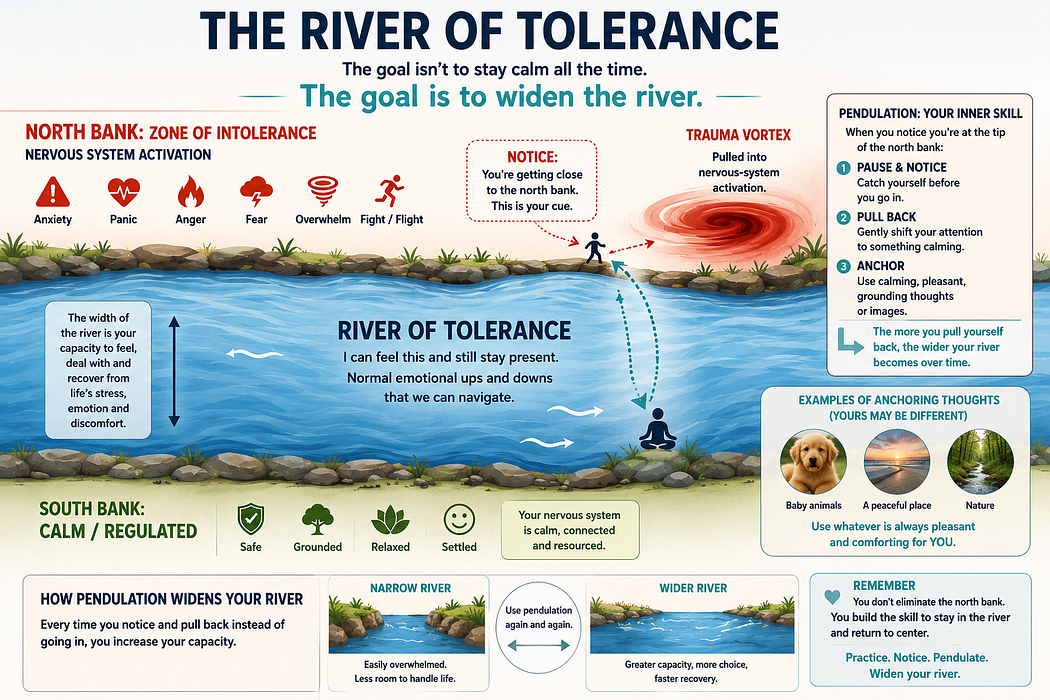
SE has a wonderful graphic called the River of Tolerance that illustrates a four-step process for increasing your ability to stay calm amid your former triggers. Here is how it works:
- The river reflects how much you can tolerate and still remain calm. A person with a narrow river is extremely sensitive and easily triggered. A person with a wide river is rarely triggered. Somatic Experiencing widens the river of tolerance, so that you are rarely triggered.
- The north shore of the river is where all your traumas are. If you hit the vortex, your nervous system gets activated, and you go into the fight, flight, freeze/fix/fawn response.
- The south shore of the river is all your resources, and things you can bring to mind that always calm you and are pleasant to think of.
- We want you to get close to the shore, or barely on the bank, and then pull yourself back to your resource. This widens your river of tolerance.
- We do not want you to go full throttle into the trauma vortex and retraumatize yourself.
Clearly, any person you have ever been around who is hyper-sensitive or easily triggered has a narrow river of tolerance, and the people you know who are calm in a storm inside and out, meaning NOT the ones who suffer inside and look stoic on the outside, have a wide river of tolerance.
Sensitivity and dysregulation.
Many people are sensitive but not dysregulated. This means one person may feel slighted and triggered, stand before you, and look extremely calm, while an inferno of rage and insensitivity is raging inside them, yet they can control their reaction. That used to be me, when I was Pleaser Becky.
To cope with feelings when someone unwittingly stuck an arrow in my heart, I’d act unbothered on the surface, but once the coast was clear, I’d medicate my wounded inner child with donuts, cookies, and whatever else I could find. It was my way of giving my hurt little girl a bottle, I suppose, in order to comfort her, but of course, self-destructive solutions are not the way; we all know those who eat, drink, take drugs, numb themselves, or get depression and anxiety, all in a misguided effort at seeking peace.
A person who can regulate themselves can prevent drama scenes and nasty confrontations, but those who are dysregulated cannot. They react in scary ways, like sister BK.
There are all sorts of theories about how people end up this way; one is that some people have nervous systems that are simply more reactive by temperament. My brother, who is three years older than BK, reported that she was born triggered and dysregulated, so I wonder if it was a genetic characteristic that made her that way. For her and my raging client, we can at least say that, for whatever reason, they had an extraordinarily low threshold for perceived threat and an extraordinarily intense response once that threshold was crossed.
One of my most interesting memories of my late sister, BK, who died alone and isolated this past March at the age of 80, was her frequent jumpiness and panic over whatever it was, usually a nothingburger. If her dog stepped one foot outside the door, it was pure panic as the first reaction. This was strange for me; a person has most always been calm in a storm. So, what made BK such a nervous woman?
Other than genetics, for many, the tendency to panic is related to childhood role models, adversity, trauma, chronic stress, or years spent in unpredictable environments that may have taught the nervous system to detect danger quickly; in some families, oversized reactions were the norm. Still others never developed particularly good skills for regulating strong emotions. And sometimes several of these factors occur together.
Triggered.
Once the nervous system perceives a threat, the body can mobilize remarkably quickly. Heart rate increases. Breathing changes. Muscles tighten. Attention narrows. The sympathetic nervous system prepares us to fight or flee. At that point, the person isn’t necessarily calmly evaluating, “Is this situation actually dangerous enough to warrant this response?” The body has already voted.
But here is the thing: we are not meant to have our sympathetic nervous systems activate and go into the fight, flight, or freeze mode over what people say and do. That response is a survival mechanism meant to save us in real life-threatening emergencies like car wrecks and house fires.
The good news is that once you start becoming aware of all this and begin working on yourself and your trauma wounds and themes, you can heal to the point of rarely or never getting activated.
In the end.
All trauma is energy stored in your body, and unless you work to discharge it, it will remain there and reveal itself in little bodily signs and symptoms. I’ve got some right now in my jaw, a common place where trauma energy collects, along with the throat, so I know there is still some trauma there that I need to focus on and release. My hope is that all hypersensitive people will get help for wounds that can be healed and make it a lifelong practice.
Because, folks, we don’t have to live our lives this way.
One more thing — the reason couples have trouble communicating is that a partner unintentionally hit their love’s old trauma wound, their nervous system activated, and we react out of that immature place we often regret. Healing your trauma and learning how to control your reaction in a healthy way will also change your relationship.
Trauma therapy will help. Here are some other healing resources to consider that I had AI prepare for you and that I edited — all are valid paths to healing, though some lack substantial research supporting their efficacy. The truth is, I have seen them all, worked with many myself, and recommend them wholeheartedly:
- Somatic Experiencing (SE) — A body-oriented approach developed by Peter Levine that works with sensations, nervous-system activation, resources, titration, and pendulation. Rather than plunging into the most distressing material, clients learn to move in manageable amounts between activation and safety.
- EMDR (Eye Movement Desensitization and Reprocessing) — A well-established trauma treatment that helps the brain reprocess distressing memories, so they become less emotionally and physiologically activating.
- Clinical hypnosis/hypnotherapy — I learned to do hypnosis over 20 years ago and know well its amazing power to heal. Hypnosis uses focused attention, relaxation, and therapeutic suggestion to help people access and modify thoughts, emotional responses, imagery, and learned associations. In trauma work, it may be used to strengthen feelings of safety and control, develop internal resources, reduce anxiety and physiological arousal, and change responses to triggers. Because trauma work can evoke intense material, hypnosis should be used by someone appropriately trained in both hypnosis and trauma treatment.
- Trauma-focused cognitive behavioral therapies — Approaches such as Cognitive Processing Therapy (CPT) and trauma-focused CBT work with thoughts, beliefs, avoidance, and behavioral patterns that developed following trauma. CPT and trauma-focused CBT approaches have strong evidence bases for PTSD.
- Prolonged Exposure (PE) — An evidence-based PTSD treatment that gradually and systematically helps people approach trauma memories and situations they have been avoiding so that these cues no longer carry the same power.
- Internal Family Systems (IFS) — A parts-oriented therapy that helps people understand protective, wounded, and reactive parts of themselves with greater curiosity and compassion. Many people find it useful in trauma work, although its research base for PTSD is less established than treatments such as EMDR, CPT and PE.
- Sensorimotor Psychotherapy — Another body-oriented approach that integrates sensations, movement, emotions and cognition, particularly when trauma seems to live as much in the body as in the person’s narrative.
- Mindfulness-based approaches — Mindfulness practices can help people notice sensations, thoughts, and emotions without immediately reacting to them — essentially creating more space between “I’ve been triggered” and “Now I have to do something about it.”
- Neurofeedback — Some clinicians and software use real-time feedback on brain activity to help people practice self-regulation, which helps the brain stop relying on parts that don’t serve them well and points it toward using the areas that work in a healthy way.
- Psychodrama — An experiential therapy in which clients may reenact situations, take different roles, speak to an imagined person in an empty chair, or revisit experiences in a carefully structured therapeutic setting. Instead of only talking about an experience, the person gets an opportunity to experience it differently — perhaps saying what couldn’t be said, setting a boundary that couldn’t be set, or receiving support that wasn’t available at the time. Research is smaller than for first-line PTSD treatments, but psychodrama has a long clinical history and some encouraging evidence.
- Gestalt therapy — Gestalt therapy emphasizes what is happening right now — thoughts, emotions, bodily sensations, unfinished emotional experiences, and patterns of relating. Techniques such as the empty-chair exercise can help a person engage with unresolved experiences rather than merely analyze them intellectually. It can be useful as an experiential approach, although it isn’t considered a first-line evidence-based treatment specifically for PTSD.
- Emotional Freedom Techniques (EFT or “tapping”) — Tapping combines focused attention on a distressing thought, memory or emotion with tapping on specified points on the body, generally described as acupuncture or acupressure points.
- Energy-healing approaches — practices such as Reiki, therapeutic touch, and other forms of energy work — are sometimes used to promote relaxation, grounding, and a subjective sense of well-being. Some people report finding these practices deeply calming. Scientific evidence has not established the existence of the proposed healing-energy fields or demonstrated that manipulating such fields treats trauma. They may be considered complementary wellness practices rather than substitutes for established trauma treatment.
- ThetaHealing — ThetaHealing combines meditation, visualization, spiritual concepts, and work with beliefs, with practitioners proposing that entering a “theta” brain-wave state facilitates physical and emotional healing.
- Psychedelic-assisted psychotherapy — This is a rapidly developing area of trauma research. Psychedelic-assisted treatment involves using a psychoactive substance in a carefully structured therapeutic setting, generally with preparation beforehand and psychological integration afterward. MDMA-assisted therapy has been extensively studied for PTSD, although the FDA declined to approve the first MDMA-assisted PTSD application in 2024 and requested additional studies. Psilocybin has shown considerable promise for conditions including depression and existential distress, but its evidence for PTSD specifically is less developed. Ketamine is already used medically for certain psychiatric indications, although ketamine treatment and psychedelic-assisted psychotherapy aren’t interchangeable concepts. Do this with trained professionals.
Somatic experiencing resources:
- Pendulation: https://youtu.be/LiXOMLoDm68
WORKING WITH ME
I’m Dr. Becky Whetstone, a licensed marriage and family therapist and America’s Marriage Crisis Manager®. I’ve spent nearly 30 years with people at the worst moment of their marriage.
I work with clients everywhere by Zoom. If something in this post hit close to home, here’s where to start.
My book: I (Think) I Want Out: What to Do When One of You Wants to End Your Marriage — Read the whole framework, in order, at your own pace.
Appointment: 90-Minute Marriage Crisis Consultation — Bring me your situation. You’ll leave knowing what stage your marriage is actually in and what to do next.
Relationship University — Live classes and a private community for people who’d rather understand relationships than keep guessing.
Quiz: What Stage Is Your Marriage In? — A free 10-question quiz.
Note. Becky is an Amazon affiliate and may receive a small percentage if you purchase a book from her links, at no extra cost to you.