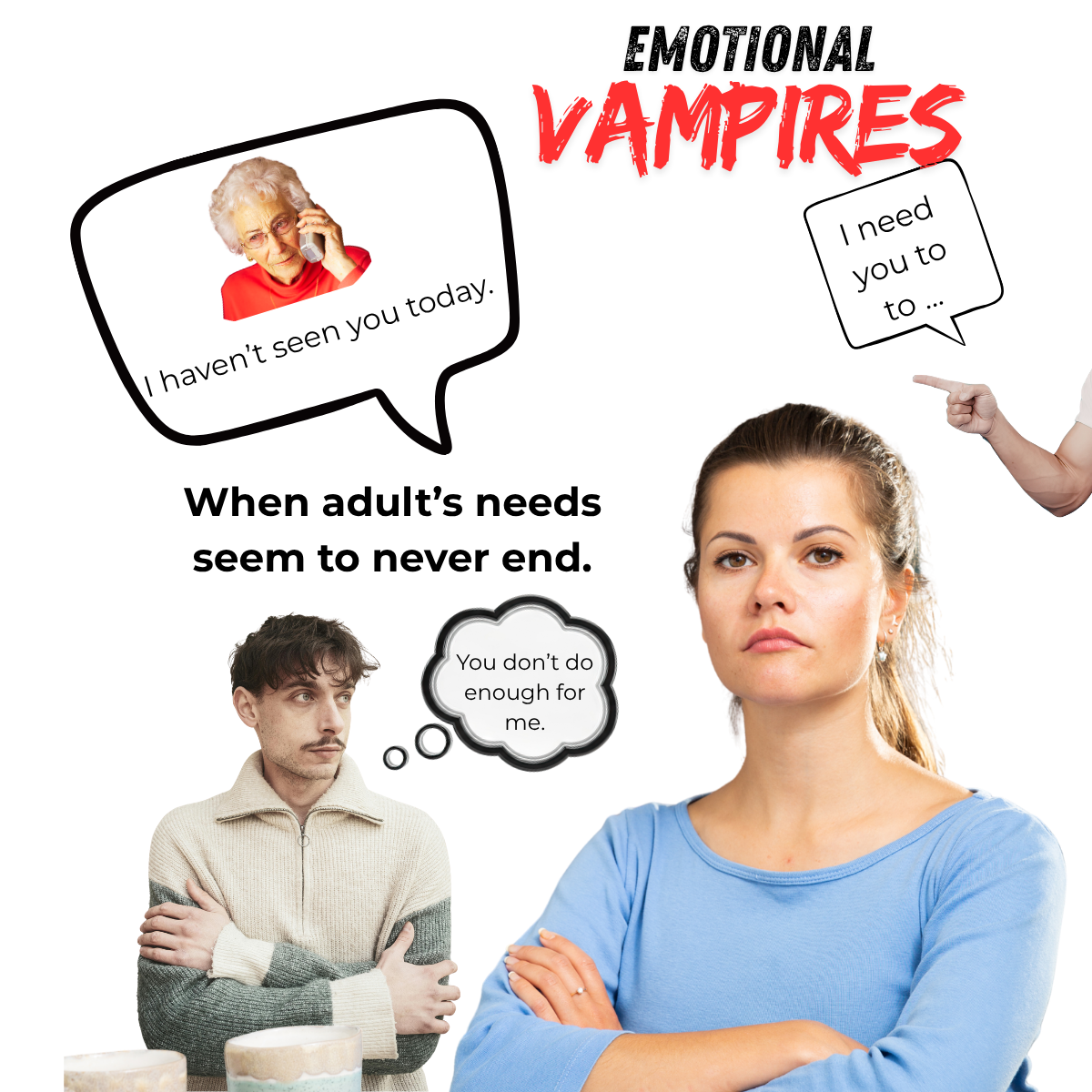
Emotional Vampires: The People Who Drain You Dry (and What to Do About Them).
Why some people are never satisfied, endlessly needy, and emotionally exhausting — and whether they can change.
Proud, original, non-AI content
There’s a particular kind of relationship-related exhaustion that sleep doesn’t fix.
It’s the kind you feel after spending time with someone who needs so much from you — attention, reassurance, validation, patience — and yet, somehow, no matter how hard you try or what you do, it’s never enough.
You leave the conversation drained.
They leave it unsatisfied.
If you’ve experienced this, you may have encountered what people commonly call an “emotional vampire.”
It’s not a clinical term, but it captures something very real:
A person who chronically pulls emotional energy from others without the ability to refill themselves.
My Emotional Vampire.
I have an emotional vampire in my family. A sibling now in their 80s. From my standpoint, they are one of the saddest, most pitiful people I have ever known, and there is nothing I or anyone can do to help them. They live alone, bitter, riddled with chronic illness, and full of blame and stories about how cruel the world and, especially, the family are.
“The Whetstones are mean as snakes,” they have told me, and they are not wrong. “There is not one ounce of empathy in any one of my siblings.”
There, they are wrong.
I have empathy. I have cut my sibling off numerous times over my 68 years, because dealing with them always ended up in some dramatic, painful disaster that could never be resolved, because they will not take responsibility for what they have done, becausethey never remember it ever occurred. It sounds ridiculous, but it is exasperatingly true.
Why can’t they remember? Is it selective amnesia? Alcohol? The fact that when anyone’s nervous system is raging, their cognitive abilities aren’t available to them? Whatever it is, decades ago, I realized that things were better for me when we weren’t in touch.
For your entertainment, here is one of the stories they do not remember:
In 1985, they were hosting my wedding at their house. Invitations were out, and a wonderful day planned. Most of the family had bought new clothes, plane tickets, and had hotel reservations. Then about 10 days out, they called me out of the blue and said, “I can’t have the wedding at my house if daddy comes.”
Our daddy, she meant. They were angry at our dad over something all of a sudden, something that had happened long in the past, and as his daughter, I could not, would not, disinvite my father.
So, my fiancé and I, faced with a quagmire, called off the wedding at her house and felt we had no other option but to elope.
The family was furious about the whole thing, of course. I was in tears for days.
My sibling doesn’t remember that. Not one bit of it.
My relative, who is 13 years older, never remembers any of the terrible betrayals that happened, and some are truly unbelievable. Outrageous dramas and explosions that started happening when I was a child and continued until I put a stop to it, or us, in my 60s. Things I could never forget.
Fast forward several decades.
Because I have empathy, I reached out to them about 8 years ago to see how they were doing. In my mind, it was a wellness check. They live 350 miles from me. I had a training in their town, so I tracked them down at their house and knocked on the door. I found them alone, lonely, barely coping, with an oxygen tank and a terminal lung condition. Their grown son hadn’t spoken to them in many years. Most of their friends had died. They needed someone, and so I opened myself up to communicating and visiting again, but with steel-reinforced boundaries in place.
I was willing to give and be there for my sibling, but only so much.
It was clear that just by my visiting that night, they assumed I was fully back in their life and could resume their bottomless expectations for what our relationship should be — the closest of sibling bonds and depending on one another — only I wasn’t up for that.
They showered me with gifts, a grooming process I had become familiar with whenever we spoke again after an estrangement.
Every few weeks, they hinted that they wanted more from me.
I could not, would not, give more. This was my healthy boundary.
I’d get texts like …
“Most of my health issues are related to a lack of support and comfort from my family.”
And another.
“Why won’t your daughter get closer to me? I don’t understand. She needs me, and I need her. Can’t you tell her she should get to know me better?”
“She is in her 30s, and I can’t control her,” I said. “She knows our history. You need to accept what she and I are willing to give and stop focusing on what we are not able to give.”
A few months later, they told me the doctor had told them they were dying, and I asked if they wanted my daughter and me to come spend the weekend with them.
It was meant to be a goodbye trip.
“No, I’d prefer not. It’s too painful when I know you can’t be what I need you to be.”
“Okay,” I said. At least we tried.
Though I knew these interactions were cries for help, cries for more, I would not be manipulated or guilted into filling the agenda she had in her mind for us.
A few weeks later, I was planning to drive to a meeting three hours away from their town and told her I could veer off my path, come spend the night nearby, and visit her for about 8 hours. They said yes, and I made my reservations.
The day I was leaving, I called to tell her what time I would be there, and they said, “Naw, naw,” in their Arkansas twang. “I don’t like being someone you see while passing through. Don’t come. I don’t want you to come.”
What I was willing to do was, as usual, never enough. And for me, that was the end. As far as they were concerned, I was closing up my heart and calling it a day.
Not long after, they texted, saying they wanted to reveal the truth of their life and feelings in missives every few days as they prepared to exit the world. I said, “Bring it.”
What followed was the nastiest, most hateful, victim-themed prose I may have ever read. Trickling in every few days, I braced myself each time a text arrived.
But people show you who they are in these kinds of situations, and my sibling revealed, once again, what I already knew: they would never see their part in their fate. Dying alone, with no one, because of how they had lived their life, while blaming others for all of their despair.
I had to laugh when, after they told me what a “selfish, empathy-less individual person I and all our siblings are, we are also “self-centered, mean, caustic, judgmental, disloyal, and more,” then sent at least 200 words at the end to tell me what a special person I am.
No wonder I have permanently resigned from my family.
What is an Emotional Vampire?
An emotional vampire is someone who:
- Requires constant reassurance or attention
- Feels easily hurt, slighted, or overlooked
- Brings ongoing problems but resists real solutions
- Leaves others feeling responsible for their emotional state
- Rarely feels satisfied, even when others show up for them
They don’t just have needs — we all do.
They have needs that feel bottomless. Endless.
Common Characteristics
While every person is different, emotional vampires tend to share recognizable patterns:
1. Chronic Dissatisfaction
No matter what you do, it’s not quite right.
You listen — but not enough.
You show up — but not the right way.
You care — but they don’t feel it.
This creates a moving target that no partner can hit.
2. Emotional Dependency
They rely heavily on others to regulate their feelings.
Instead of:
“I’m upset; I’ll work through this.”
It becomes:
“I’m upset, and I need you to take action to fix it.”
3. High Reactivity
Usually, because of false assumptions about how things ought to be, small issues become big ones.
The tone of voice is misinterpreted.
Your facial expressions are off.
You didn’t respond at the right time, quickly enough, or in the right way.
What you did is interpreted through a negative lens.
Everything can feel personal — like you can never win, and anything can escalate at any moment. Some things they handle surprisingly well, the next moment, they crumble into victimhood, and we’re knee-deep in another eruptive episode.
4. Boundary Erosion
Your time, energy, and emotional bandwidth become theirsto do with as they please.
You are put on call against your will, and you learn that they may lose all stability if you don’t respond as they’d hoped.
If you pull back, or heaven forbid, set a boundary, they may:
- Accuse you of not caring
- Say you are heartless, lack empathy, are selfish, self-centered …
- Escalate emotionally or withdraw in self-induced isolation.
- Increase demands to pull you back in or manipulate to make you feel guilty about not giving them what they need.
In the end, you have to learn not to care about how they see you or what they think of you.
5. Problem Recycling
They bring the same problems over and over — but resist meaningful change.
This is one of the most exhausting parts:
You’re not actually moving forward. You’re just looping.
Drama episode. Withdrawal. Re-engage. Tension builds. Drama episode.The cycle goes on and on until the end of time, or the end of the relationship.
Do Emotional Vampires Have a Personality Disorder?
This is the big question, and we need to know, don’t we? Because we need to know if these people can change. If it is a personality disorder, they will not change.
The answer is sometimes, most of the time, yes, but not always.
This pattern can overlap with traits seen in these personality disorders:
- Borderline personality organization (fear of abandonment, emotional intensity)
- Narcissistic traits (entitlement to attention, lack of reciprocity)
- Dependent personality traits (difficulty functioning independently)
But their issues could be trauma-related, and if so, possibly reparable.
But here’s the important clinical truth:
You do not need a diagnosis for the dynamic to be real — and damaging.
Knowing what I know, I personally wouldn’t wait around for them to change. The odds, no matter what is going on, are 100/1; they will not change.
In your world, labeling is less important than recognizing the pattern and responding effectively. Think: boundaries, without guilt.
Why Are They So Needy?
This is where compassion matters — but so does clarity.
Most emotional vampires are not “bad people.”
I have always seen them as tragic people.
They are underdeveloped in key emotional capacities.
Using a Pia Mellody (Facing Codependence) lens, you often see deficits in:
- Self-esteem → “I don’t feel okay unless you make me feel okay.”
- Boundaries → “Your emotions and mine are blurred together.”
- Reality → “I interpret neutral things as rejection.”
- Dependence → “I rely on others instead of myself.”
- Moderation → “My reactions are too big for the situation.”
In Terry Real’s (Relational Life Therapy) language:
They are often operating from the Adaptive Child, not the Functional Adult. He would also say they have a very robust Wounded Child, and instead of comforting that child themselves, they believe it is another person’s job to do that, and it isn’t.
Something in their development — often thousands of small emotional injuries, not necessarily one big trauma — left them without the internal tools to:
- Self-soothe
- Self-validate
- Stay grounded in reality
- Tolerate emotional discomfort
So they reach out for someone else to assist them in those things.
Constantly.
Can They Ever Get Healthy?
Yes — but here’s the part people don’t like:
Only if they take responsibility for their own growth.
Not if:
- They blame everyone else
- They expect others to carry them emotionally
- They resist feedback
- They refuse structured help
Change requires:
- Awareness of the pattern
- Willingness to feel discomfort without outsourcing it
- Learning emotional regulation skills
- Accepting limits and boundaries from others
- Accepting responsibility for their own feelings and taking care of those feelings.
In other words:
They have to develop a Functional Adult.
And that’s real work.
What This Means for You (Especially in a Marriage)
If you’re partnered with an emotional vampire, you are at risk of:
- Burnout
- Resentment
- Losing your sense of self
- Becoming either overly accommodating… or emotionally shut down (probably the latter).
This is where many marriage crises begin.
One partner is over-functioning.
The other is under-functioning.
And eventually, something breaks. In every marriage crisis, a moment arrived when one person couldn’t do the dysfunctional dance anymore.
What Helps (and What Doesn’t)
What Doesn’t Work
- Trying harder
- Giving more
- Explaining yourself repeatedly
- Placating
- Walking on eggshells
These actually reinforce the dynamic.
What Helps
- Clear, calm boundaries
- Refusing to take responsibility for their emotions
- Naming the pattern without attacking the person
- Encouraging (but not forcing) growth and support
- Stepping out of the emotional “job” you’ve been assigned
This is not cruelty.
It’s reality.
A Final Word
If you recognize someone in this description, you may feel torn.
You see their pain.
You understand where it comes from.
And yet — you’re exhausted.
Both can be true.
Compassion does not require self-abandonment.
And love does not mean becoming someone else’s emotional life support system.
If it comes down to having to choose you or your partner, it is every adult’s job to put their own mental and emotional health and well-being above another adult’s. You are responsible for yourself, and they are responsible for themselves. My advice is never enable it, don’t reinforce the bad behavior, and get away from it if you can.
About Becky Whetstone
If your marriage is on the brink and you need clarity — not more confusion — her 90-minute Marriage Crisis Consultation is designed to help you understand what’s really happening and what to do next.
👉 Learn more here: Marriage Crisis Consultation.
Dr. Whetstone has appeared in national and international media and on numerous podcasts. She is the author of I (Think) I Want Out: What to Do When One of You Wants to Leave Your Marriage, available wherever books are sold.
She also writes The Congressman’s Wife, a Substackthat includes her memoir of the same name, about her five-year marriage to a powerful man — and what she learned about power, manipulation, and how people get away with far more than they should.
WORKING WITH ME
I’m Dr. Becky Whetstone, a licensed marriage and family therapist and America’s Marriage Crisis Manager®. I’ve spent nearly 30 years with people at the worst moment of their marriage.
I work with clients everywhere by Zoom. If something in this post hit close to home, here’s where to start.
My book: I (Think)I Want Out: What to Do When One of You Wants to End Your Marriage — Read the whole framework, in order, at your own pace.
Appointment: 90-Minute Marriage Crisis Consultation — Bring me your situation. You’ll leave knowing what stage your marriage is actually in and what to do next.
Relationship University — Live classes and a private community for people who’d rather understand relationships than keep guessing.
Quiz: What Stage Is Your Marriage In? — A free 10-question quiz.
Note. Becky is an Amazon affiliate and may receive a small percentage if you purchase a book from her links, at no extra cost to you.