How to Get Rid of Resentment and Never Feel It Again.
How Resentment is a Me Problem, and Not a We Problem.
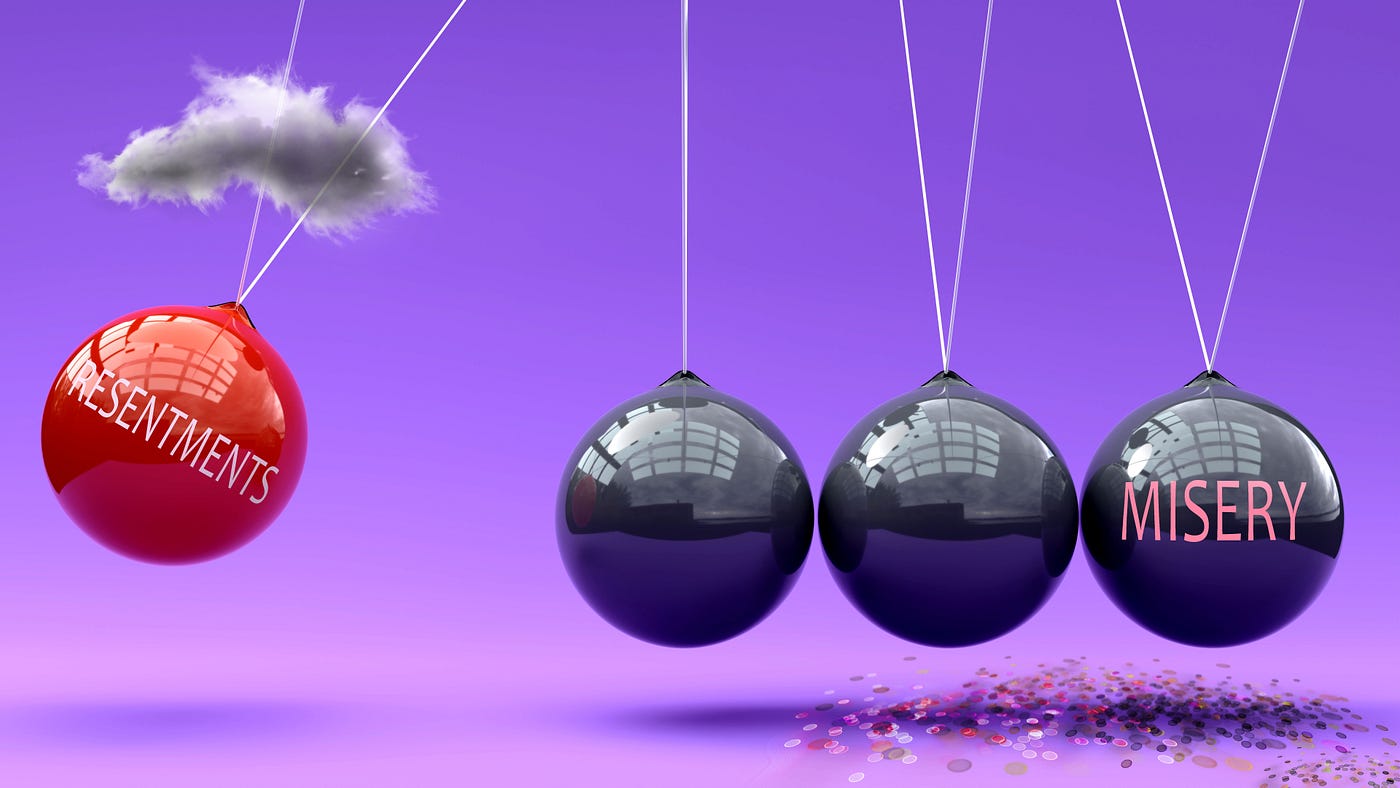
Spouses, partners, family, and friends often spend their lives filled with feelings of resentment toward people past and present who they deem have offended them or have fallen short in some way. Resentment is also one of the biggest wastes of time and energy, and hurts the person feeling it inside and out. Think about it. What good does it do? What ends does it achieve? Who does it change? What growth does it foster?
Today, we will examine resentment and learn what it is, then discuss how to clean out your tank of toxic negative feelings once and for all. Doing this will affect your mental health almost immediately, and that’s good news. Let’s get started.
Expectations are the seeds of resentful feelings.
We humans are born a blank slate, with just our personalities and DNA that are finite. It doesn’t take long for even a dependent infant to be classically conditioned to form expectations of their parent about what they should be doing for them. The baby is determined to survive and will do what it takes to get what it needs. We learn early on that our survival often depends on other people, at least to some degree. As we grow, we’re supposed to meet specific developmental goals, leading us to the will, drive, and motivation to be independent and fly the nest. To say that a considerable portion of the population does not meet every goal is an understatement. Part of a therapist’s job is to figure out where a person is stuck and nudge them toward their next developmental goal. For example, black and white thinkers are stuck before age 11. Age 11 is when our brains can come out of concrete thinking and see the gray. It’s why school gets a bit harder at that age.
For example, the MAGA movement and its leader, Donald Trump, are stuck at the 9-year-old developmental level. They are black-and-white thinkers, compassionless bullies, full of spewing contempt, just like a 3rd grade schoolyard bully. All mean girls and boys are like this … and millions of people are stuck at that same level worldwide. These people denigrate others and are full of expectations and resentment, which is a perfect concoction for self-righteous destruction and condemnation of those different from them.
Add to this that once humans are around other humans, they inherently compare themselves and their situations. Who is stronger, better, smarter, nicer, more attractive, and on and on? I am told that many men who meet size the other person up with the question, “Can I beat him up?” Good God, I am so glad I am not wired like that.
The thing about children, too, is that they are like little narcissists, thinking of themselves all the time. In their families, they’re measuring what’s going on and if they are getting enough through the cognitive abilities they have at the time, which are not deep or complicated. When they don’t get their needs met enough or are slighted in some way, they note it, which can often lead to ongoing resentment. Children aren’t thinking about their situation in the context of empathy or compassion; they are thinking of right and wrong, and some conditions are indeed very bad or unfair, but other times, children misperceive reality and conclude incorrectly that something wasn’t right.
For example, a young child runs out into a busy street. A parent screams, runs after the child, harshly grabs them, and pulls them to safety. Anyone watching this would say the parent did the right thing. For the child, though, they don’t understand that there had been danger. For them, it was a moment of shame and realization that their parent can go off on them at any moment. It instills a cautious and distrustful perspective that changes the dynamic between parent and child.
Regarding expectations, humans tend to assume what others should do for them or how things should be, rather than work it out with the other person. One causes problems, the other doesn’t.
The rule of thumb on expectations is that we cannot have them of others without their agreement. Unilaterally expecting something from someone without their knowledge is a recipe for relational disaster, disappointment, and persistent contempt. A good mother/sister/friend should do X.The unpleasant feelings from this type of thinking are needless from start to finish. People are who they are, and we must accept them the way they are.
Many of our parents should never have had children, that’s for sure. But they did, and we must work with what is, especially as we sort through our complicated feelings about our families as we grow up and get perspective. If we need more or less from them, we may make a request. The other person may not grant our request. If they do grant it, then you may have an expectation. If we are disappointed, we must take care of our wounded self that feels hurt, but to walk away with resentment is on you, not the person who would not grant your request, as their self-care is just as important as ours.
Pierre, the lost child.
Pierre is resentful and walks around with a chip on his shoulder. He resents his family because they treated his brother Andre as if he could do no wrong. His every wish was granted, while Pierre had to work twice as hard to get half as much. If that chip could talk, it would tell you that life is unfair, people suck, and his family played favorites, which is wrong. How dare they? Why couldn’t they love him like they loved Andre? “There’s something wrong with me: my own family member couldn’t love me as much as my brother,” Pierre explained.
Here is the truth about life: Most parents with multiple children prefer one child over another. Inside secret: They usually liked the one who was easiest to raise and relatively low maintenance. They also may enjoy a child more if that child is interested in the same things they are, or surprises them with various gifts and talents. Every child has a different personality, and treating each child the same is impossible. Parents have to adjust themselves for each child. One child needs constant attention, another almost none, and there’s everything else in between.
I was bestowed with a daughter who could not be more different from me, go figure. We don’t get to choose our children at the child department store, nor do they get to choose their parents. We get who we get, and our challenge is to learn patience, and to love them and their love languages, and even those of us who try to get it right fall short, and none of us can guarantee that what we did was enough for any particular child. My daughter is 35 and critiques me on different areas of success and failure as a parent, much to my amusement. I excelled at birthday celebrations and Halloween costumes, and she cherishes that I took them to almost every kid-friendly Broadway play that came to town and blasted show music in the car. I wasn’t so great at loving her cats, listening to her talk about cats, and allowing her to have as many cats as she wanted.
Most parents fret about whether they have done too much or too little for their child. What is enough? Most tell me they could have given a lot more if there had been fewer difficult emotions and chaos that almost every child brings. When my daughter tells me I left her with a babysitter too much, I remind her of the 1258 tantrums she had in nearly every public place in town, once crawling around on the ground wailing underneath a dinner table on the San Antonio River Walk on Mother’s Day. If kids were more cooperative and able to be controlled, we could have all had more time to spend on positive things, except for one little problem…
Unless they are super wealthy or privileged royals with a staff, most parents are completely overwhelmed with life and managing wild and rambunctious children, household chores, careers, friends, and biological family issues. They rarely get enough time for the self-care required to stay in the black mentally and emotionally. This is a breeding ground for children to have bitter feelings and perceive that they were neglected, overlooked, and unvalued. A child may have experienced all those sad things, but it wasn’t because the child was unlovable or unvalued. Most often, the parents were so over their heads with life and responsibilities that they could not give their little ones the nurturing, care, and attention needed.
Pierre firmly believes that his parents played favorites and let him down. Once again, basking in negative thoughts about this hurtful event or that will do no good. It just puts him in a place of expending negative energy over things in the past he cannot control. He now gets to choose: Will he let this destroy him, or will he take that energy and use it for more productive passions? As an adult, he can certainly decide what type of relationship he has with his family. Still, it’s sad to see him apply his resentment about his family environment to all mankind, but that’s what children tend to do. If Dad was unfair, the world is unjust. If you can’t trust mom, the world can’t be trusted.
What is resentment?
Resentment is a harsh judgment stance that is a negative response to wishing that things had been different from what they were. It is the “You should have” disease. Sometimes we are complicit in our resentment. For example, Sue called and asked me to donate to her church’s foundation fund, and I don’t want to, and feel put on the spot, so I begrudgingly agree to donate the money, then I resent having to do that. I resent Sue for putting me on the spot, but the truth is, she had the right to ask. As soon as she asks, I know I will resent donating to that particular thing, so I should set healthy boundaries and say no. It was not Sue’s fault but mine for not saying no. Better put: Never say yes to anything if you resent the person for it. If you will resent them, you must say no. That’s self-care 101. I coach clients so that when their spouse or family member asks them to do something, they only say yes if they can do it with a neutral or happy heart. A neutral heart sounds like this: “Mm, I don’t care about doing that, but I don’t mind doing it, so I can go ahead and agree to do it.” Part of partnership means doing things you’d prefer not to do, but you do it because that’s what being a partner is. Just don’t do the things you will resent. One of the biggest causes of this type of self-created resentment is the human’s propensity to throw themselves under the bus.
About 2500 years ago, Buddha contemplated resentment and other forms of suffering. His purpose was to figure out what would prevent this, and he concluded that desire caused suffering — the desire for things to be different from what they are. We suffer because we are attached to and crave things. In the case of resentment, we desire, crave, want whatever situation it is to be different from what it is. Pierre is filled with the feeling of resentment toward his family for focusing on Andre more, which poisons his soul and ability to enjoy his days. The lens through which he views the world is negative, and he obsesses over past hurts. He can go on living this way, absorbing all the negative energy that comes with it, harming only himself, or accept the family dynamic that he had no power over and could not change, his expectations of them now, the things he learned from it, and the gifts he gained, like self-sufficience, independence, and awareness of the importance of spending time and focus for those you care about.
Buddha said that suffering is part of life and is caused by our attachment to things. He also said that the path to liberation is to cultivate equanimity, or the ability to weather and get through and past the tests, obstacles, and challenges that life always brings every person. Learning ways to be resilient is the key to getting through life. Buddhist philosophy is the basis for many counseling theories, which tell us that peace of mind is attained by accepting things the way they are. Work to change what you can, know what you can’t change, and keep moving toward friendly skies if you don’t like where you are.
Should Pierre address the injustice to his family?
Figuring out the puzzle of why we are the way we are through the lens of our biological family dynamics can be profound and enlightening. A lot of my emotional healing has come from understanding each player in my biological family, and all of the roles we played. As the dynamics became clear to me, I found emotional healing, mainly in learning how to take care of the sad and unprotected little girl I was in the past. I would feel unsafe speaking with anyone in my family about this now, and I don’t need their agreement or validation of my experience.. The only healthy way to approach a family about the things you take issue with is with zero expectations about how they might respond, no intention to blame, and no requirements, such as demands for an apology. Do not do this if you sense you might be injured or further traumatized by anything they might say or do. If you don’t have a solid boundary against what your family thinks or says about you, this exercise is not for you. The purpose of the conversation is for your healing purposes only. Here’s a plan for how to do it:
You state: I know this happened. I don’t need a response or defense; I just wanted to acknowledge what happened.
When I did this with my late mom about 10 years ago, she was 97 and completely with it. I explained to her what I had realized about her not protecting me as a child and why, and told her I didn’t expect anything from her, I just wanted to share what I had come to understand. To my surprise, she said, “Yes, I did that, and that’s why I did it.” That blew me away. “God — it was intentional,” I said to myself. “She knew she was putting her love addiction over her children.” That was one of the most insightful moments of my life. I would never have to wonder again whether she was just clueless or in on it.
At the same time, I am not all up in my negative judgment about her choices. I have a lot of compassion for a woman born into a patriarchal world in Arkansas in 1919. She lacked confidence and had no place to get it. Her survival plan was to marry and be supported by as good a man as she could find. She was utterly dependent on her husband, my dad. She had to default to choosing him over anything else because she would never be able to support herself or her children, even though he abused his power by cheating on and demanding servitude from her, while also being abusive to their children.
Life beyond resentment.
The work of Byron Katie, author ofLoving What Is,has gone a long way in helping me learn how to process the bad deeds of others, whether intentional or not. She informs us that people are flawed, self-centered, unaware, critical, and all sorts of negative things. That is human nature, so why are we surprised when they act in any of these ways? We can say, a mother should … a father should … a sibling should … a spouse should… a work colleague should… a friend should… and on and on, but that doesn’t change the fact that many humans didn’t or won’t do what they should, people mistreat one another, and we can not fix or change that. We can let the thoughtless deeds of others take us down mentally and emotionally, or rise out of it and move forward to whatever successful outcome we choose. The irony is that most of the things humans do that we can’t stand are done ourselves. After reading Katie’s work, I thought, “I’m just going to be surprised by humans only when they do the kind, generous, or gracious thing, not when they disappoint.”
We have to be able to heal from slights and abuses without our abuser’s participation. To sit in your self-righteous indignation about what a person did or did not do, and wait for them to repair, is beyond ridiculous. Don’t get me wrong, repairs are a wonderful thing, the best thing, but how often has a family member or friend come to you and instigated a heartfelt repair, expressing awareness of their mistakes, regrets about that, and wanting to make amends? I made it a point to do that with my children when I learned how crucial it is, but my parents never did it for me. My kids responded with grace and forgiveness. I try to imagine what it would have been like if my parents had done that, and I get the sense that it would have been cathartic.
I find forced apologies meaningless and wonder why so many people wait around hoping for or demanding one. If a person doesn’t understand that they were out of line, didn’t do enough, weren’t there for you, or failed to see whatever you wanted them to see, then what good is their expressing forced regrets about it?
Resentment is a creation of the ego, and the ego does us no favors. The way to escape the pain of others’ shortcomings is to unhook yourself and let go of resentment, while realizing that your unworthiness didn’t cause it, but their inabilities, and we all have those.
Breaking Free From Narcissistic Abuse
Forks — A podcast about forks in the road
The D Shift with Mardi Winder-Adams
Pam Perry
https://www.youtube.com/live/FzNpoMkDPcg?si=n-GO4zApV9uVtDQp
Couples Therapy in Seven Words w Bruce Chalmer
https://youtu.be/IkZpxRxLM8Q?si=UudwcleRqkAekDyd
Pacific Cascade Legal
https://www.youtube.com/live/NCKOVt9sR8s?si=4DjhbexDtqe50zjf
Shake it Off with Mert and Lucas
https://youtu.be/EM6-0lLxZr0?si=86eIZMcPkFS5DXuF
Becky will start in June 2025, with weekly drop-in support groups for those in serious marriage trouble or crisis. Join us for information and support; you’ll be glad you did. For more information, visitMarriageCrisisManager.com.
She is a former features writer and columnist for the San Antonio Express-News and is the author of“I (Think) I Want Out: What To Do When One Of You Wants Out,”published by HCI Books, distributed by Simon and Schuster.
She has worked with thousands of couples to save their marriages. She can also work with you as a life coach — she is a licensed therapist in Texas and Arkansas. She also has aYouTube Channel called Marriage Crisis Manager,where she talks about relationships. She has a private telehealth practice as a therapist and life coach via Zoom.
Becky is looking for individuals who are thinking about divorce, people who are cheating, and couples in crisis, or people with amazing personal marriage crisis stories to tell, to appear on her video podcast. For information, contact Becky.
WORKING WITH ME
I’m Dr. Becky Whetstone, a licensed marriage and family therapist and America’s Marriage Crisis Manager®. I’ve spent nearly 30 years with people at the worst moment of their marriage.
I work with clients everywhere by Zoom. If something in this post hit close to home, here’s where to start.
My book: I (Think)I Want Out: What to Do When One of You Wants to End Your Marriage — Read the whole framework, in order, at your own pace.
Appointment: 90-Minute Marriage Crisis Consultation — Bring me your situation. You’ll leave knowing what stage your marriage is actually in and what to do next.
Relationship University — Live classes and a private community for people who’d rather understand relationships than keep guessing.
Quiz: What Stage Is Your Marriage In? — A free 10-question quiz.
Note. Becky is an Amazon affiliate and may receive a small percentage if you purchase a book from her links, at no extra cost to you.