Your Marriage is a Partnership.
Does Your Spouse Know That?
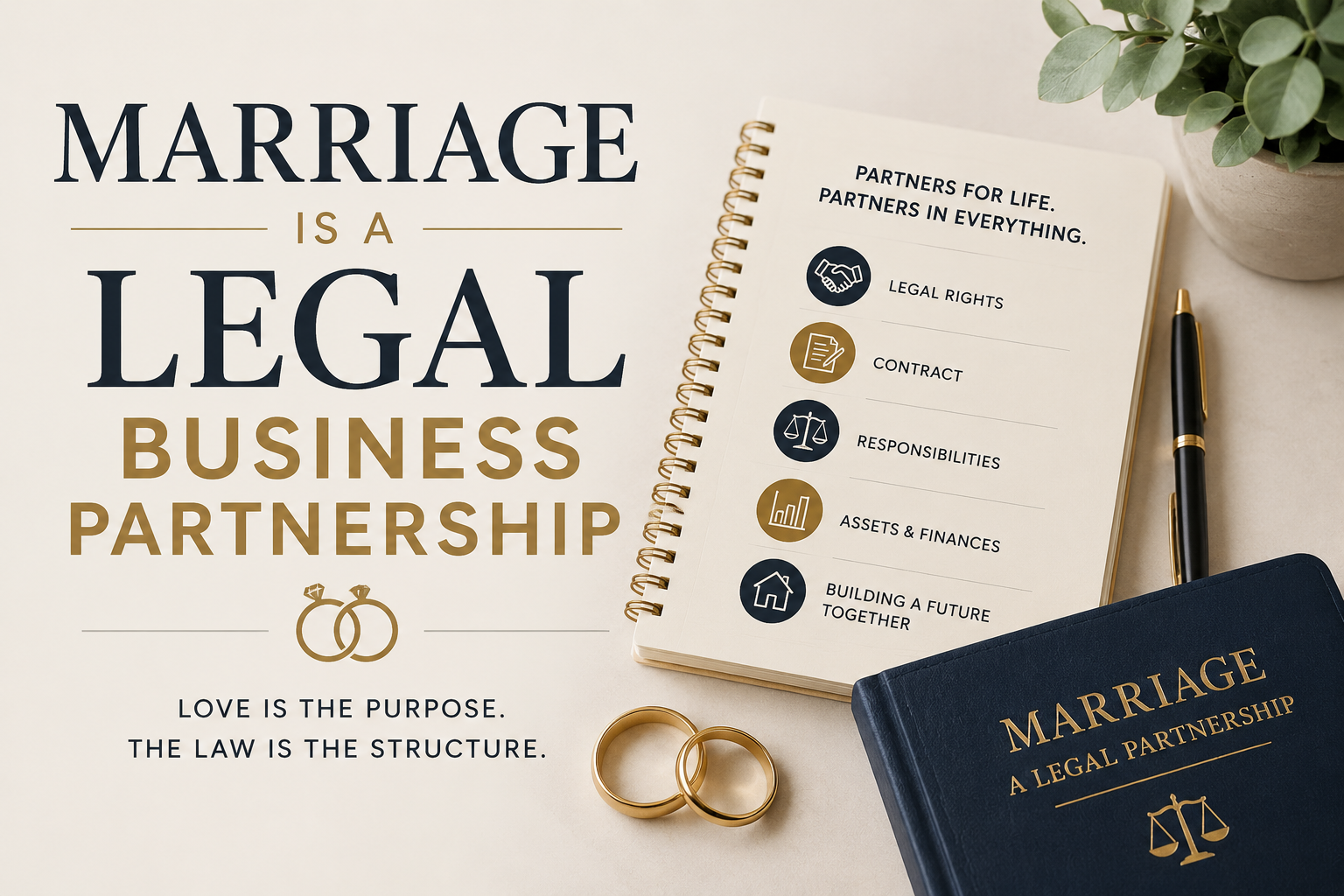
Marriage is a partnership — a legal and financial one — and almost nobody talks about that part before the wedding.
People fall in love and get married. But does anyone stop to think that marriage is also a business agreement, in which two people form a legally binding partnership that can only be undone through the court system?
I think about this a lot because I work with many people who are considering divorce or are in the process of getting one. Time and again, the partner who makes the majority of the money bitterly laments that they may have to fork over a significant portion of what they have made if they go the divorce route.
“I don’t see why I have to hand my partner half when I am the one who did all the work and made most of the money we have,” is a frequent cry.
“They weren’t the one who went to graduate, medical, or law school, built a company, designed that software, blah, blah.”
I do empathize. I wouldn’t care to hand over half either, or, heaven forbid, pay my former spouse a monthly support payment so they can maintain the lifestyle they enjoyed while married to me. But if I chose to marry legally, I also chose to enter a legal and financial partnership that protects both spouses equally, with laws meant to keep things fair, even though some things may not always seem fair.
Here are some things I wish couples considering marriage would consider.
1. Marriage is a partnership even when people don’t treat it like one.
As I said, you may have married your partner because you were madly in love and wanted them in your life forever. You wanted children with them and a family. Maybe you are religious and wanted God and your traditionally minded extended family to condone your union.
That’s all good, but what the marriage license you file at the courthouse means is that you are willingly agreeing to become legally and financially connected to another person for the foreseeable future and, in some ways, possibly for the rest of your lives.
If you think of a marriage as a country, like the United States, there are — or ought to be — two co-presidents who operate and manage the family equally, negotiating which person will oversee which roles in keeping the family afloat.
One partner may be secretary of the Department of Business and Finance, while the other is secretary of Household Duties and Child-Raising.
There are endless ways to divide responsibilities, but in a healthy family, both partners should negotiate how the responsibilities of running the household will be divided up, how major decisions will be made, and how the household will operate.
In healthy business partnerships, contributions do not have to be identical to be of equal value.
Did you read that? Do you understand it? If not, you need to.
One person may make 10 times what the other does monetarily, while the other stays home with the children or manages the household because the first partner works too many hours to contribute equally there. The contributions are different, but that does not mean one is worthless and the other is everything.
Where couples go wrong time and again is valuing income more than the nonfinancial contributions the other spouse makes. Often, the person making the hefty financial contribution assumes they get more power or say than the other, creating innumerable power struggles and arguments over domination and submission.
So, one might ask: If two people started a company together, with one in charge of sales and the other handling operations, would you think only the person making sales actually built the company?
If they dissolved the company, should the salesperson automatically get more?
2. How to hear someone’s model of marriage in the Words They use.
I can get a sense of where a spouse stands on marriage as an equitable partnership simply by listening to the language they use.
Some spouses refer to their partnership and various aspects of their marriage using words such as we, ours, and us. They think in terms of mutuality and what is fair for both.
These people are usually commitment-oriented and take marriage and the enormous promise it involves seriously. They think relationally, using language that expresses a sense of couplehood and partnership.
How Terry Real Changed My Practice.
Famed marriage and family therapist Terry Real, author of Fierce Intimacy, The New Rules of Marriage, and Us, has built his career around this concept. He calls his trauma-based model of couples therapy Relational Life Therapy, or RLT.
Therapists who work with couples also notice this kind of language.
When our relationship first became serious, my husband immediately started using relational terms, which caught my attention and meant a lot to me – not a red flag, but a green light. I am not sure anyone I have ever had a serious relationship with has spoken to me, or about us, using relational language.
Just listening to him talk to other people on the phone, it was clear he thought of us as a unit.
This doesn’t mean his or my own identity or self doesn’t exist or have a strong presence. It does. But at the end of the day, it’s us against the world, and we have each other’s back.
The Dictatorship Model.
Then there are spouses who get an eyebrow raise from me in our sessions because they never speak in relational terms.
I have told some spouses that the way they speak about the relationship and conduct themselves in it sounds more like a dictatorship.
It’s how I imagine North Korean Supreme Leader and dictator Kim Jong Un might speak in marriage therapy:
It’s my money. My house. My children. My birthright. It’s all mine. I worked for this. I can do what I want. You can’t tell me what to do. The property is in my name. You’d have nothing without me.
The Medicaid Model of Marriage.
Then there is what I refer to as the Medicaid model of marriage, in which one spouse is completely dependent on the other in virtually every way.
I am sad to say, my mother signed up for this arrangement with my dad.
My mother was a dependent adult, and her self-esteem was on the floor. She finished high school, briefly attended junior college, and her only job was selling tickets at the movie theater. Her plan for survival was to become the caboose attached to a financially solid male engine, which was quite common in the 1940s.
When I once asked her why she chose my dad, she said, “Well, he was 27 and a lawyer.”
That was a big deal in the post-Depression-era South of the 1940s.
To her, marriage was like a benefit program. She would provide sex on demand to her sex-addicted husband, who would ultimately humiliate and cheat on her for more than 60 years. She would have to raise the children, cook, and run the household from a position of servitude, and accept whatever he chose to give her.
He provided money, a home, a car — and that’s about it.
In my memoir, The Congressman’s Wife, I talk about my congressman husband Charlie’s oldest brother, Henry, who was a blatant misogynist, stuck in patriarchy and autocracy, and was the ultimate Medicaid husband.
Though he was a trial attorney, lived in a flashy house in the Monte Vista section of San Antonio, and had three children with his second wife, who was a stay-at-home mom, he didn’t allow her to carry money.
Every time she went to the grocery store, she took a blank check. She had to call his office, report the cost of the groceries, and he would either approve her filling out the check or not.
She told me how jealous she was of me because I could support myself and had my own money, and I remember thinking, “Woman, it is you who chose not to work and marry the little dictator.”
In dictatorships and Medicaid models of marriage, there is little concept of reciprocity or us, yet millions of men and women sign up for arrangements like these all over the world.
Often, the only explanation I can come up with is that they believe they have few other options for surviving as adults.
3. Is a Healthy marriage 50/50? Why I Prefer 100/100.
I don’t believe a healthy marriage is 50/50. I have an aversion to it because I envision a couple with spreadsheets trying to figure out what percentage they gave last month.
I prefer the 100/100 model, in which each person gives their all, is generous and helpful to the other, and isn’t constantly keeping score.
Some couples I work with literally keep receipts and ledgers and divide everything straight down the middle or according to the percentage of income each person brings in.
They may share a credit card, for example, but if one spouse spends more than expected, the other expects that spouse to pay the overage.
I don’t know about everyone else, but even though my husband and I use the same card for groceries and family items, sometimes I pay for them myself.
I would never keep a ledger of what I do or present him with a bill because I think that when I contribute to us, I am giving to him and to myself.
It’s all the same.
A marriage of equality is one in which each partner has equal standing, an equal voice, mutual obligations, and shared consequences when issues arise that affect both of them.
Sometimes one spouse may carry most of the marital obligations, and sometimes the other way around.
A healthy marriage can’t be 50/50 in everything every day.
Equality also does not mean enmeshment, tit-for-tat, your turn, then my turn. A healthy marriage still has room for mine, yours, and ours. Each person remains an individual with a right to autonomy.
The problem begins when mine consistently outranks ours — or when ours is used to erase yours.
4. What Divorce Reveals about How Your Partner Sees the Partnership.
An old cliché fits perfectly here: Divorce is where the rubber meets the road when it comes to how someone thinks about the marital partnership.
In my book, I (Think) I Want Out: What to Do When You or Your Partner Wants to Leave Your Marriage, I coach those who don’t want to divide their estate according to the law, pay what the law requires, and move on.
I say, “Guess what? She is going to say no. So, save yourself from being seen as a self-centered asshole and deal with what she is legally entitled to.”
“But what about my retirement?”
“She has to think about her retirement, too. And you have far better future monetary prospects than she does. If she is smart, she will be thinking about her survival right now, just as you would if the situation were reversed.”
It begs the question I originally asked: Did he not understand that signing a marriage certificate meant giving his spouse major legal rights to assets accumulated during the marriage if they ever divorced?
Sure, he did.
But he was in love and wasn’t thinking about the business side of the marital bargain.
5. Prenuptial agreements: When They Protect You and When They Don’t.
I usually recommend prenuptial agreements because the terms of a marriage can be tailored to a couple’s beliefs and values. Each person can make sure they are protected in whatever ways they agree upon, and it is all written down while the relationship is strong and each partner thinks the best of the other.
When I met my husband, he had just come out of a costly divorce after 25 years of marriage. Feeling depleted, he didn’t want to deplete himself any further, so if he married again, he wanted a prenup. I completely understood.
Further, I didn’t want him to live in fear that I would ever want him to support me should our marriage not make it, so I signed it. I always wonder about those who refuse to sign. Is that not a red flag that they may not be thinking relationally?
But prenups can go wrong.
Meet Rebecca, a client married to Charles, a self-centered, controlling, and domineering man. After over 30 years and three children, she was sick of living under Charles ‘ control and was contemplating divorce.
She told the story of falling in love with him as a young woman, becoming pregnant and, as conservative Christians living in the South, deciding to marry.
He told her he would not marry her unless she signed a prenup, so she did.
During their marriage, he accumulated more and more assets; his empire grew into a multimillion-dollar dynasty. In theory, if Rebecca divorced Charles, she shouldn’t have to worry about finances for the rest of her life.
During divorce negotiations, he pulled out the document, and lo and behold, she had signed away virtually every right she might otherwise have had in a divorce.
She was forced to walk away with essentially nothing, though Charles gave her a little bit to get on her feet. When I heard how much it was, I felt sick.
He got the house, the furniture, the assets, the business. She drove away in a new, large SUV with her clothes.
You would think the law would protect a young, pregnant Southern woman who was ignorant and asked to sign a prenup under duress. She didn’t even know enough to hire her own lawyer to review the document back then, and after months of agonizing divorce negotiations, feeling exhausted and spent, she decided not to fight for more, though I had begged her to.
Her husband clearly grasped the power imbalance involved, did not care or feel bad about it, and because of this, he goes down in Becky’s marriage therapy practice history as one of the least relationally minded people I have ever met.
6. “Everything is in his name?” What This Actually Tells You.
I have heard this one at least a thousand times.
The spouse who buys things while married and puts everything solely in their own name frightens the other spouse, who wonders why.
Often, it’s because they don’t think relationally.
They don’t see themselves as being in a partnership.
What’s his is his, he thinks. If he paid for most of it, it’s his.
I tell the worried spouse that having one person’s name on an asset does not necessarily determine how it will be treated in a divorce. But the fact that someone insists on putting everything in their own name can still be very revealing.
It reminds me of an animal marking its territory.
It tells you something about how that person thinks about the marital partnership. I know in some cases it is the smarter thing to do tax-wise or whatever, but I’d only be okay with it if both my spouse and I agreed, but that’s not usually how it goes down.
Other people with this territorial mindset have been known to have secret bank accounts or sock away money and property in places their spouse may never find.
I remember a wealthy and popular architect in San Antonio who always brought the tax return to his wife to sign, with everything covered up except the signature line.
Who does this, right?
But also, who would tolerate it?
Transparency is closely associated with relational health.
Secrecy is, well, very telling.
Fortunately, in the digital age, forensic accountants can function much like private investigators for bank accounts, investments, and assets.
It’s sad, though, that anyone should need one because of the person they married.
7. I married him when we had nothing. When Money and Power Change People.
Money and power attained during marriage can reveal the truth about who people really are.
If a primary breadwinner with a fragile ego suddenly rises through the ranks and becomes wealthy and prominent, they may let it go to their head and begin exploiting that success in the marriage.
They may have felt like partners before.
Now the successful spouse says:
“I make more, so I get more say.”
Or:
“Why aren’t you grateful and appreciative for all that I provide you?”
On the other hand, the lower-income spouse may interpret the new influx of cash as meaning they no longer have to contribute anything.
All sorts of things can go wrong when success and money change how a person thinks about the marital partnership.
8. The hostile spending arrangement: When One Spouse Takes and Never Invests.
It isn’t always the higher-income partner who has trouble thinking of the marriage as a business partnership.
I’ve met plenty of people whose philosophy seems to be, “What’s mine is mine, and what’s yours is mine, too.”
I guess that’s fine if both spouses genuinely agree to such an arrangement.
Most of the people I meet like this make significantly less than their spouse and expect the higher-earning one to pay all the bills while they contribute nothing financially. Then whatever money they make is to spend as they please.
Spouses on the short end of this financial stick often mention it in sessions. On one level, they are proud that they can afford to be so generous, but on the other, they often say their partner, with the sweetheart deal, is unrestrained in how they view money and spending, and they feel disrespected and taken advantage of.
The sweethearts may make major purchases without consultation, insult the other partner for asking about it, avoid or refuse meetings to address their spouse’s concerns, hide financial information and credit card accounts, make unilateral decisions, threaten to leave whenever challenged, contribute as little as possible while extracting maximum benefits, and treat compromise as losing.
I had a friend in San Antonio who used to fill her car with packages from the department store on a secret credit card she was running up. Before entering the house, she’d go through every bag, cut the tags off, and take them straight to the outdoor trash can, hidden in an opaque sack, then sneak the things into the house when her husband wasn’t there.
“Then, Ron asked me if the pants I was wearing were new, and I said, no, I have had them,” she explained. “But what I didn’t tell him is that I had owned them for at least 24 hours, which doesn’t qualify them as new.”
Ah, honesty on a technicality. Jeeze.
But in marriage, it’s dicey, especially when children are involved.
In all the years I have worked with couples, I have rarely seen people with a chronic, reckless disregard for family finances simply become healthy, balanced financial partners. Many of these types have character disorders that prevent them from seeing life in any other way than how they currently do, and no household budget or attempt at restraint is going to fix that.
It is never too late to form a mutual partnership, the way marriage was meant to be.
Often, when I work with couples contemplating marriage, I have them negotiate and write down an operating agreement and a mission statement for the union.
Just like a business.
If you are already married, it isn’t too late to do this exercise.
To formulate an agreement, I have couples sit down together and ask each other these questions:
The Marriage Operating Agreement: 13 Questions to Ask Each Other.
What is marriage to you? What is it for?
Do you see marriage as an equal partnership? Why or why not?
What do you believe you owe your spouse?
What do you believe your spouse owes you?
Who gets to make decisions in this partnership? What happens if you disagree?
What does earning more money entitle someone to, if anything?
When one or both of you earn income, whose money is it? How will you divide expenses?
What do equity and equality mean to you in a partnership?
What responsibilities come with being financially supported?
What sacrifices are you willing to make for the partnership?
Do you value contributions to the family that are not monetary?
When your interests and the marriage’s interests conflict, what happens?
If your marriage ended tomorrow, what would you believe you were entitled to take with you — and why?
I am not asking you to run your marriage like a corporation.
But in many ways, a good marriage operates on the same principles as a good business partnership.
Good partners communicate. They are transparent. They disclose relevant information. They consult one another. They honor agreements. They don’t exploit power imbalances. They understand that their success isn’t the result of one person alone, but of the health and success of the entire system.
They don’t continually take distributions while refusing to invest.
It’s Not a Communication Problem. It’s a Partnership Philosophy Problem.
A lot of marital conflict that gets labeled a “communication problem” is really a partnership philosophy problem. Two people with opposing beliefs about what a marriage and family is.
You can teach somebody reflective listening until the cows come home in marriage therapy.
If, underneath everything, he believes, “I earned the money, therefore I should decide how it’s spent,” communication training doesn’t solve it.
If she fundamentally believes, “If you loved me, you’d take care of everything I want,” communication training doesn’t solve that either.
They aren’t failing to communicate.
They may be communicating their beliefs perfectly clearly.
And that brings us to what people need to do:
Stop arguing only about the latest incident, and identify the underlying belief about marriage.
Then determine whether both people are willing to replace dictatorship, dependency, or rugged individualism with genuine partnership.
And ask yourself one final question:
If you wouldn’t accept this from a business partner, why have you decided it’s acceptable from a marriage partner?
WORKING WITH ME
I’m Dr. Becky Whetstone, a licensed marriage and family therapist and America’s Marriage Crisis Manager®. I’ve spent nearly 30 years with people at the worst moment of their marriage.
I work with clients everywhere by Zoom. If something in this post hit close to home, here’s where to start.
My book: I (Think)I Want Out: What to Do When One of You Wants to End Your Marriage — Read the whole framework, in order, at your own pace.
Appointment: 90-Minute Marriage Crisis Consultation — Bring me your situation. You’ll leave knowing what stage your marriage is actually in and what to do next.
Relationship University — Live classes and a private community for people who’d rather understand relationships than keep guessing.
Quiz: What Stage Is Your Marriage In? — A free 10-question quiz.
Note. Becky is an Amazon affiliate and may receive a small percentage if you purchase a book from her links, at no extra cost to you.