Gamma Brain: Why Your Partner Snaps When You Interrupt Them
No, (in this instance), your partner is probably not an impatient asshole.

I consider myself a hard-working woman, and I do it because I love it. Not only do I write blogs and books, but I also run a successful marriage crisis coaching business, from marketing it to seeing clients, with no secretary or assistant. The only one around is a retired husband upstairs who comes down to the basement business lair several times a day to interrupt whatever I am doing.
I can’t get the printer to work.
Did you call the accountant?
Didn’t you buy sandwich meat? I can’t find it.
Can you help me lift this heavy thing and take it out to the garage?
What’s the password and the last four of your social?
His head peaking over my computer screen breaks my concentration. I am mid-paragraph into writing the best sentence of my life, my brain firing like literary rockets, chemicals excreting creative juices at the highest level, and he interrupts the flow.
I want to strangle him. Not really, but almost.
In this total concentration mode, aka ecstasy, I usually hear nothing. I infamously had to be asked to leave my desk in the San Antonio newsroom when remodeling of the building began, and a jackhammer began tearing out the floor, because I didn’t hear it.
My children complained constantly about my deep concentration. I could be in the kitchen thinking about something, and they could be standing right next to me speaking, and I wouldn’t know it.
The brain state I am speaking of is what I have come to know as the gamma brain. It is time everyone learned about it and what to do when their co-worker, friend, family, or partner is in that ultra-high-level creative state, sometimes called “the genius brain.”
The unnecessary interruption of my creativity doesn’t sit well with me.
“I gave you a list of passwords and my social security number? Don’t you still have it?”
“Yes, but it’s quicker just to ask.”
“I gave you the list so you wouldn’t have to.”
It’s not just me. Couples will come in and give me a list of complaints, and interruption is often on the list.
“He snaps at me when I interrupt him when he’s in the middle of a home project.”
“Of course he does,” I say. “He was in gamma brain, and the worst thing you can do to a person in that brain state is interrupt them.”
Some people easily attain gamma and can return to their tasks in a few seconds. Others find it takes a little while to work up to it, so an interruption is often a bigger deal. It’s that, “Let me get my mind on what I am doing,” state.
I tell my husband, “Let me work downstairs as if I were in an office on the other side of town. Please don’t interrupt me unless it is a major emergency. During the day, I’ll come upstairs for a break, lunch, whatever, and you can ask me questions then.”
How many times does a spouse have to say in an exasperated tone, “I am in the middle of something,” before the other person understands?
We would not interrupt Picasso mid-paint stroke.
We would not have the audacity to walk into a brain surgery and start talking to the surgeon, whose knife is slicing into the organ, and say, “What is our bank password?”
So I have come to realize over time that the people in our lives value what we do less than those with what they consider to be truly important jobs.
In these scenarios, you can clearly see two different perspectives: Both people are sure the other one is the problem. The interrupter thinks the snapper is contemptuous. The interrupted thinks the other person is oblivious and disrespectful. Neither one is entirely right, because what just happened isn’t really about manners. It’s about brain waves.
What Gamma Brain Actually Is
Your brain runs on electricity, and that electricity moves in waves. Scientists sort those waves by speed. The slow ones, delta, appear at the bottom, or lowest, level of brainwaves and indicate you are in deep, dreamless sleep. One level up from there is a little faster, theta, the drifty state right before you fall asleep, where daydreams and strange ideas come from. Theta is the brain wave we hypnotherapists aim to get our clients into by helping them relax and engage in peaceful visualizations. Theta is where the subconscious mind is found; the brain is highly suggestible here and can also offer answers to deep questions about our lives, often things we don’t consciously remember.
Faster still, alpha is calm, relaxed wakefulness, the easy idle. I think of it as the chill channel. Interestingly, people who self-medicate anxiousness with marijuana don’t realize that what they are doing is taking their anxious brain out of beta, which is the next level up from alpha, where our conscious mind is located, and down to the alpha-theta state, where there literally are no worries.
Then beta, the fast, alert, get-things-done state where most of your waking life happens. This is where all of our thinking, worrying, and anxiousness are found.
And then there’s gamma. The fastest of them all.
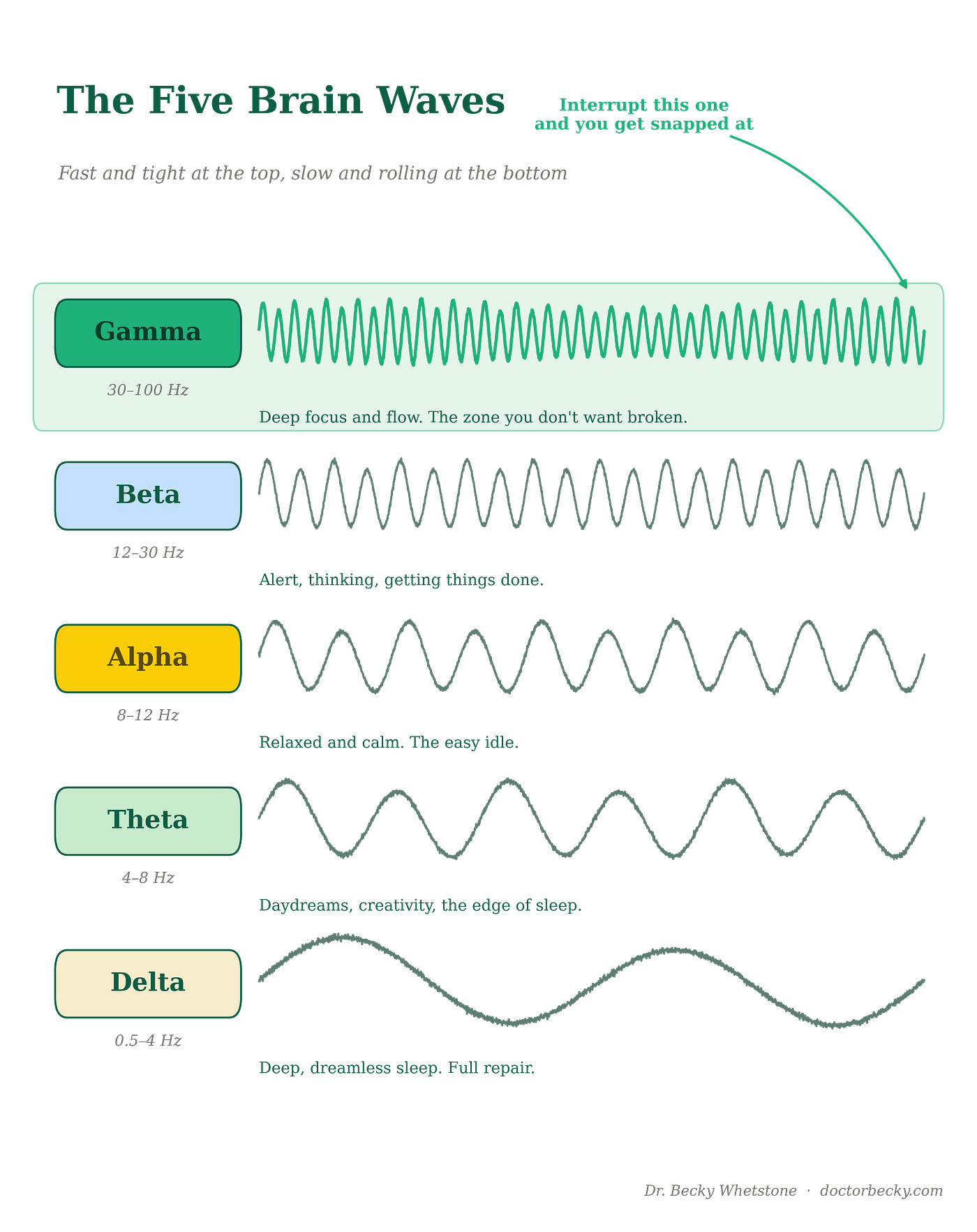
Gamma signals the brain is firing on every cylinder at once. It’s what’s happening when you’re so absorbed in something that the room disappears. Deep reading. Hard writing. A concentrated, focused trance. The surgeon mid-operation. The kid building Lego who doesn’t hear you call him for dinner four times. It’s the closest thing the brain has to a flow state, and here’s the part people don’t realize: it feels wonderful.
I know it firsthand. When I’m writing, and the words are coming, I’m in gamma, and I love it. It’s the best feeling I get all day. I often end up at the same place when I read. So, when someone walks in and breaks it, I don’t feel a mild flicker of irritation.
I feel robbed. Grabbed by the shoulders and pulled out of my bliss into the cold, cruel world where questions and problems exist. My whole system was humming along in a rare, gorgeous gear, and someone yanked the wheel.
“Have you seen the cord to the floor fan?”
The voice in my head says: “Are you serious?”
That is gamma brain. And once you understand it, your partner’s rudeness stops looking like cruelty and starts looking like a nervous system getting whiplash. It might be something you can come to understand and be mindful of.
My family knows I don’t hear when I am reading or writing. I have asked them not to speak to me without first getting my attention, so I won’t come off as if I don’t care to listen, which is not the truth. I do want to hear what they say, and I do care, so when they speak, I want to be sure I’m paying attention. In gamma, I am in a state where I am incapable of hearing.
Why Is the Snap So Sharp?
Coming out of gamma isn’t smooth. You can’t pop out of deep focus and land gently in a pleasant little chat about the plumber. I liken it sometimes to getting a cold bucket of ice thrown over my head without knowing it was coming. The brain has to slam on the brakes and change gears, and that hard stop comes out as a spike of irritation. The closer to the good stuff the person in gamma is, the harder the yank, the nastier the snap. He’s not snapping because he stopped loving you at two o’clock on a Tuesday. He’s snapping because you caught him at nine thousand RPM, and he couldn’t downshift in time.
That’s the explanation. Now here’s the part where I stop letting him (and myself) off the hook.
An Explanation Is Not a Permission Slip
Gamma brain explains the snap. It does not excuse it. You are allowed to be deep in your work. You are not allowed to bite the head off the person who loves you because they asked you a question. Plenty of people feel that spike of irritation and manage, in the half-second before they open their mouth, to not be ugly about it. That half-second is the whole ballgame.
So, if you’re the one who lives in gamma, you owe your partner a signal. Headphones, a closed door, and a simple “I’m heads-down till three.” Tell your partner the gear you’re in before they walk into it blind. Don’t make them guess.
You owe them a soft landing. When you feel the snap rising, buy yourself that half-second. “Give me two minutes and I’m all yours” costs you nothing and saves you a fight. You’re not obligated to drop everything. You are obligated not to be cruel.
And you owe them a repair. If you do snap, and you will, come back and fix it. “I was short with you, and that wasn’t fair. I was just deep in gamma.” takes ten seconds and keeps the cold thing from settling in.
As for me, my husband and I have had this conversation, so he knows about gamma. That’s all I have to say. “I am in gamma,” and he gets it right away.
And if you’re the one doing the interrupting, you get homework too. Learn your partner’s rhythms. A person in flow at their desk is not the moment to say, “We need to talk about your mother.” But hear me on this: “he was concentrating” is not a life sentence that requires you to absorb rudeness forever. A decent partner who snaps owns it afterward. If yours never does, if every interruption is your fault and the snapping is just who he is and you should know better by now, that is not gamma brain anymore. That’s contempt wearing gamma’s coat.
When It Stops Being Gamma Brain
Here’s the trap. Gamma brain is real, and it’s a genuinely useful idea, and a marriage in trouble will use it as cover. The snapping that used to come only when he was truly absorbed starts showing up everywhere. At the dinner table. In the car. When you ask what he wants for his birthday. The “I was concentrating” excuse stretches to cover behavior that has nothing to do with concentration.
When that happens, you’ve left the territory of brain waves and entered the early stages of a marriage coming apart. In my work, I track marriages through stages of deterioration, and chronic contempt dressed up as “leave me alone, I’m busy” is one of the clearest early signals that something deeper is wrong.
Contempt has nothing to do with gamma brain. It is the lowest of the low when it comes to human behavior in marriage. It reveals a loss of respect and an overdrawn emotional bank account. I tell clients, for me, it is a sign that the marriage has metastatic cancer. It won’t be cured, but it can be managed. Maybe. But not if the contemptuous person doesn’t change their stance.
To know whether a person is in gamma or just being mean, ask the real question. Do they snap when genuinely deep in something, and do they come back and make it right? That’s gamma brain, and you can work with it. Or does he snap whenever he likes, blame your timing, and never repair it? That’s something else, and no amount of tiptoeing around his concentration is going to fix it.
The Question That Actually Matters
You don’t argue with a brain in the wrong gear. You wait for it to shift, you learn to read it, and you ask for the basic decency of a soft landing and a real apology. That’s a solvable problem, and most couples can solve it once they understand what’s happening under the hood.
But if you’ve read this far with a sinking feeling that the concentration excuse stopped being true a long time ago, take that seriously. That’s the conversation I have with couples every day. If you’re not sure which one you’re living in, that’s exactly what a Marriage Crisis Consultation is for, and it’s a lot of what I wrote about in my book, I (Think) I Want Out: What to Do When One of You Wants to End Your Marriage.
Your partner’s brain runs on waves like everyone else’s. The question is never just whether the person snapped. It’s whether, once the gear shifted, they turned around and treated you like someone they love.
Here’s an article you might also enjoy: https://marriagecrisismanager.com/marriage-is-a-partnership/
WORKING WITH ME
I’m Dr. Becky Whetstone, a licensed marriage and family therapist and America’s Marriage Crisis Manager®. I’ve spent nearly 30 years with people at the worst moment of their marriage.
I work with clients everywhere by Zoom. If something in this post hit close to home, here’s where to start.
My book: I (Think)I Want Out: What to Do When One of You Wants to End Your Marriage — Read the whole framework, in order, at your own pace.
Appointment: 90-Minute Marriage Crisis Consultation — Bring me your situation. You’ll leave knowing what stage your marriage is actually in and what to do next.
Relationship University — Live classes and a private community for people who’d rather understand relationships than keep guessing.
Quiz: What Stage Is Your Marriage In? — A free 10-question quiz.
Note. Becky is an Amazon affiliate and may receive a small percentage if you purchase a book from her links, at no extra cost to you.