
How to Complain to Your Partner Without Damaging Your Relationship.
Diplomacy is the Only Way to Get Most of What You Want in Marriage.

People love to bitch, gripe, and complain, and most never learn how to do it in a way that can actually be heard. When I say heard, I mean delivered in a way that a partner can calmly and respectfully receive and respond to what is being said. It’s all in the timing, tone, and delivery of the message as to whether your words will be taken seriously and get the response you desire.
Surely all of us have experienced delivering a complaint in a way that got either zero response, an eyeroll, a laugh, repudiation, or a defensive diatribe that told us that getting anywhere with the person was not possible, at least in this moment. When people tell me they can’t communicate, this is what is happening, pure and simple.
Josephina is proud that she speaks out when she has a problem, but the way she delivers her messages comes across as an attack on her husband, Mathew. What should have been a minor, solvable issue becomes a fight, a withdrawal, or a shutdown because she usually delivers her messages with the grace of an angry gorilla.
Complaining is not the problem.
It’s how we complain that determines whether our relationship grows or erodes.
As a marriage therapist, I teach my clients that complaining, done well, is actually a tool of intimacy. It’s how we keep the relationship honed over time, as we adjust to one another’s quirks and sensibilities. By communicating and respecting one another’s reasonable requests, we feel aligned, heard, respected, and emotionally safe. But when a complaint slips into criticism, everything breaks down, and as it continues, frustration and resentment seep in.
So, let’s talk about how to bring up an issue in a way that your partner can truly receive — without defensiveness, fear, or backlash.
The Difference Between Complaining and Criticism
This distinction is the foundation of healthy communication. It may be the most crucial thing you could ever learn about communicating in relationships, and people who don’t understand the difference between these two end up doing damage that was never intended.
Criticism attacks the person:
- “You’re so lazy.”
- “You never listen.”
- “What’s wrong with you?”
The person saying it is in a one-up position, talking down to the second person, like a parent to a naughty child, or a judge at an inquisition. It labels, blames, and implies that there is something wrong with your partner as a human being. Criticism doesn’t give someone a path forward — it corners them into shame or counterattack.
Complaining, on the other hand, addresses a behavior and a person’s experience of that behavior:
- “When the dishes are left out overnight, I feel overwhelmed in the morning.”
- “When you walked away while I was talking, I felt dismissed.”
Complaints are specific, respectful, and about the issue — not the person’s identity.
If you say, “You are the biggest coward and asshole when you shut down and walk away,” what do you think is going to happen next? Anything good?
Here’s the bottom line:
Criticism says, “You’re the problem.”
Complaining says, “This behavior is creating a problem, and I’d love us to fix it together.”
The Soft Start-Up: How to Begin So You Don’t Trigger Defensiveness
Most fights start within 10 seconds, with one person taking a one-up stance and adopting a harsh tone. Cutting to the chase, know that this method never works. Even the way a person walks into a room to address an irritation is all-important. The methods that don’t work are the storm trooper, the wtf-are-you-doing-now, the surprise attack, the interrupter, the gotcha now, and what the-hell-is-wrong-with-you, and the you never listen.
That’s why the Gottman Institute, the lab in Washington State that has studied communication between couples and what predicts long, happy marriages and divorce more than any other, implores us all to understand the “soft versus harsh start-up.” A harsh start-up sounds like an explosion: blaming, raised voice, sarcasm, accusation.
A soft start-up, by contrast, gently invites your partner into the conversation.
Soft start-ups use:
- A calm tone
- “I” statements
- Specificity and accuracy. (No all or nothing words like … you always, you never …)
- A request instead of a demand
- A signal of goodwill
I deliberately use the soft start-up when I have a beef with my own spouse. I look for a good time, when he is in a relaxed mood, and I softly step into the room and slide up next to him and touch him in some sweet way, like rubbing his neck or knee. Then I say something like, “Honey, can I tell you about something that’s been bothering me?”
Or even better, sometimes I ask him for a good time to tell him what is bothering me, making sure my tone, stance, and energy are soft and non-threatening. Above all, we want to create a space where our spouse feels safe and not threatened.
Examples:
“Hey, love, can we talk about something small that’s been on my mind?
I’m not upset — I’d like to have a conversation of mutual understanding.”
This way of opening the conversation bypasses the threat response. It keeps the nervous system regulated, so both people can stay present and collaborative.
Diplomacy: The Adult Way to Bring Up a Problem
Diplomacy is emotional intelligence at work. It’s choosing connection over being “right.” It’s speaking in a way that honors both the message and the relationship.
Diplomatic complaining looks like:
- Respectful timing (“Is now okay to talk?”)
- Kind tone
- Humility (“I might be wrong here…”) Pride and ego have no place in a loving relationship.
- Avoiding exaggerations like “always” or “never” — exaggerations that are not based in truth will be dismissed the first moment they are uttered, so make sure what you are saying is factual and accurate.
- Curiosity about your partner’s perspective — meaning not there to blame, but you are there to understand.
Add a Little Flirtation: The Secret Weapon
One of my favorite communication strategies is to add a touch of flirtation or playfulness. This surprises people — they don’t expect “complaining” and “flirting” to belong in the same sentence. In graduate school, we watched videos from Gottman’s love lab of emotionally healthy couples fighting, and it looked precisely like flirting, laughing things off, gentle teasing, and taking ownership. Both people were usually calm, relaxed, and smiling.
But it works beautifully.
Flirtation softens tension.
Playfulness and taking ownership of your issues and difficulties disarm defensiveness.
Warmth communicates, “We’re on the same team.”
Examples:
“Baby… can we talk about your sock colony taking over the house?”
“I need to tell you something about myself and my experience of your Styrofoam boxes piled in the fridge.”
“You know I adore you, but your dishes are trying to take me down.”
The energy stays light, connected, and affectionate — which keeps your partner open.
A Simple, Repeatable Formula
Here’s a graphic to help you visualize the way to complain effectively:
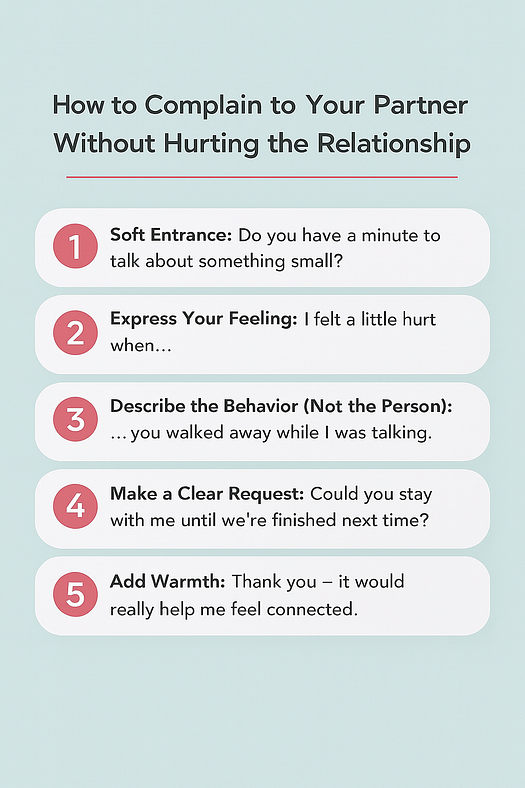
This is an example of adult, functional, “US” rather than “YOU” or “I” energy communication.
Why This Matters
Couples don’t fall apart because they have complaints. All couples have complaints.
They fall apart because the complaining isn’t delivered through a diplomatic filter that makes the other person feel safe.
Criticism, harshness, contempt, or character assassination never works, and when a person does it, I can assure them their spouse will never give them what they are asking for. In fact, when people are assholes in the way they criticize, human nature dictates that the criticizee will take pleasure in not giving the jerk what they want. This is our stubborn pride and ego that says, “I won’t give you that if you ask like that,” and it is not the way to handle it, but that’s how most humans respond.
You can’t avoid friction in a long-term relationship, but you can learn how to approach issues without damaging the bond. You did promise to honor and respect in your wedding vows, didn’t you?
When you complain with diplomacy, softness, and a little flirtatious warmth, your partner can hear you without feeling attacked.
That’s how connection grows.
That’s how resentment stays low.
That’s how relationships stay emotionally safe.
Healthy love requires the exchange of sensibilities — but delivered with love and understanding.
675,000 people divorce in the USA every year. January is known as Divorce Month because most divorces are filed after the holidays, when people have waited to face their issues. Does this mean you need marriage assistance now? Divorce is a serious decision that should be well-considered. Make sure you know what you’re doing, and no matter what, don’t do it alone.
Becky Whetstone is a marriage and family therapist with 25 years of experience helping individuals and couples. Although she is a fully licensed therapist, she works as a consultant and life coach via telehealth. She created the concept of marriage crisis management, the radically positive, amicable divorce plan, and the positive co-parenting plan, and seeks to take the nastiness out of anything to do with relationships. For more information, click here, or visit her website at www.marriagecrisismanager.com.
Latest Media
Daily Mail article on Travis Kelce and Taylor Swift do not fight
YouTube Video interview with the Matadoras
Positively Healthy Mom Podcast
Links to Other Articles by Becky