How Being Unaware Guarantees Lifelong Suffering.
Wake up to the Effects of Trauma or Have Terrible Relationships.
“We are spiritual beings having a human experience,” Pia Mellody
Before it’s too late, you must learn a few simple concepts about the personalities of human beings and how to have healthy adult relationships. This is not optional. What you will learn will change the way you think, act, and feel, and if you haven’t previously been able to figure out the different ways your life isn’t working and why, you will most likely find the answer here. I have written about this concept before, but based on the results, it appears that people have skipped those reads. Now it’s time to get in your faces, yell from the rooftops, wave a flag in your faces, jump up and down, wave my crepey arms, and tell you to look at this, so you can begin to have a better life. Knowledge is power and changes everything. If you want to be healthy yourself and have healthy relationships, put your coffee down, straighten your spine, and let’s get started.
Basic parts of the personality.
Most humans don’t realize they have different parts of their personality. Carl Jung posited that we have four, but I’ll get to that later. For now, we’re working with three. Freud is the first to say we have three parts, which I explained in detail in a recent article: the responsible part, the child part, and the part in the middle that regulates our lives between the two. In Freud’s model, both the responsible adult and the child possess negative and positive traits. Virtually every religion and psychological expert or mental health professional has sought ways to steer clear of the negative characteristics, and get human beings to stay on the positive side of things, with not the greatest track record. This is because people aren’t aware of them, and they go out into life acting on instinct and best guesses on how to handle situations with other people. The childhood trauma they don’t even know they have trips them up in numerous ways, keeping adults as emotional children who misbehave.
We’ve all heard of the concept of the devil on one shoulder and the angel on the other. These are two different parts of our personalities with completely different agendas, and it’s safe to say you have struggled with those two your entire life. If your devil part wants one thing, and your angel wants another, you will feel torn, and that is why some people say, “A part of me wants X, but the other part wants Y.” How do we manage the two parts tugging at us? What do we do? Why do some people seem to be drawn to the devil’s ideas, while others are dedicated to being good and listen to their inner angel? For example, the devil part may encourage you to lie and cheat to get ahead, whereas the angel wants you to earn your way through honest work and study. Being aware of these two throughout your days is a good first step in understanding our basic personality parts.
Let’s talk about the part Christians call the devil, first. I asked ChatGPT to create a chart that showed the various words used to describe the same dark aspect of our personality across different philosophies and sciences, specifically including the language of the godmother of trauma, Pia Mellody. Here it is:
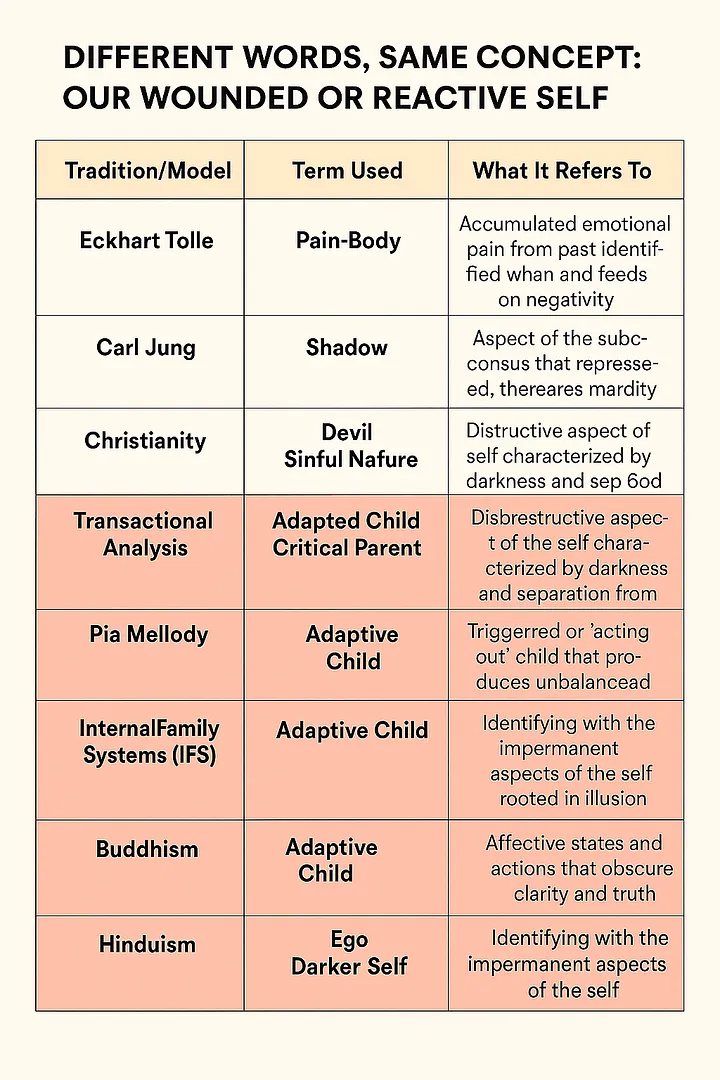
Choose which term you prefer to describe the part of your personality that undermines your life, or make up one of your own. When I talk to self-sabotaging clients, I tell them to think of it in terms of the devil, because most of us are very familiar with what the Christians say about that one, whether we are Christian or not.
For example, I use an exercise where I tell my client:
“Let’s imagine the devil is sitting next to you, and whispering in your ear. It says things like, “Everyone else is judging you, and they think you’re worthless. Look at you, you’ll never succeed at anything. Have you looked in the mirror? Who would want you? Everyone is trying to take advantage of you, so beware of people. If you give your heart away, it’ll be shattered, so it’s best to keep it locked away. Your partner doesn’t care about you and is going to leave. You’re a stinking piece of dog crap, and there’s nothing you can do about it. You’re a loser.”
I could go on and on with various insults and criticisms people put on themselves. The point is that the entity that sits next to you and plants fearful thoughts and images, that describes you in negative terms, and tells you that you are worthless and unlovable, is a pathological liar. Its purpose is to cause destruction and suffering, misery, brokenness, and failure. Visualize what it must look like — an evil clown, a rabid wolf, a schoolyard bully … whatever you visualize it as, is that something or someone that you would give credence to as being a valued source of information? I hope not. Look at the terms above that describe the dark part — whatever term you choose, or choose one of your own, just be aware that it is a part meant to disempower, destroy, and weaken. We will work on making a conscious choice to keep that part out of our lives and relationships.
I was once in the woods near my house, having a spiritual moment, feeling connected to nature. I was holding onto a tree, looking around at all the trees, brush, plants, and hearing the wind rustling around, and I was thinking about this negative voice, which Pia Mellody describes as the adaptive child. I asked the universe, “Who would I have been, and who would I be, without that terrible negative voice in my head?”
The answer was immediate and clear: “More powerful than you can imagine.”
This is true for all of us. We are born powerful. The negative voice takes it away if we allow it and buy into its negative messages. The more a person listens to the voice and believes what it says, the louder and larger it becomes, and it’s a vicious cycle. The less you listen to it, the smaller and quieter it gets.
What to do about the dark voice.
You can quiet the dark voice if you dedicate yourself to it. I rarely hear mine anymore, thanks to years of mindfulness and calling it out. Here are some steps to get the job done:
- Mindfulness and awareness. This is key. Mindfulness is about paying attention to yourself, your thoughts, and your feelings. You must be tuned in to yourself and begin to recognize which part of your personality is vying for your attention. I know when my dark part is at work, because it encourages me to do things that aren’t in my best interest. “Eat the third piece of pie, Becky. Eat it, it’s okay, you deserve it.” I eat the pie, then it says, “You’re such a pig for eating that pie. Look at you. Good God, you are so gross. Disgusting.” Yes, it leads me to evil, then berates me for self-sabotaging and doing the very thing it pleaded with me to do. I visualize this interaction as if I am a fish in the river, swimming along. The dark voice drops a hook right in front of me and tempts me to do something that will not be good for me, and the question is, am I going to bite the hook and end up on someone’s dinner plate, or am I going to swim on by? You must become aware of when the hook is being dropped and have the discipline and self-control to move away from it.
- When you hear the negative voice, call it out. My voice may call me out for overeating, but I will answer it with something like, “Listen, I am an adult. I can do what I want. You want to shame me, I’m not doing that. I enjoyed the food; you want me to suffer and be miserable, and I won’t allow it. Now shut up and go away. I can handle my life myself.” If it tells you you’re not good enough, say something like, “You’re a liar and you’re wrong. I am good enough. You want me to suffer and not be in my power. I refuse to take what you say seriously.” The more you do this, the more it will give up trying. You must also understand that this voice is not you, and has nothing to do with you. I don’t know why we have to deal with this negative entity, but we do. Part of the trick of life is recognizing it when it’s there, and refusing to go along.
- Console, nurture, and positively coach yourself. Let’s say the negative voice told you that you aren’t smart enough for college. It told you not even to apply. You were tuned in and caught it, refusing to believe its lie. Catching it and ignoring it is a fantastic feat, so praise yourself instead. “You didn’t fall for the negative junk about your intelligence, Becky. Anyway, you are good enough for whatever you want to do. You did great with that.”
Making a concerted effort to pull yourself out of your thinking mind, which obsesses about potential adverse outcomes, is also a crucial piece of awareness. We teach clients to catch negative thoughts as soon as possible and then pull themselves into the present moment, focusing on what is around them. The chair, the sounds in the room they are in, and their feet on the floor. We must train ourselves to recognize that negative movie-making in our minds will not be tolerated moving forward. Worrying about every potential outcome, or what disaster might happen that probably won’t, is one of life’s biggest wastes of time and energy.
The three main parts of an adult and their adaptive strategies.
Imagine that within yourself, you are three people — a wounded child, a nasty teenager, and a healthy part that is all good things. At any given time, one of those parts is ruling your feelings, thinking, and actions, for better or worse. I tell clients that life is like sitting inside a car, and which part of your personality holds the steering wheel is one of the most important things to be aware of. The clients I work with, who are typically struggling in their marriages, have not been mindful or are. When we aren’t paying attention to ourselves and act on instinct, it will be the wounded child and the nasty teenager that are tearing their relationships and family apart, like a teenager having a party when their parents are out of town.
If only they knew the inside take on what is happening, they might be able to do something about it. The truth is, becoming aware of these three parts can change everything about your life for the better. Here are the three parts of a personality, as described by Pia Mellody, for 99.9 percent of all adults: the wounded child, the adaptive child, and the functional adult. Understanding this and learning how to control which one controls your personality is crucial.
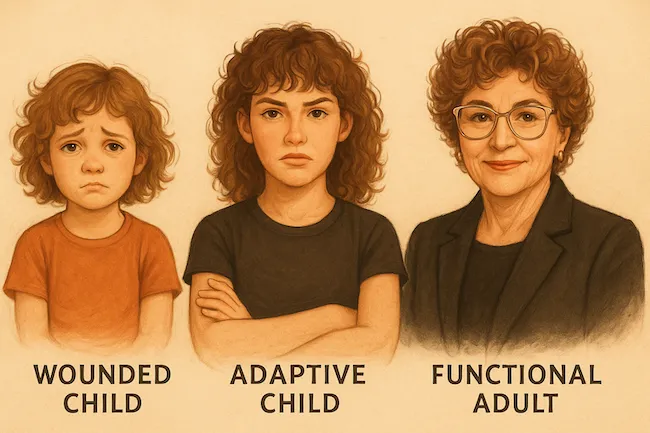
1. Wounded Child. Almost all of us are trauma survivors, whether we are aware of it or not. It doesn’t take physical violence or blatant abuse to do it. It’s exceedingly easy to be a well-meaning parent and unwittingly traumatize a child, unfortunately. Nearly all of us become wounded emotionally at a young age; that child remains with us, and within our personality, forever. The wounded child is typically around 5 years old or less, when the limbic part of our brain, our operating system, is still developing, and we act mainly on instinct. Children can’t make an accurate sense of the world because their brains aren’t yet fully developed. Critical thinking and precise processing of the world around us weren’t available to us. Children’s inner coping mechanism is to create false stories and make decisions that won’t serve them well in the years to come, like, “I don’t measure up. Something is wrong with me, I’m defective. I’m not good enough, I better stay off people’s radar, never be vulnerable.” “My parents are always in a bad mood because I am not a good person.” All the disappointments, hurts, traumatic events, and wounds from our lives are stored within this part of our personality, so as adults, it is the storage unit for our childhood trauma.
The mindset of the wounded child: Afraid, rageful, sad. Think: Instinct, high emotions. Not able to understand things in context or rationalize.
The role it plays: Imagine my arm has a highly tender spot from an old injury that has never completely healed. It doesn’t hurt at all, unless something or someone presses it, then the pain from it will send me through the roof. This is what the wounded child part of our personality is like; only the tender spots are emotional, and from hundreds of situations in our lives where we were hurt, disappointed, abused, dismissed, overlooked, and more. Once grown, any situation that arises that remotely resembles something that wounded us in the past awakens our wounded child, and our younger self will sense a threat. That’s how childhood trauma works. If I was ignored in my childhood, and my partner ignores me, my wounded child will go on alert. In that moment, that tender spot is pressed, and I feel intense emotional pain, fear, rage, or whatever it was I felt back when it originally happened. Because my wounded child feels threatened and can’t protect herself, the next part of my personality dives in to save the day, but in a self- or relationship-destructive way. (See the adaptive child below.)
We’ve all met the highly sensitive person who is quick to have a meltdown and struggles with self-regulation. I always think of them as a walking wounded child. In trauma therapy, these wounds that trigger you will be dealt with, so that moving forward, that sensitive spot that was once there will be healed. Over time, few things will trigger you, and your ability to tolerate what you once could not will widen exponentially. Some people with severe mental disorders may not heal like most people I work with. It pains me that some will likely live their lives stuck in negative emotions and feelings of pain.
2. Adaptive child (or whichever name you choose from the list of dark parts above, like devil, pain-body, etc). An older child, typically around age 15, who tries to act like an adult but remains very immature. This is the home base for contempt, resentment, stubborn pride, self-righteousness, arrogance, victimhood, and all things dysfunctional and unloving. It is the part of us that also obsesses, lies, has affairs1, and can be involved in substance abuse or addictions. This part not only encourages us to self-sabotage and self-abuse, but it also protects the wounded child when she feels under threat, by acting out of the fight, flight, or freeze response. It also beats up the wounded child for making perceived mistakes. In relationships, the adaptive child’s responses are defensive, sarcastic, angry, and blaming.
The mindset of the adaptive child. Don’t mess with me. I can mess with myself, but don’t you mess with me.
The role it plays: The adaptive child protects the wounded child from perceived threats by lashing out, getting defensive, running away, or shutting down. Nothing good happens in our relationships when we allow our adaptive child to take the reins of our personality. Our wounded child feels a threat, the adaptive child is triggered, and does its damage. The adaptive child also shames the wounded child for mistakes and for not measuring up. It’s a mean girl or boy in our head, telling us everything negative about ourselves that it can think of.
3. Functional adult. Genuine, authentic self. Everything we need in life is found here. It’s the best part of us: responsible, playful, compassionate, caring. Relational. A person can only have a truly vulnerable, intimate relationship that stems from this part of their personality.
In trauma therapy, we will be working on your childhood wound, as I said, and we also work to control the adaptive child’s role in your life. When I am doing couples therapy, I stop people who fall into the wounded child/adaptive child trap. I tell them what they are doing: “Your wounded child just felt a threat, and your adaptive child has gotten hold of you.” I ask them to back down, calm themselves, and then speak again out of their functional adult self. The rule of thumb is not to proceed in a conversation when your nervous system gets activated; instead, take a time-out, and return to the conversation when you are calm. If couples could learn to do this regularly, the divorce rate would plummet.
Controlling the adaptive child is one of the most crucial interpersonal skills you can develop.
The immature rabble-rouser within us is what leads us down the dark path to self-destruction, and relationship breakdown can and must be brought to task. The more familiar you become with it, the less power it will have over you. I often ask clients to name theirs, so that we can be sure to emphasize that this dark part is not you; it is simply a wounded part of you that never matured and acts like an immature person. I call mine “Bad Becky.” Clients have named theirs all sorts of things over the years, sometimes using their middle name, their parents’ name, a nickname, or the name of someone they dislike, a character from literature or the movies, or whatever resonates with them. It also helps our partners find more empathy for us when we screw up. I might tell my spouse, “That was Bad Becky who said that, but she was acting like an idiot, and your wife Becky regrets it, and would like to apologize.” He can process that I am unreasonable, or he can process that Bad Becky is unreasonable. Being able to see it as separate from our true self is extremely powerful.
The main steps to reducing the frequency and power of this negative aspect are:
- Become aware of it.
- Name it and be able to look at it as separate from you,
- Allow your healthy part, the functional adult, to take care of the wounded child and help it grow and heal, so that it won’t need the adaptive child’s perverse assistance. Your functional adult self now parents your wounded child, rather than having the adaptive child protecting it with harmful and damaging actions.
Different names, same thing.
Just like the part of us that is dark and reactive has numerous names depending on what philosophy, religion, or science you are looking at, so does the angel on our shoulder. Take a look at all the different names we use for this wonderful part that is healthy, vibrant, and all things good:
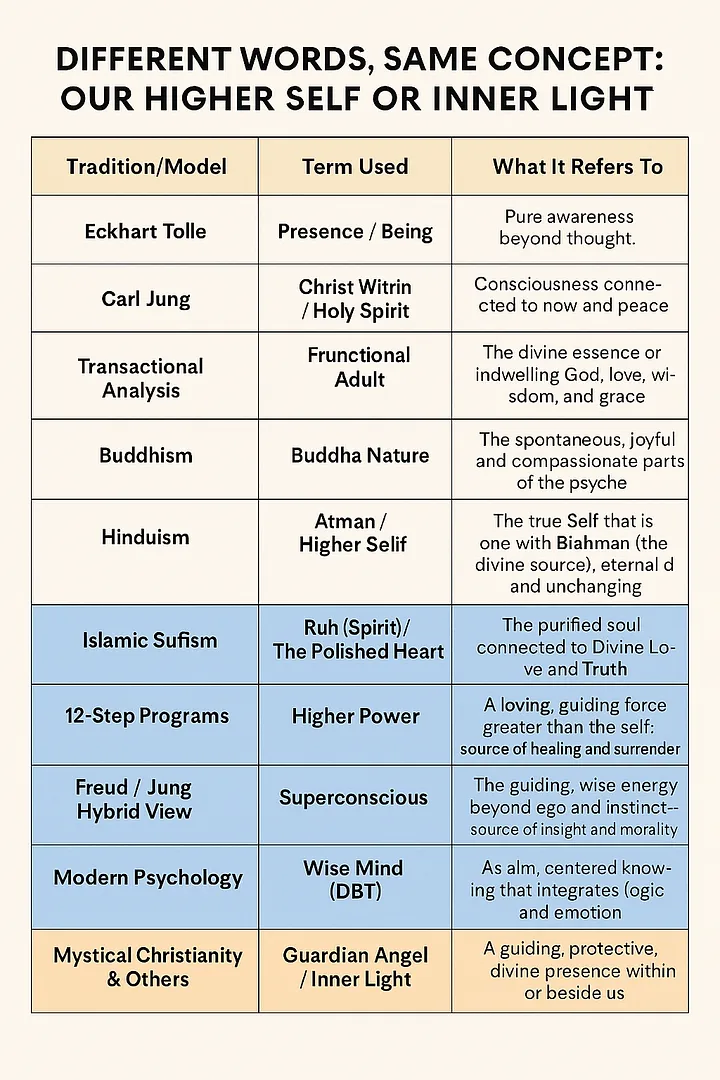
The Functional Adult. The only personality part you’ll ever need.
Pia Mellody’s functional adult wasn’t included on the chart above, but it’s the term I most often use for the healthy part of our personality.
Within the functional adult, all three parts of personality that Freud wrote about are present; however, the parent and adult parts are predominantly positive, with none of the negative aspects. For example, in the parent part, you find a person of integrity who keeps their word, does the right thing, seeks to understand, addresses issues head-on with respect, pays their bills on time, is solid and reliable, and lives life in moderation and balance. In the parent part, the person is playful, curious, expresses positive emotions, and is easygoing and fun.. Everything we need to have successful relationships is found within the functional adult. We still experience the fight, flight, or freeze response in our functional adult, but only when there is a real potential threat.
The goal of trauma therapy is to help clients become self-aware, to understand their different parts vying for control of their personality, learn how to manage them, and seek to have the functional adult part in control most of the time. Although continually operating from your functional adult is a great concept, human beings aren’t perfect, and will probably never achieve being in that space 100 percent of the time. I am asking you to strive to reach it as much as you can.
Carl Jung’s four parts of the personality.
Although Carl Jung met Freud in 1907 and was chosen to be his heir, they parted ways in 1913 because they could not agree on theoretical concepts, such as the number of parts of the personality and the role of sex in human behavior. Jung said there are four parts:
- Persona — the mask we show to the world
- Shadow — rejected or hidden parts
- Anima/Animus — inner feminine/masculine
- Self — the whole, integrated psyche
Because humans decide they aren’t good enough or don’t meet the world’s expectations, they create a persona they present to the world, designed to be successful and avoid rejection. My mask was that of a pleaser for decades, but today it sits in mothballs in my brain’s attic of discarded ways. At one point in my journey, I learned that personas make people miserable. They weigh us down and are a form of psychological jail. Human beings long to be free, to be themselves authentically, yet almost every adult I work with has one or more personas, such as the perfectionist, overachiever, caretaker, rebel, loser, rescuer, fixer, and more. This is another thing that we hope our clients will become aware of and dismantle.
The shadow part is the same as the devil and the adaptive child. The anima is the feminine part in a man, and the animus is the masculine part in a woman. Jung agreed that self-awareness of the different parts was key, noting that both men and women need the balance of inner masculine and feminine to live their lives authentically, rather than as a person our culture may try to control.
Jung’s self is the same as Pia Mellody’s functional adult. It is you, having dropped all the ridiculous rules and conforming behaviors our culture has pressured us to maintain, and then living as your self, authentically.
Putting it all together.
Most of the people who come to see me are intelligent, successful individuals living within the confines of a persona or false self, who are not self-aware and are immersed in allowing their wounded child and adaptive child parts to wreak havoc in their committed relationships. When I work with them, that is often where we must begin. We conduct a classroom where clients learn what I am teaching you now. We examine the aspects of their personality that lead to self-sabotaging behaviors and rely on others to learn to live authentically, utilizing their functional adult as the captain of their personality.
Most humans won’t apply themselves to learn these vital concepts, which is why the world, our culture, and families are in such a mess. When they do, however, I have found that they learn and grow quickly. The concepts aren’t that difficult, and doesn’t it make sense that we’re going to be leaning on adults to be respectful, diplomatic, and caring about what comes out of their mouths?
The human personality and the study of psychological concepts are among the most fascinating subjects in the world, and they are a relatively new science. Amazingly, there was no such thing as psychology or mental health treatments until the 20th century. My field of Marriage and Family Therapy didn’t emerge as a distinct entity separate from psychology and social work until the 1960s. In the field of trauma, there was no help for anyone until after World War II. In the 1980s and 1990s, significant breakthroughs in understanding trauma began, and now we have real, solid help for people seeking to heal and change their lives. This is the best time in human history to get yourself and your relationships together. You’ll never get there without learning about it. Study the basics of psychology, learn about the parts of the personality, how to be self-aware, how to heal from trauma, and how to grow yourself into the functional adult you were meant to be. It’s the best thing you can do for yourself and your family.
Solid people.
People who have done their work are stable, their emotions are regulated, and their actions and behaviors are controlled. They understand that they’re responsible for their own happiness and for meeting their own needs.
Yes, a partner can assist us with our needs, but when they’re not available, we can get them met ourselves. These adult survivors are tuned into themselves and their loved ones. They continually tweak their lives to maintain their peace. They aren’t afraid to communicate, speak out about what’s going on with themself and what they need. They address issues as they arise and don’t hold things in. They have no problem with asking for help or contacting medical doctors or mental health professionals when they have issues and can’t figure things out themselves. These people are safe to be in a relationship with, and are capable of the vulnerability required in intimate relationships. They don’t torture themselves with unrealistic expectations and maintain a balanced life. This is what we call functional adults, and I hope more of us can reach that level.
Becky Whetstone, Ph.D., is a licensed Marriage and Family Therapist in Arkansas and Texas* and is known as America’s Marriage Crisis Manager®.
She is a former features writer and columnist for the San Antonio Express-News, and is the author of “I (Think) I Want Out: What To Do When One Of You Wants Out” published by HCI Books, distributed by Simon and Schuster, and to be released February 4, 2025.
She has worked with thousands of couples to save their marriages. She can work with you, too, as a life coach if you’re not in Texas or Arkansas. She also has a YouTube Channel called Marriage Crisis Manager where she talks about relationships. She has a telehealth private practice as a therapist and life coach via Zoom. To contact her, check out www.MarriageCrisisManager.com. Also, here is how to find her work on the Huffington Post. Don’t forget to follow her on Medium so you don’t miss a thing!
For licensure verification, find Becky Whetstone Cheairs.
If you liked this, you might also like: https://marriagecrisismanager.com/talking-and-listening-boundaries-the-key-to-healthy-communication/