Why Being Truthful and Honest is Seen as Brutal.
Clients Call Me Brutal, I Say My Style is Honest.
Clients often comment in therapy sessions that I am brutally honest. Or blunt. Or candid. Even though I accept their characterization, it stuns me every time. “Am I really brutal in my honesty?” I ask myself.
Webster’s defines the word brutal as savagely violent. Using that definition, I can assure everyone that I am not savagely violent in my language in therapy sessions, but I often tell people the truth about what I see. Not in an ugly, mean, or harsh way, I say what I feel needs to be said that will be helpful, plainly and clearly, so as not to be misunderstood. It is a good thing in my opinion, because as Paul Simon wisely and correctly wrote in the song, The Boxer, “A man hears what he wants to hear and disregards the rest.” If I am vague, clients will fill in the blanks themselves and often be inaccurate in discerning what I meant. There are strong feelings and opinions in the marriage therapy and marriage crisis management arenas. People are afraid, and their brains feel a threat; their nervous systems are activated. We broach complex topics that a couple can’t seem to discuss with each other without my presence; they need emotional safety, honesty, and truthfulness are imperative, and misunderstandings can be dangerous and may set us back.
I don’t see how a good therapist can get a person to where most want to go — they tell me they want lasting, root-level healing, change, and growth — without telling them what I see from my trained and experienced eye.
Since I am dedicated to telling the truth, and clients often describe that truth as brutal honesty, I must therefore conclude that truth is brutal to hear, as in, emotionally painful. I’ve frequently said, and written in blogs, that when a person speaks with no sugarcoating and ambiguity, they are often viewed as an asshole. This is probably why so many dance around the truth in conversation, or refuse to say what they need to say, and come off as being full of baloney or a bullshit artist. I am allergic to baloney and bullshit, and everyone else should be, too, but I digress. Fluffy fake talk goes nowhere and fills the air with nonsense, and for what?
The purpose of the speaker, by the way, is to show the listener who they are with the content that comes out of their mouths. If you’re a fluffy talker, I tell myself you likely don’t want me to know who you are, for whatever reason that might be. At the end of the day, people who do that are avoiding connection, bonding, and the potential friendship and closeness that can come from sharing a piece of who they are. They are showing me invulnerability, that they are avoidant of connection, or me, specifically.
When I am the listener and I’m bombarded with unimportant facts, deflections, and details, I find myself saying, “Get to the point, person, please!” Based on the evidence, I have come to believe that most humans prefer to live in a world of superficial interactions, engaging in surface conversations, and never really getting to know one another. That’s fine to be invulnerable in your social life, I guess, but in therapy, I don’t see the point. However, I understand the need for a client to build a rapport and comfort level with their therapist before sharing significant truths and details, such as a traumatic experience they may have never told anyone, or discussing difficult topics, or expressing their previously unexpressed truths to a family member.
I use my intuition and experience to gauge when it is appropriate for me to say the truth of what I see, or to push gently for a client to reveal a truth. I am patient, to be sure. I will tell my clients what I think I see when I feel the time is right, but you can take your time in opening yourself up. I strive to be compassionate and diplomatic in my approach.
No matter how or when I deliver an unpleasant observation to a client, I will almost always be described later as brutal. Why?
Therapeutic softies.
Clients tell me that other therapists and mental health professionals they have been to were soft, reflective, but not a teacher or person who points out negative patterns, faulty thinking, or things they say that can’t possibly be true. Certain philosophies in therapy are meant to show unconditional positive regard, compassion, understanding, reflection, and tenderness, to a fault. We all need that, no doubt, and while I genuinely have unconditional positive regard for clients, I can feel that way about them despite the relational flaws and imperfections I see. People don’t have to be perfect and unflawed to be accepted and cared about; in fact, presenting oneself as unflawed and perfect prevents that.
To that end, I will probably need to deliver uncomfortable truths at some point to help the couple achieve the change, knowledge, or understanding they’re seeking. I know the best therapists I have had shared the truth about me with me, with kindness, respect, and in a non-threatening way, and I was able to receive it. There will not be a change without acknowledgement of the problem.
A great counselor, therapist, or social worker must share the truth of what they see, but also be a teacher, in my opinion. I like the idea of individuals and couples treating therapy as a life school, and something we would all benefit from. Suppose I see that you’re doing your relationship math incorrectly. In that case, I will point it out, not to shame, but to claim a learning opportunity: “That kind of behavior/interaction/attitude doesn’t work in relationships, so we have to learn how to do it in a way where it does.” It often helps clients to normalize not knowing much about healthy relationship dynamics, as few do. They are learned skills from start to finish, and if you haven’t learned them by the time you get to me, you soon will.
For your entertainment, here are some of the things I might say that have been described as brutal:
I have been watching and getting to know you and your spouse for a while now. And I’m starting to think you may be a relationship problem child. Sometimes we have one person who is 90 percent at fault in a marriage, and that person might be you. Please tell me I’m wrong.
Blaming other people for your unhappiness is one of the most immature acts an adult can engage in. How about focusing on your part in this and stop pointing fingers?
What day, at what time, at what moment, did you decide you know more about most things than anyone else?
When you tell me you didn’t have sex with a person you went on a business trip with, and tell us it was an emotional affair only, you insult our intelligence.
Why is it so hard for people to hear the truth?
We all have an image of who we are, and who we’d like to be, and for most people, that image involves being seen as a good person. For too many of my clients, being seen as good isn’t nearly high enough; they strive to be seen as perfect. The ego concocts this image of who they ought to be early in life, usually based on what their family system valued, like academic or sports performance, achievement, perfection, pleasing, or being a helper, for example. From this sprouts the false persona, and the person decides they must be seen as a success in that way, no matter what it takes. Their ability to esteem themselves depends on this. Imagine doing marriage therapy when one spouse must be seen as good and perfect. They will never admit to being wrong about anything, and the most juice you can squeeze out of that vegetable is, “Well, I didn’t intend to injure/hurt/deceive/you.” So, they had good intentions, and therefore, they remain good, and … perfect. They say the world is paved with good intentions, right? Ugh.
I always remember ridiculous Wayne, who was a good example of the good intentions defense, and one of the last poor souls I dated before I met my husband.
Wayne came on strong. He told me a story about his ex-girlfriend of several years, whom he had recently parted with, and how glad he was to be out of the relationship. We went out, and he was fun to hang out with; I thoroughly enjoyed his company.
Then, I noticed that on our dates, we rarely went out in public, and when we did, it was usually in an out-of-the-way place with few patrons, or he cooked something at his house. Hmm. He went from the full court press to sporadically touching base, telling me he had pulled back only to work out some things, and just to be patient with him and hang on. She was back, I guessed. Not long after, he called and asked me to meet him at the Starbucks nearby. “No, Wayne, if you have something to tell me, you can drive to my house and say it privately, to my face.” I already knew what he was going to say. He arrived and said, “Uh, yeah, Susan and I have gotten back together.”
“Wayne, you misled me all these weeks and months.”
“It was not my intention.”
“Yeah, well, it is the reality. Good-bye, Wayne.”
“Don’t you want to talk about it?”
“No need.” I knew he just wanted to make excuses and justify things to make himself feel better about lying and wasting my summer from a romantic standpoint, and I wasn’t up for it.
Wayne did mislead me. He had been seeing Susan while leading me to believe they were done. I called him out for it, and all he could do was show me the need to protect his image of being a good and decent man, and not the dating scoundrel he was. Greater baloney has rarely been uttered than the words, “I didn’t intend …”
Believe it or not, he called again a few months later and asked me to give him another chance, that this time, Susan was gone for good, and he hated her. I said no, then saw him about two days later picking up race packets in a bicycle shop with Susan acting lovey-dovey. He knew I was there, but never made eye contact.
Just be yourself and everything will be fine.
People who live in their ego and false personas have self-esteem built on a foundation of mud and quicksand, as the person they present to the world is phony, fake, and an act. Underneath the mask is a person who is full of toxic shame who feels they are not good enough. If a person can twist whatever story we are discussing in marriage therapy to make themselves look righteous and refuse to admit they’re wrong, they will, but I will know they are living their life in denial. Their false ego will protect that self-image with all it has, using every defense mechanism there is, just like Wayne did. People still living firmly in the self-image of their false persona cannot hear the truth from others without feeling the emotional pain of not measuring up. It is that, and not the truth, that hurts.
Human beings who can face their flaws, acknowledge making mistakes, and approach situations with humility, saying, “I know there is a lot I don’t know, and a lot I could learn,” have to have some level of ego strength or ability to esteem themselves while also knowing they’re human and fallible. The false self-image maintainers can’t do that.
I remember a time in my life when admitting I didn’t know something, or being wrong, was emotionally painful. I felt shame and embarrassment because my persona was always to look good and mistake-free. I killed my false persona after realizing how much pain and self-sabotage it was causing me and began living authentically. In many ways, I feel like I’ve come out of the closet from the fake, perfect person I presented myself as to the fallible mistake maker I am today. Now that I’m okay with being flawed, I can usually accept negative input.
The cure was to accept myself as I am, understanding that I am good enough, but also human and imperfect, and that was a relief. I no longer needed a false persona to hide behind, pretending I had it all going on. When who you present to the world is who you are, in all of your perfectly imperfect imperfections, you’ll be there, too.
Fear of rejection.
Part of why people struggle to face unpleasant truths about themselves is the fear of rejection and abandonment, thinking, “Hey, if my spouse finds out I’m just a scared child inside, they won’t love me anymore.” Interestingly, when these sorts of things come out in therapy, the spouse listening to their mate’s confession almost always feels deep caring and empathy for having heard them and expresses a desire for them to share more, so they can help them shoulder the burdens of life. I have never seen anyone be wholly rejected for finally saying the truth about themselves, as unpleasant as it sometimes is.
One of the most powerful moments I have seen in therapy was when a husband who was critical, obnoxious, and a control freak, turned to his wife and said softly, “Honey, I know I’ve been a complete dick, and I am so sorry.”
She said, “You know you’re a dick? You’re actually aware of it? That’s huge! Oh, honey, I love you.”
Yes, ownership of negative truths about yourself can change everything about how others see and experience you.
However, some will resist this, as confronting a hard truth often requires a subsequent effort to grow and change. I have written thousands of words about how resistant most people are to facing that and doing the work they need to do, and even the client who admitted to being a dick quickly returned to being a dick. Still, it was a powerful moment that softened everyone’s hearts. If only he could have maintained himself in that place of humility and self-awareness, he might have saved his marriage.
The truth acceptance ladder.
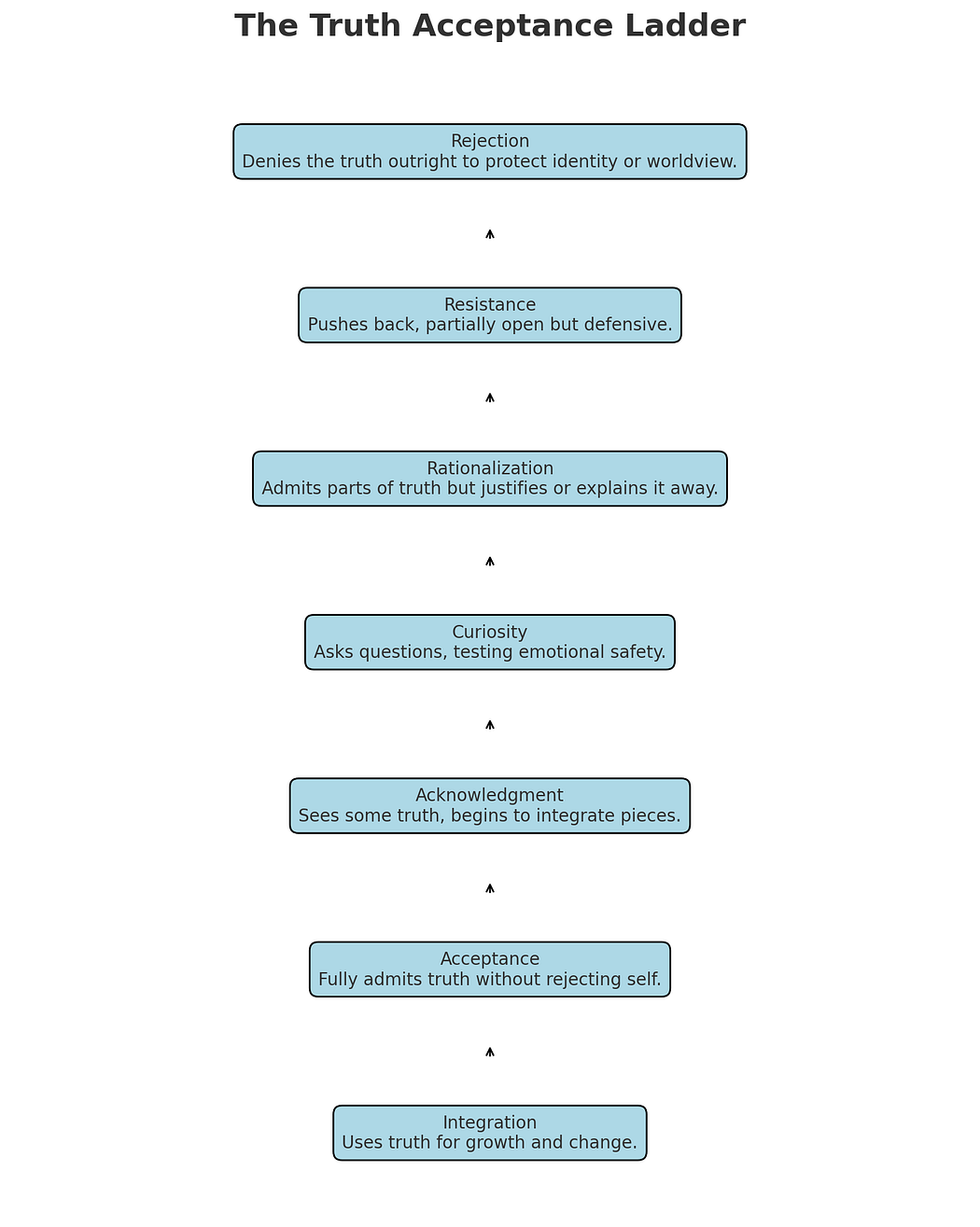
When people say they sometimes need the truth to sink in, they aren’t kidding. Psychologists have studied this, of course, and have come up with all sorts of understandings of how humans absorb, or don’t absorb, the truth. I have consolidated them into something I call the Truth Acceptance Ladder. The rungs on the ladder work from high to low, and we seek to make it to the bottom rung. In my experience, most people in therapy reach the third stage, rationalization, but only a small percentage progress further. When it comes to the MAGA political movement, they never go past the first rung on the ladder, which is outright rejection of the truth.
I honestly believe that the reason I was able to change my life so much was because I was finally ready to get real with myself and face truths about myself that I didn’t like. The more I looked into it, the clearer it became that the path only pointed in one direction: get honest with yourself, even about the bad stuff.
When looking at the ladder and thinking about yourself and others, keep in mind that clients invite a therapist to offer them advice and suggestions, so we do. But in daily life, it is a boundary violation to tell someone the truth of what you think about them without their invitation or agreement.
If someone has a painful truth to reveal to me, they usually don’t ask; they just do it. Even though they’re out of line, I feel these are moments where I might get to learn something, so I strive to hear another person’s truth respectfully and look for the grain of truth in it at the very least. To face the truth, we must make it down the rungs, processing the premise with humility, to fully experience significant change and growth.
If you reject a truth offered outright, it’s not the end of the world and doesn’t mean something is wrong with you. When MAGA calls democrats communist, I hit the reject button, for example. We do have a right to our own truth. I am just asking people to be open to considering that the person observing and commenting on you might at least be partially correct.
Maybe we can’t hear the truth because we aren’t kind and tender enough to one another.
Yes, sometimes the messenger delivers their message of truth with harshness and contempt, and that is a massive problem. No one will react positively to a message delivered like that, and it never gets a person what they want. Diplomacy is essential for humans to get along, and in today’s world, much of this has been lost, and abusing one another has become mainstream. In marriage and close relationships, diplomacy is a must-do, not a might-do.
In marriage therapy, I continually see couples who are terrified to reveal their deepest fears or honest thoughts, perhaps about their disillusionment in the relationship, to the person they are spending their life with, when the best thing you can do is to have the difficult conversations softly, with a warm heart, soft touch, and intentional tenderness. While studying trauma and how to help people recover from it, I came to understand that we are all aching for tenderness from others as adults, and few of us get it. How can we help humans understand that being kind and respectful, while being honest and congruent with their thoughts and feelings, is the way? In theory, we are all big boys and girls and should be able to handle difficult truths, shouldn’t we?