All roads to working with Dr. Becky Whetstone begin with the marriage crisis consultation.

25 years of experience, thousands of couples served.
The Five Stages of a Deteriorating Marriage
In 2005, I was working on my doctoral dissertation, a study of how people in long-term marriages of 10 years or more decide to divorce. I was intensely curious to find out how a person, who at one time could not wait to marry and spend their life with someone, could go from that much love and desire to be together, to wanting to end it altogether. I also wanted to know what happened during that time to make them change their mind, and what they were thinking along the way.
What I learned was stunning. Some marriages start off healthy, and then become sick. Once sick, they deteriorate in predictable stages, until they die, while other marriages begin that are already sick, meaning that one or both people were already disillusioned at the time of the wedding, but for whatever reason, married anyway. These relationships also go through the same stages, and unless something is done, the marriage ultimately dies.
After I completed my research and learned about the stages that lead a couple to divorce, I began seeing couples in my private practice, most in full-blown marriage crises. When I speak of a marriage crisis, I mean that the truth of one person’s unhappiness has come to the surface: he or she is leaning out of the marriage, not completely certain they want to end it, while the other person is fighting to save the relationship.
After seeing how these experiences played out over many years, I combined my research with how marriages die with what happens when the truth of the unhappiness is finally revealed, and the marriage crisis begins.
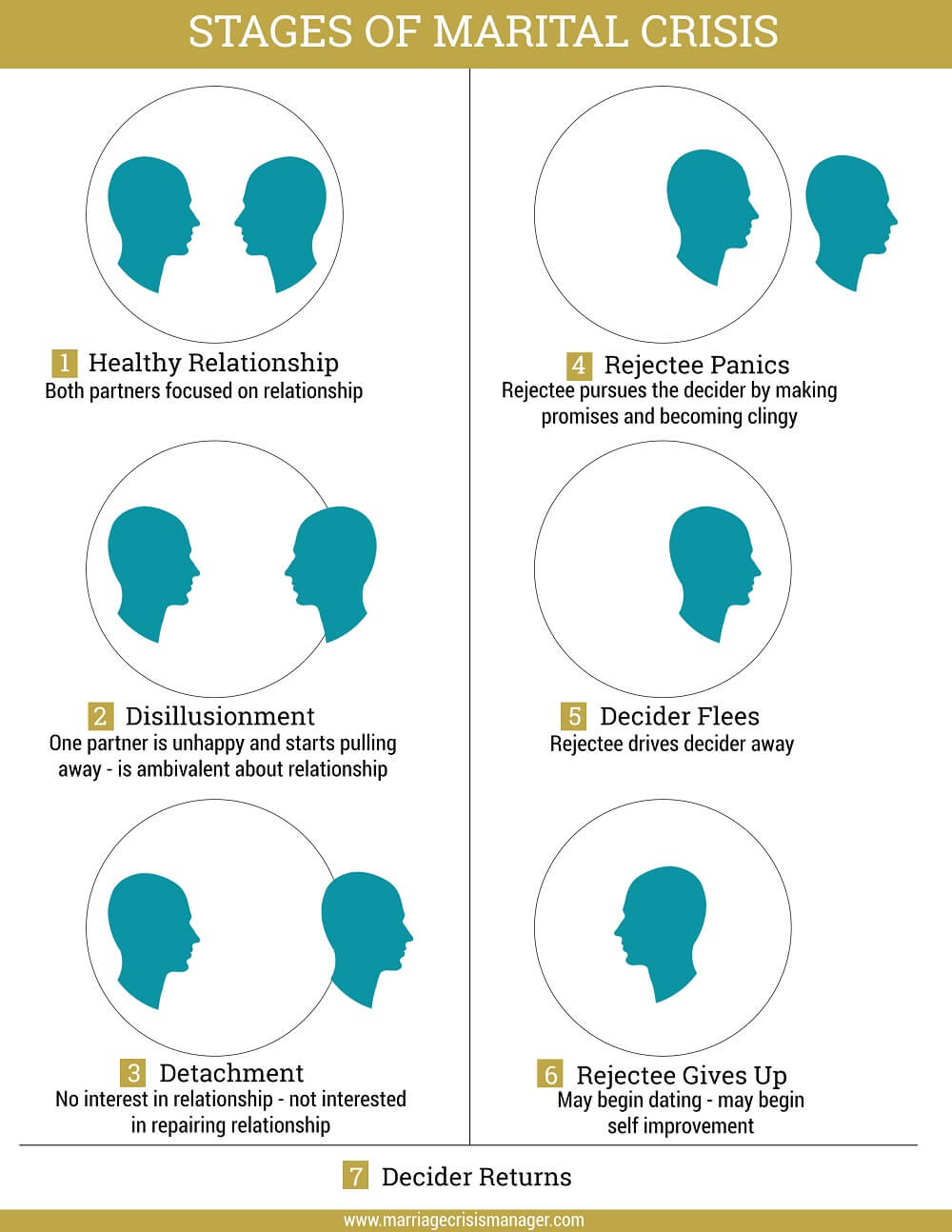
The graphic below is a result of that.
To understand the marriage crisis process, we begin with the relationship at its highest point, then move through the deterioration process. When the truth of the unhappiness comes out, the crisis begins. I will describe each stage in more detail to help you understand what usually happens. It is my hope that you’ll find it helpful to understand what has happened to your marriage, and where your relationship might be headed in the months to come – knowledge is power!
Stage One – The Healthy Relationship.
Quite honestly, too many relationships don’t start off this way, at least from my point of view. But let’s not get into the details of my definition of a healthy relationship – I’m creating a whole separate page on this site to tell you all about it! For our purposes here, I am talking about relationships that started out with both partners really wanting to be married to each other, and both were in love and sincerely planning to spend the rest of their lives together, with hopefulness for a great future.
In this graphic, the circle represents the marriage, and both partners are firmly in it and focused on each other.
Stage Two – Disillusionment.
At least one partner has the realization that they are unhappy or that something is wrong in the relationship. I often describe it as an “uh-oh” moment, such as, “Uh oh, I think I’m unhappy in this relationship. But hey, I know relationships have problems and ups and downs, so I’m just going to let some time pass and see if my concerns last and if this is serious.” The disillusioned partner tells no one what they’re thinking … it’s all a secret.
As disillusionment continues, it slips further down the deterioration process as the unhappy partner decides that their problems are persistent and serious, and could possibly lead to divorce, though the idea of divorce is quickly dismissed due to a multitude of reasons, such as children, religious, social, moral beliefs, finances, fear of failure or disappointment, and many more considerations.
Snide remarks are showing up in the relationship, as is an occasional bad attitude.
In this graphic, one person (or both people) stands back and watches what is going on in the relationship to see if their concern and unhappiness persist, and when they realize it does, they back away from their partner ever so slightly.
Stage Three – Detachment.
Unhappiness increases, and since the unhappy person has already told his/herself that divorce is not an option, they must find ways to cope. So they search for distractions and interests that they can pursue away from the marriage, such as going back to school, pursuing a new hobby, an affair, working out, or … it could be anything. It is as if the person says to themselves,” OK, I am really unhappy, but I can deal with it if I have someplace else to direct my attention.” So they pull away from the marriage and start doing whatever they can, so long as it does not include their spouse.
Unhappiness and ugly remarks have spread from being confined to the two partners to affecting others, such as family and friends.
Sometime during the detachment stage, the unhappy partner’s unhappiness increases to the point of being unbearable. Just being detached from outside distractions no longer does the trick. So in the final part of this stage, the unhappy partner turns all the way around and pulls away from their partner. Often, they reveal the sad truth: they are unhappy in the relationship and unsure they want to remain married.
In this graphic, the “happy” partner remains focused on their partner, though they may sense that something is not right. Most likely, they feel that their partner is pulling back and turning away from the marriage, but most do not understand that it is due to the extreme seriousness of their partner’s unhappiness.
When the partner turns all the way around and away from the marriage, and the truth and seriousness of the unhappiness are revealed, the true Marriage Crisis begins.
“The Marriage Crisis begins in earnest when both partners are completely aware that the marriage may end due to one partner’s extreme unhappiness.” – Doctor Becky
Stage Four – Rejectee Panics.
You are finally told the truth about why your partner has been pulling away … they are so unhappy that they are not sure they want to remain married to you anymore … what would anyone do? Panic!
Your brain can’t help but go into an adrenaline-rush producing, fight or flight mode, and the path you are going to take is fight. That is what all partners do who want to save their marriage at all costs… they wake up and do whatever they can to work on and save the marriage. “So now you’re doing all of the things I’ve been asking you to do all of these years!” your partner exclaims. “Well, guess what? All I want right now is for you to leave me alone!”
That’s right. Your instinct is to fight for your marriage with all your might. Nothing else makes sense. You must do whatever it takes to make up for past errors and win your partner back! The problem is, they are absolutely not going to be receptive to it at this time.
Note to the panicking partner: What you are experiencing is called “Attachment Panic,” because the person you are attached to is pulling away from you and is at high risk for leaving for good, which always triggers a need to take a huge fisherman’s net and wrap it around your spouse so that you can pull them back into marriage. Although it feels completely intuitive to do this, it actually will get you the opposite of what you most desire. That’s right, pursuing and doing all you can to get them to come back will only make them go farther outside the circle at this time. So you must, must give your partner the breathing room and/or space they are asking for at this time, and spend that same energy working on yourself. That is why I have a personal growth page on this website, because you must learn and grow during this time if you want to have a chance at winning your partner back!
In this graphic, the unhappy partner has left the marriage (at least emotionally, if not physically), and is not interested in working on the marriage. They need time and space, and nothing else will do. Any pursuit, pressure, wooing, or romancing by the rejected partner will push them even further outside the marriage and may lead to a divorce.
Stage Five. Decider Flees.
The rejected spouse has continued to pursue their unhappy partner, leading to an overwhelming need to get away from both the partner and the marriage. Many times, the unhappy spouse decides to end the marriage at this point, or to at least separate.
It will likely take some time for the rejected spouse to finally give up hope of winning their partner back. The absolutely best and healthiest thing for the rejected partner to do at this time is to focus on their mental, physical, and spiritual health. Counseling, self-reflection, and processing the failed relationship with a trusted source are key to maintaining your equilibrium and coming out of these sad days on your feet, moving in an upward and forward direction.
This graphic shows the unhappy partner finally leaving the marriage altogether and moving on to a new life away from their spouse.
Stage Six. Rejectee Gives Up.
It’s hard to imagine when you are the rejected partner in a marriage crisis, that a day will come when you will finally give up hope that your estranged spouse will ever return to the relationship, but it will. We can’t say how long it will take, or when the moment will arrive, but eventually you will stop thinking about it constantly, and the obsession with the subject will go away. You may even have found a certain level of disgust for your spouse’s self-centered, hurtful, and rejecting behavior. Your life will eventually come together in a different way, and you will find some level of contentment and peace, while perhaps on your way to a higher level of happiness than you’ve ever known. Perhaps now you even think you are “over” your former marriage partner, and you can see them more realistically, with their many flaws and negative traits.
As you return to your new normal, it shows. Things are getting good. You may even feel like dating, or you may already be interested in someone special. The sun is definitely coming out again.
In this graphic, the rejected person has also given up hope for a reconciliation and is moving away from the marriage circle. Healing is taking place, and a new life is beginning.
Stage Seven. Decider Returns.
It doesn’t happen in every case, but it does happen. But it almost never happens unless the rejected partner has given up and started moving on in their new life in an improved, upward, and forward direction. Yes, some people who go through the agonizing stages of leaving their marriage find, in time, that they have regrets. When they look back at the spouse they left and see all the damage that has been done, the hurt that has been caused, and that a person they had thought could never change has changed, has managed to survive well, and has made lemonade out of lemons, they experience a softened heart. In every case I have ever worked on, when the decider returned, the rejected spouse ended up rejecting the person who initially rejected them. Too much damage done, too much trust lost, and too much work to be done to ever have a hope that it could work. That is one more reason why I do all I can to get the deciders to stay and work on the marriage while there is still a chance that it might be saved. Sometimes the Marriage Crisis manager’s most difficult job is to get two partners on the same page of willingness to work on the marriage at the same time.